Gemstone Inclusions Bibliography

Gemstone Inclusions Bibliography

Explore books, articles and historical sources on inclusions in gemstones in Four Treasures, the Lotus Gemology reference database. This bibliography brings together matching records from the collection, with publication details, abstracts and cover images where available.

Gemstone Inclusion References

The list below matches the terms inclusion or inclusions in the database's searchable fields. Some references discuss inclusions as part of a broader subject.
1,001–1,020 of 1,344 matching references

Fluorite and its inclusions

Journal Article
Gübelin, E.J. and Koivula, J.I. (1987) Fluorite and its inclusions. Australian Gemmologist, Vol. 16, No. 5, February, pp. 184–185.
Record No. 5062  |  Sinkankas/Born No.: NIS/NIB  |  RWHL
This illustrated introduction surveys the mineralogical character and internal features of fluorite, with photomicrographs documenting solid inclusions, trapped petroleum and growth-related colour zoning. Reproduced from the authors’ Photoatlas of Inclusions in Gemstones, the account describes fluorite as calcium fluoride, generally with only minor substitution by elements such as yttrium, cerium and strontium. Its isometric structure commonly produces cubic crystals, with octahedral and dodecahedral forms occurring less frequently. Although too soft and fragile for ordinary jewellery wear, fluorite is used for decorative carvings, beads and faceted collector stones. Gem material forms through hydrothermal and pneumatolytic processes and occurs in diverse colours, including green, purple, blue and yellow, while banded material is particularly associated with England. The principal internal features include primary and secondary two- and three-phase fluid inclusions, sometimes containing freely moving gas bubbles. Primary negative crystals commonly have cubic or tetrahedral forms, whereas secondary fingerprint patterns tend to occupy one or more of fluorite’s four perfect cleavage directions. Trapped liquids are described as predominantly saline brines or natural petroleum. Colour zoning is also common and may provide a visible record of crystal growth. Important solid inclusions include pyrite, sphalerite, galena, tourmaline and quartz. The illustrated examples expand this survey by showing sphenoidal chalcopyrite crystals with conspicuous growth striations in Mexican fluorite, together with a separate cluster of opaque grey galena crystals from the same country. Fluorite from Illinois contains blocky, translucent reddish-brown sphalerite crystals identified as syngenetic inclusions, accompanied by hydrocarbon fluids. Another Illinois specimen displays numerous nearly spherical primary fluid inclusions, each enclosing a golden-brown oil droplet, a gas bubble and black tar-like material. A further image shows petroleum globules restricted to a phantom growth layer within fluorite marked by right-angled colour zoning. Transmitted and oblique illumination reveal complementary details of these metallic, translucent and fluid inclusions. Together, the text and photographs demonstrate the range of internal features preserved by fluorite and the relationships between inclusion distribution, cleavage directions and successive stages of crystal growth.

The Lennix synthetic emerald

Journal Article
Gübelin, E.J., Graziani, G. and Martini, M. (1987) The Lennix synthetic emerald. Gems & Gemology, Vol. 23, No. 3, Fall, pp. 140–147.
Record No. 5061  |  ISBN/ISSN: 0016626X  |  Sinkankas/Born No.: NIS/NIB  |  RWHL
The Lennix synthetic emerald, currently n~anufacturedin France, is a dark green, moderately transparent to translucent material grown by flux fusion. With the microscope, zones of lighter and darker green are evident. For the most part, the gemological properties of this synthetic emerald overlap those of natural einer-aids, although the low refractive-index and specific-gravity values are good indi-cators that this material is synthetic. The presence of wispy veil" inclusions pro-vides conclusive proof of synthetic origin, as do the chemical analyses, infrared transmission spectra, and cathodo-luminescence."

Sapphirine (not sapphire) in a ruby from Bo Rai, Thailand
Journal Article
Koivula, J.I. and Fryer, C.W. (1987) Sapphirine (not sapphire) in a ruby from Bo Rai, Thailand. Journal of Gemmology, Vol. 20, No. 6, April, pp. 369–370.
Record No. 4854  |  ISBN/ISSN: 221252  |  Sinkankas/Born No.: NIS/NIB  |  RWHL

Blaue und gelbe sapphire aus der provinz Kaduna, Nigeria
Blue and yellow sapphires from Kaduna Province, Nigeria
Journal Article
Kiefert, L. and Schmetzer, K. (1987) Blaue und gelbe sapphire aus der provinz Kaduna, Nigeria. [Blue and yellow sapphires from Kaduna Province, Nigeria] Zeitschrift der Deutschen Gemmologischen Gesellschaft, Vol. 36, No. 1/2, pp. 61–78.
Record No. 4848  |  Sinkankas/Born No.: NIS/NIB  |  Language: In German  |  RWHL
Kiefert and Schmetzer describe blue and yellow sapphires from a secondary weathering deposit in Kaduna Province, about 45 km northeast of Jos, Nigeria, based on examination of 38 rough crystals and 31 cut stones. The rough sapphires are tabular, barrel-shaped or prismatic and occur with quartz, kaolinite, goethite, hematite and gibbsite. Gemological properties are typical of corundum, with RI nε 1.759–1.761, nω 1.768–1.770 and SG 3.99–4.01. Spectroscopy shows that the blue coloration involves Fe³⁺, Fe²⁺/Ti⁴⁺ and Fe²⁺/Fe³⁺ absorptions, with Cr³⁺ present in some specimens, whereas the yellow sapphires show Fe³⁺ and Ti³⁺ features. Characteristic microscopic features include pronounced growth and color zoning, fissures along basal parting planes, negative crystals, pseudosecondary healed fissures and secondary inclusions in open fractures. Identified mineral inclusions include albite, uranpyrochlore and zircon, some associated with primary fluid inclusions.

Gem Trade Lab Notes: Heat-treated yellow sapphire
Journal Article
Hurwit, K.N. (1987) Gem Trade Lab Notes: Heat-treated yellow sapphire. Gems & Gemology, Vol. 23, No. 3, Fall, p. 167.
Record No. 3006  |  ISBN/ISSN: 0016626X  |  Sinkankas/Born No.: NIS/NIB  |  RWHL
A beautiful orangy yellow oval mixed-cut stone weighing 7.60 ct (figure9)was submitted to the Santa Monica laboratory for identification. The refractive index, birefringence, and optic figure proved that the stone is sapphire. Microscopic examina-tion revealed natural inclusions as well as the strain discs, very fine dot-like silk," and round cotton-like inclusions that are indicative of heat treatment. Exposure to short-waveultravio-let radiation revealed three zones of chalky blue fluorescence close to the girdle, another sign of heat treat-ment. When the stone was immersed in methylene iodide, some interest-ing structural characteristics be-came visible. In addition to the straight angular yellow color zoning alternating with near-colorless areas, which is characteristic of natural origin, three straight blue zones close to the girdle (coinciding with the areas of chalky blue fluores cence] were seen. Figure 10 showo these blue areas, which could be the result of the heat treatment."

Recently observed inclusions in gemstones
Journal Article
Gübelin, E.J. (1987) Recently observed inclusions in gemstones. Transactions of the XXI International Gemmological Conference, Brazil, 1987, pp. 43–49.
Record No. 2186  |  Sinkankas/Born No.: NIS/NIB  |  RWHL

The gemological properties of the De Beers gem-quality synthetic diamonds
Journal Article
Shigley, J.E., Fritsch, Emmanuel, Stockton, C.M., Koivula, John I., Fryer, C.W., Kane, Robert E., Hargett, D.R. and Welch, C.W. (1987) The gemological properties of the De Beers gem-quality synthetic diamonds. Gems & Gemology, Vol. 23, No. 4, Winter, pp. 187–206.
Record No. 2008  |  ISBN/ISSN: 0016626X  |  Sinkankas/Born No.: NIS/NIB  |  RWHL
Gem-quality synthetic diamond crystals weighing up to 11 carats have been grown experimentally in limited quantities at the De Beers Diamond Research Laboratory since the 1970s, though they are not commercially available. Examination of 14 synthetic diamonds in shades of brownish yellow, yellow, and greenish yellow reveals distinctive gemological features, including uneven color distribution, geometric graining patterns, metallic inclusions, and, in most cases, fluorescence under short-wave but not long-wave ultraviolet radiation.

Recent find of sapphirine from Bo Rai, Thailand
Journal Article
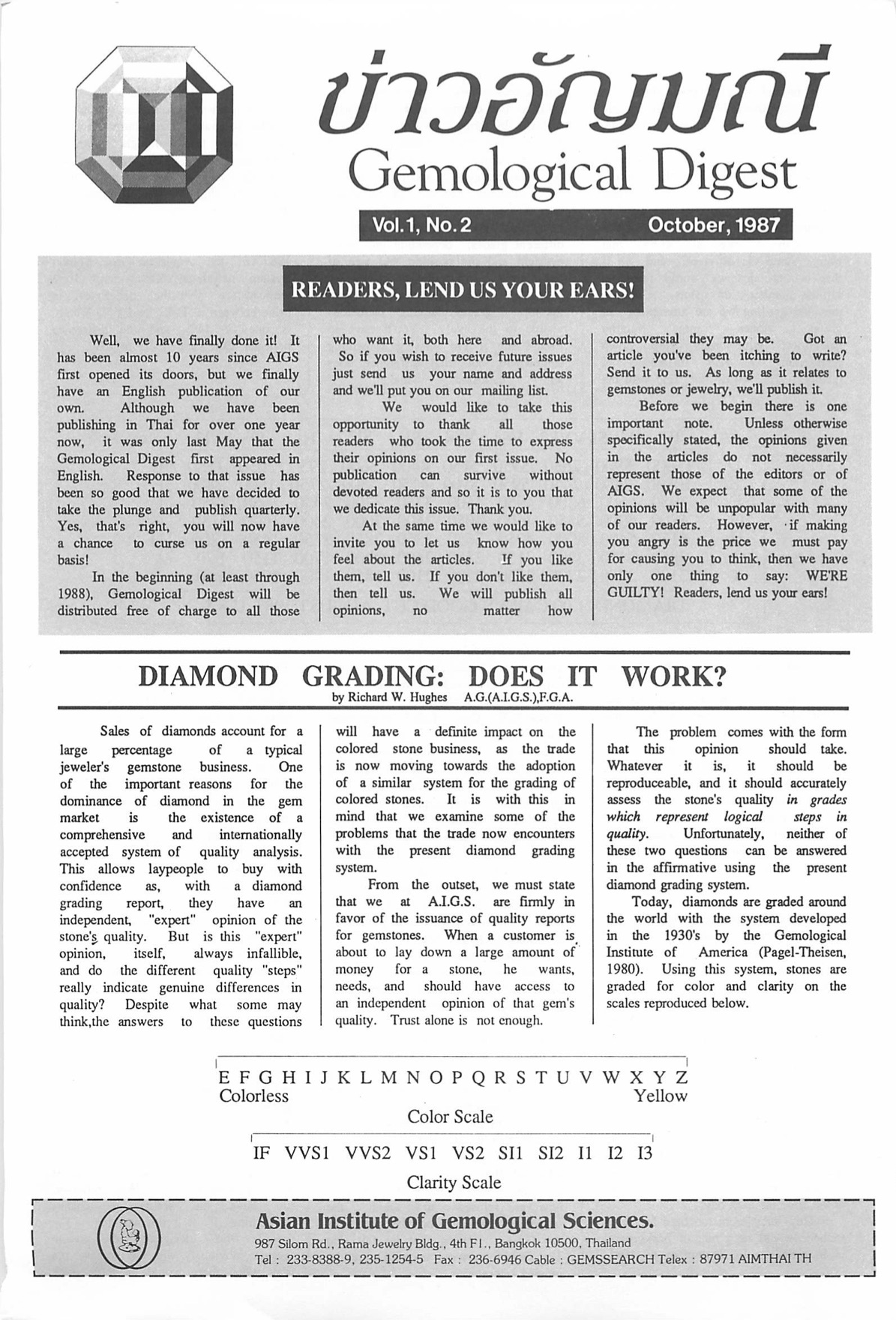
Illenberger, S. (1987) Recent find of sapphirine from Bo Rai, Thailand. Gemological Digest, Vol. 1, No. 2, pp. 5–6.
Record No. 1989  |  Sinkankas/Born No.: NIS/NIB  |  RWHL
Steve Illenberger describes the identification of sapphirine among rough rubies from Bo Rai, Thailand, following the recovery of several apparently black mineral fragments in November 1986. Although such material would normally have been discarded as worthless, closer examination showed that the specimens were not opaque but intensely dark green. One stone was cut and polished and submitted to the Asian Institute of Gemological Sciences for identification. Preliminary testing yielded refractive indices of 1.710–1.715 and a birefringence of 0.005. Its specific gravity was estimated at approximately 3.50 using methylene iodide. The specimen was inert under both long-wave and short-wave ultraviolet radiation and showed no reaction through the Chelsea filter. Spectroscopic examination was inconclusive. The most conspicuous diagnostic observation was strong pleochroism, with bluish green and yellowish brown colors so distinct that the change could be seen simply by rotating the stone in ordinary light. Attempts to obtain an interference figure were unsuccessful, although interference colors appeared between crossed polarizers. Microscopic examination was restricted by the material’s deep color; the cut specimen appeared relatively clean internally, apart from one long needle of undetermined identity. Another piece of rough displayed several six-sided surface etch features. An initial hardness estimate of 8–8.5 was also recorded. Because the available tests did not establish the identification conclusively, the material was submitted for X-ray diffraction analysis at the Gemological Institute of America’s laboratory in Santa Monica, which identified it as sapphirine. Illenberger summarizes the mineral as a monoclinic, biaxial silicate containing magnesium, iron, and aluminum, and compares his observations with published reference properties. These include refractive-index ranges of 1.701–1.729 for α, 1.703–1.732 for β, and 1.705–1.734 for γ; birefringence of 0.004–0.007; specific gravity of 3.40–3.58; and hardness of 7.5. Thus, the measured optical properties and estimated density fall within the cited ranges, while the preliminary hardness estimate exceeds the reference value. The article also notes a contemporaneous report by J.I. Koivula and C.W. Fryer of dark blue sapphirine occurring as an inclusion in ruby from Bo Rai. The account documents sapphirine’s presence in material associated with the locality’s ruby production and illustrates the importance of investigating unfamiliar minerals recovered during rough sorting.

Idaho Geuda

Journal Article
Themelis, T. (1987) Idaho Geuda. Lapidary Journal, February, p. 57.
Record No. 1699  |  Sinkankas/Born No.: NIS/NIB  |  RWHL

Discoids in sapphire

Journal Article
Themelis, T. (1987) Discoids in sapphire. Lapidary Journal, Vol. 41, No. 8, November, p. 19.
Record No. 1698  |  Sinkankas/Born No.: NIS/NIB  |  RWHL

Crystallines in Burmese ruby

Journal Article
Themelis, T. (1987) Crystallines in Burmese ruby. Lapidary Journal, Vol. 41, No. 9, December, p. 19.
Record No. 1697  |  Sinkankas/Born No.: NIS/NIB  |  RWHL

Structural aspects of some fingerprint inclusions in corundum
Journal Article
Tay, T.S. (1987) Structural aspects of some fingerprint inclusions in corundum. Australian Gemmologist, Vol. 16, No. 5, February, pp. 188–190.
Record No. 1686  |  Sinkankas/Born No.: NIS/NIB  |  RWHL

Dreiphaseneinschlüsse in einem gelben sapphir aus Sri Lanka
Three-phase inclusions in a yellow sapphire from Sri Lanka
Journal Article
Schmetzer, K. (1987) Dreiphaseneinschlüsse in einem gelben sapphir aus Sri Lanka. [Three-phase inclusions in a yellow sapphire from Sri Lanka] Zeitschrift der Deutschen Gemmologischen Gesellschaft, Vol. 36, pp. 79–81.
Record No. 1552  |  Sinkankas/Born No.: NIS/NIB  |  Language: In German  |  RWHL
Schmetzer describes unusual three-phase inclusions in an untreated yellow sapphire from Sri Lanka. The inclusions occur as tabular negative crystals oriented with their broad surfaces parallel to the basal plane of the host corundum. Each contains a transparent, doubly refractive solid crystal together with liquid and gas phases. At the time of this study the phases could not be identified conclusively; Schmetzer suggested that the solid might be mica, while the fluid and gaseous components were probably CO₂. Subsequent work by Schmetzer and Medenbach (1988) resolved the question. Examination of more than 300 Sri Lankan sapphires showed that comparable three-phase inclusions contain liquid and gaseous CO₂ plus needle-like to tabular crystals of diaspore, the latter identified by X-ray diffraction.

Eine neue generation synthetischer rubine von P.O. Knischka unter verwendung natürlicher nährsubstanz [A new generation of synthetic rubies from P.O. Knischka grown without the use of seeding crystals]
New generation of synthetic rubies from P.O. Knischka grown without the use of seeding crystals
Journal Article
Galia, W. (1987) Eine neue generation synthetischer rubine von P.O. Knischka unter verwendung natürlicher nährsubstanz [A new generation of synthetic rubies from P.O. Knischka grown without the use of seeding crystals]. [New generation of synthetic rubies from P.O. Knischka grown without the use of seeding crystals] Zeitschrift der Deutschen Gemmologischen Gesellschaft, Vol. 36, No. 1/2, pp. 19–31.
Record No. 804  |  Sinkankas/Born No.: NIS/NIB  |  Language: In German  |  RWHL
Describes a new generation of Knischka synthetic rubies grown by spontaneous nucleation from a flux using natural ruby as the starting material, without seed crystals. Growth periods of approximately eighteen months produced large crystals containing very few platinum inclusions. Microscopic examination revealed occasional milky or cloudy areas but no curved growth markings. Detected traces of platinum, sodium, tungsten and tantalum provide evidence of the platinum crucible and flux constituents used in production.

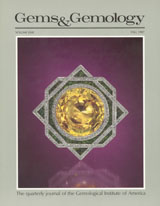
Gem Trade Lab Notes: Sapphire: A synthetic blue sapphire; synthetic yellow sapphire; unusual inclusions in heat-treated blue sapphire
Journal Article
Fryer, C.W. (1987) Gem Trade Lab Notes: Sapphire: A synthetic blue sapphire; synthetic yellow sapphire; unusual inclusions in heat-treated blue sapphire. Gems & Gemology, Vol. 23, No. 2, Summer, pp. 107–108.
Record No. 799  |  ISBN/ISSN: 0016626X  |  Sinkankas/Born No.: NIS/NIB  |  RWHL
The blue oval cut shown in figure 11, which was submitted to the New York lab for identification, is interesting for a number of reasons. The stone has an extremely deep pavilion and a shallow crown, with a total depth-to-width ratio of approximately 115%—so that it is actually deeper than it is wide. In addition, to the unaided eye it appears to be free of inclusions and has a pleasant light blue color. These facts suggested that the stone might be an old, “native cut,” unheated Ceylon sapphire. However, careful examination with the microscope revealed a shadow of curved color banding near the culet and suspicious stress cracks on some facets. The strong chalky blue fluorescence to short-wave UV radiation suggests that the stone either was subjected to extreme heat in treatment or is of synthetic origin. The curved color banding together with the Plato test positively identified it as a Verneuil flame-fusion synthetic sapphire. The stone is also an excellent example of how a very small color zone can produce a pleasant face-up color. Notice in the side view (figure 12) that the top of the stone is colorless; the small blue area near the culet, visible at this angle, is virtually the entire extent of color. Blue synthetic sapphire boules often have color only in a thin layer near the surface. Figure 12 also shows the extreme depth-to-width ratio of this stone.

Gem Trade Lab Notes: Heat-treated yellow sapphire
Journal Article
Fryer, C.W. (1987) Gem Trade Lab Notes: Heat-treated yellow sapphire. Gems & Gemology, Vol. 23, No. 3, Fall, p. 167.
Record No. 797  |  ISBN/ISSN: 0016626X  |  Sinkankas/Born No.: NIS/NIB  |  RWHL
A beautiful orangy yellow oval mixed-cut stone weighing 7.60 ct was submitted to the Santa Monica laboratory for identification. The refractive index, birefringence, and optic figure proved that the stone is sapphire. Microscopic examina-tion revealed natural inclusions as well as the strain discs, very fine dot-like silk," and round cotton-like inclusions that are indicative of heat treatment. Exposure to short-waveultravio-let radiation revealed three zones of chalky blue fluorescence close to the girdle, another sign of heat treat-ment. When the stone was immersed in methylene iodide, some interest-ing structural characteristics be-came visible. In addition to the straight angular yellow color zoning alternating with near-colorless areas, which is characteristic of natural origin, three straight blue zones close to the girdle (coinciding with the areas of chalky blue fluores cence] were seen. Figure 10 showo these blue areas, which could be the result of the heat treatment."

Metallic inclusions in Chatham synthetic corundums
Journal Article
Burch, C.R. (1987) Metallic inclusions in Chatham synthetic corundums. Journal of Gemmology, Vol. 20, No. 5, January, pp. 267–269.
Record No. 543  |  ISBN/ISSN: 221252  |  Sinkankas/Born No.: NIS/NIB  |  RWHL
C.R. Burch describes the morphology and diagnostic significance of metallic inclusions in coloured flux-grown Chatham synthetic corundums, emphasising their greater diversity of form than the familiar triangular and hexagonal plates alone would suggest. Detailed microscopic examination covered red, blue and orange-pink material of padparadscha colour, including rough and crystal clusters totalling 1,046 carats, together with twelve faceted stones: five orange-pink sapphires, four blue sapphires and three rubies. Solid flux inclusions occurred in every specimen examined, while many samples also contained well-developed metallic inclusions. These are considered almost certainly platinum derived from the growth crucible, although the author retains the general designation metallic because rhodium or iridium crucibles may also be employed in flux growth and no definitive compositional identification is reported. When appropriately oriented and illuminated, all the metallic inclusions were strongly reflective, appearing silvery, grey or yellowish in reflected light. Triangular and hexagonal outlines were most common, but perfect symmetry was unusual; truncated triangular forms and pseudohexagonal crystals were also illustrated. Other relatively abundant forms resembled thin plates, needles, spicules, daggers, blades, rods, bars and pyramids, with additional inclusions having irregular outlines. Several displayed pitting or etching on one or more surfaces, tentatively attributed to corrosion by molten flux before incorporation into the growing corundum. Some metallic inclusions were partly covered by white flux layers of variable thickness, demonstrating the close association between these two inclusion types. Twelve photomicrographs document examples in ruby, blue sapphire and orange-pink sapphire, using reflected light or combined transmitted and reflected illumination at magnifications of approximately 10–16×. Illustrated features include etched hexagonal crystals, dense groups of differently shaped metallic inclusions, elongated blades with partial flux coatings, a flux-coated needle and a bar with triangular cross-section beneath a faceted stone’s girdle. The author concludes that careful assessment of metallic inclusion shapes, considered together with flux inclusions, can provide valuable evidence of synthetic origin in doubtful corundum. Although the investigation concerns Chatham products exclusively, comparable morphological diversity is suggested as a possibility in other gemstones grown from flux melts.

A re-investigation of gahnospinels from Sri Lanka
Journal Article
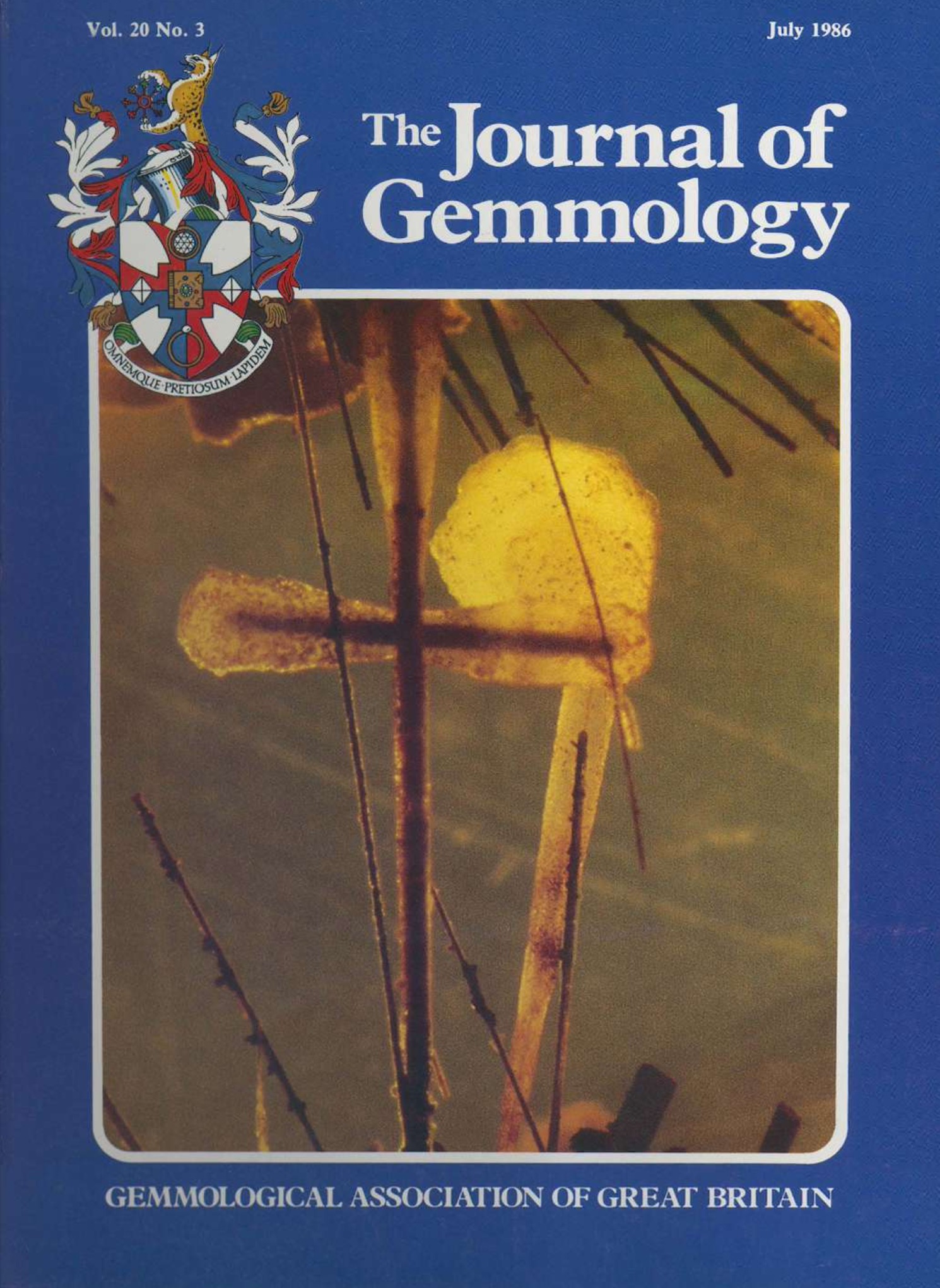
Schmetzer, K. and Bank, H. (1986) A re-investigation of gahnospinels from Sri Lanka. Journal of Gemmology, Vol. 20, No. 3, pp. 157–160.
Record No. 5994  |  ISBN/ISSN: 221252  |  Sinkankas/Born No.: NIS/NIB  |  RWHL

Inclusions in opal

Journal Article
Gübelin, E.J. and Koivula, J.I. (1986) Inclusions in opal. Journal of Gemmology, Vol. 20, No. 3, July, pp. 139–144.
Record No. 5058  |  ISBN/ISSN: 221252  |  Sinkankas/Born No.: NIS/NIB  |  RWHL
This illustrated survey describes the diversity, appearance and geological significance of inclusions in natural opal, drawing principally on transparent and translucent Mexican material. Published as a preview of the authors’ Photoatlas of Inclusions in Gemstones, it combines an introductory account of opal with 26 photomicrographs showing mineral inclusions, internal structures, fluid cavities and treatment features. Many opals lack visible inclusions or are too opaque for their inclusions to be examined, whereas Mexican fire and water opals provide particularly favourable opportunities for observation. Hornblende needles and crystals, goethite, quartz, chalcedony, cristobalite, kaolinite and fragments of rhyolite matrix occur in varied associations. Pre-existing hornblende and goethite crystals projecting from cavity walls were enclosed during opal deposition, and some retain coatings or alteration products. Successive deposition around earlier crystals produces white opal envelopes and concentric structures resembling tree rings. A broken needle-like inclusion is interpreted as evidence of movement within the viscous silica gel. Chalcedony forms rounded or botryoidal masses, sometimes accompanied by curved fractures attributed to internal stress, while cristobalite occurs as white inclusions or aggregates of minute plate-like crystallites. Quartz crystals may project from kaolinite or the rhyolite matrix and may carry limonite coatings. Hornblende can likewise be coated or replaced by limonite, producing distinctive pseudomorphs. A three-phase inclusion contains liquid, a large gas bubble and numerous small red solids within a rhombohedral cavity interpreted as the former site of a mineral such as calcite or dolomite. Later alteration is illustrated by an iron-rich deposit left in a fracture after invading fluids dried out. Examples from other localities include manganese oxide dendrites in Tanzanian yellow opal, tiny dark grey bravoite octahedra reported in Brazilian white opal, and sand-like matrix particles in Australian material. Finely laminated botryoidal structures in Mexican hyalite produce iridescence, while Australian oolitic opal displays natural circular structures that should not be mistaken for treatment effects. The final examples distinguish these natural features from black subsurface soot clouds in smoke-treated Mexican opal and the pepper-like appearance produced by sugar and sulphuric acid treatment of porous Australian opal. The survey demonstrates how microscopy reveals successive stages of inclusion entrapment, opal deposition and alteration, while also helping recognise artificial darkening.

Some unusual sillimanite cat’s eyes

Journal Article
Gübelin, E.J., Weibel, M. and Woensdregt, C.F. (1986) Some unusual sillimanite cat’s eyes. Gems & Gemology, Vol. 22, No. 2, Summer, pp. 96–98.
Record No. 5056  |  ISBN/ISSN: 0016626X  |  Sinkankas/Born No.: NIS/NIB  |  RWHL
Brown-black sillimanite cat's-eyesfrom Sri Lanka present an unusually sharp band, which would make them extraordinary gems wereit not for therather un-attractive body color of the stones. A study of six of these stones found that they contain 0.5 wt.% iron oxide.Theprincipal inclusionmineralisilmenite, which occurs in elongated, submicroscopically thin lamellae. Complex thicker lamellae consist of hercy-nite spinel grown together with a member of the pyroxene group. Thesethickerinclusions werenot foundin all of the specimens investigated.

Exploring the Literature of Gemstone Inclusions

The literature of gemstone inclusions covers identification, origin determination, treatments, synthesis, mineral inclusions, fluid inclusions and other internal features of natural and synthetic gems.

For a curated selection of important sources, read Inclusions in Gemstones — Hyperion Literature Sources.

About Four Treasures

Four Treasures is Lotus Gemology's freely accessible gemological reference database. Use the full database to search by author, title or keyword and explore literature on gemology, mineralogy, jewelry and related fields. Where available, hyperlinks on titles may lead directly to the full publication.

Search the Complete Four Treasures Database