Gemstone Inclusions Bibliography

Gemstone Inclusions Bibliography

Explore books, articles and historical sources on inclusions in gemstones in Four Treasures, the Lotus Gemology reference database. This bibliography brings together matching records from the collection, with publication details, abstracts and cover images where available.

Gemstone Inclusion References

The list below matches the terms inclusion or inclusions in the database's searchable fields. Some references discuss inclusions as part of a broader subject.
1,021–1,040 of 1,344 matching references

Untersuchung eines sapphir-katzenauges aus Burma
Examination of a sapphire cat's eye from Burma
Journal Article
Schmetzer, K. and Kiefert, L. (1986) Untersuchung eines sapphir-katzenauges aus Burma. [Examination of a sapphire cat's eye from Burma] Zeitschrift der Deutschen Gemmologischen Gesellschaft, Vol. 35, No. 3/4, pp. 105–111.
Record No. 4972  |  Sinkankas/Born No.: NIS/NIB  |  Language: In German  |  RWHL
Schmetzer and Kiefert examine an unusual chatoyant sapphire from Burma in order to determine the cause of its cat’s-eye effect. Microscopic examination shows numerous fine, elongated inclusions arranged in a strongly preferred crystallographic orientation. The authors study their orientation in relation to the corundum crystal structure and show that reflection and scattering from these oriented inclusions produce the sharply defined eye. The stone’s internal growth structures, inclusions, optical properties and absorption characteristics are also described and compared with those of other sapphires. The study illustrates how crystallographically oriented inclusions can produce chatoyancy in corundum and documents a relatively uncommon phenomenal variety of Burmese sapphire.

Inclusions in sapphire and heat treatment
Journal Article
Moon, A.R. and Phillips, M.R. (1986) Inclusions in sapphire and heat treatment. Australian Gemmologist, Vol. 16, pp. 163–166.
Record No. 4920  |  Sinkankas/Born No.: NIS/NIB  |  RWHL

Rosafarbene und violette sapphire aus Nepal
Pink and violet sapphires from Nepal
Journal Article
Kiefert, L. and Schmetzer, K. (1986) Rosafarbene und violette sapphire aus Nepal. [Pink and violet sapphires from Nepal] Zeitschrift der Deutschen Gemmologischen Gesellschaft, Vol. 35, No. 3/4, pp. 113–125.
Record No. 4846  |  Sinkankas/Born No.: NIS/NIB  |  Language: In German  |  RWHL
Kiefert and Schmetzer describe pink and violet sapphires from a newly recognized occurrence in Nepal. Associated minerals include calcite, phlogopite, margarite and rutile. The pink color is attributed principally to chromium, whereas the violet coloration results from a combination of Cr, Fe and Ti. The corundums commonly contain twin lamellae and dense sets of straight, parallel growth planes that separate zones differing in color and concentrations of fine mineral particles. Particularly characteristic are small, doubly refractive mica platelets, identified as margarite, some occurring as the solid component of three-phase inclusions. Numerous healed and unhealed fractures are also present and substantially reduce the gem quality of much of the material.

On the origin of blue sapphire from Elahera, Sri Lanka
Journal Article
Heilmann, G. and Henn, U. (1986) On the origin of blue sapphire from Elahera, Sri Lanka. Australian Gemmologist, Vol. 16, No. 1, pp. 2–4.
Record No. 4802  |  Sinkankas/Born No.: NIS/NIB  |  RWHL

A description of ruby from Nepal

Journal Article
Harding, R.R. and Scarratt, K. (1986) A description of ruby from Nepal. Journal of Gemmology, Vol. 20, No. 1, January, pp. 3–10.
Record No. 4797  |  ISBN/ISSN: 221252  |  Sinkankas/Born No.: NIS/NIB  |  RWHL
Ruby reportedly originating from a new occurrence in Nepal is characterized through examination of two cut stones, a large prismatic crystal in a carbonate-rich matrix, and corundum-bearing mica schist. The precise locality was undisclosed, and a possible connection with previously reported material from Taplejung remained unconfirmed. Initial examination of a 7.90 ct cabochon and a 2.17 ct faceted stone raised identification difficulties because curved, twisted feather-like inclusions resembled features observed in several synthetic rubies. Subsequent study of rough specimens demonstrated comparable fluid-bearing fractures and undulating films in natural corundum. Straight blue sapphire bands occur within the rubies, and a section through the prismatic crystal reveals a strongly coloured ruby core surrounded by paler red zones and sharply defined blue bands with growth lines meeting at 120°. Accurate refractive indices measured on the polished section are 1.760–1.768. Specific gravities of the two cut stones are 3.99 and 3.98, while the inclusion-rich crystal section has a lower value of 3.79, attributed to abundant margarite. Ultraviolet–visible spectroscopy of differently coloured zones yields predominantly ruby-type absorption patterns, with additional absorption associated with the blue regions. An ultraviolet absorption minimum at 361 nm supports natural origin under the comparative method employed. Electron-microprobe analyses detect up to 0.32 wt% Cr₂O₃ and 0.30 wt% TiO₂, although titanium content does not correlate consistently with blue colour intensity; iron remains below the analytical detection limit of approximately 0.2 wt% oxide. Identified inclusions and associated minerals include margarite, muscovite, zoisite, epidote, rutile and apatite, with some apparently black apatite owing its colour to graphite. The prismatic crystal’s matrix consists chiefly of calcite, dolomite and margarite, whereas the schist is dominated by phlogopite with apatite, graphite and corundum. Ruby fluoresces red to pink, more strongly under long-wave ultraviolet radiation, while margarite displays conspicuous greenish-white fluorescence and sapphire zones fluoresce less strongly. Margarite mantling and intersecting corundum is tentatively interpreted as partial replacement following changes in metamorphic conditions. The mineral assemblage resembles carbonate-associated ruby occurrences at Mogok and in Pakistan’s Hunza Valley. The study emphasizes both these geological affinities and the identification risks posed by natural inclusions that resemble those of synthetic ruby.

The Elahera gem field in central Sri Lanka
Journal Article
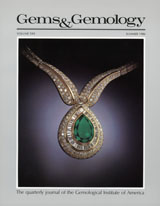
Gunawardene, M. and Rupasinghe, M.S. (1986) The Elahera gem field in central Sri Lanka. Gems & Gemology, Vol. 22, No. 2, Summer, pp. 80–95.
Record No. 4792  |  ISBN/ISSN: 0016626X  |  Sinkankas/Born No.: NIS/NIB  |  RWHL
Gunawardene and Rupasinghe provide a detailed account of the Elahera gem field in central Sri Lanka, historically an important gem-producing area and, by the mid-1980s, the country’s second-largest gem field after Ratnapura. They review its history, location, geology and mining methods. Gem-bearing residuum and alluvial gravels associated with highly metamorphosed Precambrian rocks yield a notably diverse assemblage, including sapphire in many colours, spinel, rhodolite and hessonite garnet, chrysoberyl (including alexandrite and cat’s-eye), zircon, tourmaline, kornerupine, sinhalite, epidote, sillimanite and taaffeite. The authors document the chemistry and gemmological properties of these materials, including refractive indices, specific gravity, pleochroism, absorption, fluorescence and characteristic inclusions; selected inclusions were investigated by microscopy, electron microprobe and X-ray diffraction. At the time of publication, Elahera was estimated to supply approximately 35% of Sri Lanka’s gemstone exports.

A peculiar inclusion in a yellow corundum from Malawi
Journal Article
Grubessi, O. and Marcon, R. (1986) A peculiar inclusion in a yellow corundum from Malawi. Journal of Gemmology, Vol. 20, No. 3, July, pp. 163–165.
Record No. 4788  |  ISBN/ISSN: 221252  |  Sinkankas/Born No.: NIS/NIB  |  RWHL
Grubessi and Marconi describe a complex three-phase inclusion in a yellow corundum crystal from Malawi, interpreting its form as the result of necking-down after initial entrapment. In this process, an originally larger inclusion becomes constricted and subdivided into smaller cavities, some of which may appear isolated within the host crystal. A schematic sequence illustrates the proposed development as temperature decreases, while photomicrographs taken under different illumination conditions document the resulting internal structures. The principal inclusion comprises two large cavities joined by a narrow hollow channel and surrounded by smaller cavities forming a fingerprint pattern. The authors regard the connected cavities as a single inclusion containing solid, liquid, and gaseous phases. The solid component consists of fine, radiating and intersecting birefringent needles, reddish golden in reflected light and tentatively identified as rutile. The liquid is considered possibly carbon dioxide. A mobile vapour bubble changes position within the cavity system and disappears on heating to 31–32 °C, an observation described as homogenization. Photographs under direct illumination and polarized light show the bubble’s movement towards the constricted connection and its disappearance within the channel between the cavities. Small triangular or tetrahedral markings within the larger cavity are interpreted as possible crystallization nuclei. The host crystal is characterized by a vitreous lustre, hardness of 9, density of 4.00 g/cm³, refractive indices of 1.769 and 1.759, and birefringence of 0.010. No pleochroism was observed. A hand spectroscope revealed an absorption band at 690–700 nm, and ultraviolet examination produced weak yellow luminescence under long-wave radiation but no response under short-wave radiation. Other internal features include fractures and twins, and a table presents an energy-dispersive X-ray chemical analysis. The report emphasizes the morphology and behaviour of the inclusion rather than establishing definitive compositions for its constituent phases. Comparisons with necked-down inclusions previously observed in North Carolina amethyst, Montana sapphire, and other minerals place the Malawi example within a broader class of post-entrapment modifications.

An examination of four important gems
Journal Article
Fryer, C.W. and Koivula, J.I. (1986) An examination of four important gems. Gems & Gemology, Vol. 22, No. 2, Summer, pp. 99–102.
Record No. 4781  |  ISBN/ISSN: 0016626X  |  Sinkankas/Born No.: NIS/NIB  |  RWHL
The authors report on their gemological examinations of four important gemstones: the Star of Bombay sapphire, the Portuguese diamond, and two large diamonds known as the Marie Antoinette earrings, all of which are part of the collection at the Smithsonian Institution. Brief historical information on some of the pieces is also included.

Differentiation between natural gems and synthetic minerals by laser Raman microspectrometry
Journal Article
Déle-Dubois, M.-L., Dhamelincourt, P., Poirot, J.-P. and Schubnel, H.-J. (1986) Differentiation between natural gems and synthetic minerals by laser Raman microspectrometry. Journal of Molecular Structure, Vol. 143, pp. 135–138.
Record No. 4752  |  Sinkankas/Born No.: NIS/NIB  |  RWHL
By allowing positive identification of fluid and solid inclusions inside minerals, laser Raman microspectrometry has proved to be a perfect technique for discriminating between natural gems or synthetic minerals made for jewellery (sapphire, ruby, emerald)

Die diagnostischen Eigenschaften der neusten Synthesen
The diagnostic properties of the latest syntheses
Journal Article
Gübelin, E.J. (1986) Die diagnostischen Eigenschaften der neusten Synthesen. [The diagnostic properties of the latest syntheses] Deutsche Goldschmiede-Zeitung, November, pp. 69–76.
Record No. 2180  |  Sinkankas/Born No.: NIS/NIB  |  Language: in German  |  RWHL
Gübelin reviews the diagnostic features of the latest synthetic gemstones then appearing on the market, concentrating on Lennix, Biron, Soviet and Seiko synthetic emeralds and Seiko, Lechleitner and Knischka synthetic corundums. Particular emphasis is placed on microscopic identification, especially characteristic inclusions and growth features associated with the different synthesis methods. Gübelin shows that conventional physical and optical properties may overlap substantially with those of natural stones, making internal features especially important for reliable separation. The study compares the characteristic inclusion patterns of the various products and provides practical criteria for distinguishing these increasingly sophisticated synthetics from their natural counterparts. A later English version contains 46 color figures.

Les opales Mexicaines

Mexican opals
Journal Article
Gübelin, E.J. (1986) Les opales Mexicaines. [Mexican opals] Revue de Gemmologie A.F.G., No. 88, September, pp. 3–6, with 11 color figures.
Record No. 2178  |  Sinkankas/Born No.: NIS/NIB  |  Language: in French  |  RWHL
Gübelin provides a historical and technical survey of Mexican opal, discussing the principal varieties and their major localities. He notes the use of opal in pre-Columbian Mexico and describes the important deposits in the volcanic regions of Querétaro and Jalisco, where opal occurs in cavities and fractures in rhyolitic rocks. Particular attention is given to Mexican fire opal, with its characteristic yellow, orange and red body colors, as well as transparent precious opal displaying play-of-color. The article discusses the appearance, occurrence and characteristic inclusions of Mexican material; later studies cite Gübelin for two- and three-phase inclusions and mineral inclusions including hornblende, goethite, hematite, fluorite, quartz, cristobalite and chalcedony in Querétaro opal.

Opal from Mexico

Journal Article
Gübelin, E.J. (1986) Opal from Mexico. Australian Gemmologist, Vol. 16, No. 2, May, pp. 45–51.
Record No. 2176  |  Sinkankas/Born No.: NIS/NIB  |  RWHL
Mexican opal is surveyed through its history, distribution, geological setting, mining, cutting and gemmological characteristics, with particular emphasis on the important deposits of Querétaro. The article traces its use in jewellery, mosaics and ritual objects to pre-Hispanic cultures and describes the later rediscovery and commercial development of deposits known to the Aztecs. Occurrences are associated with Mexico’s volcanic highlands, especially rhyolitic rocks containing cavities in which opal accumulated as a secondary filling. Silica-bearing thermal waters are interpreted as responsible for successive episodes of deposition, sometimes enclosing quartz crystals, goethite needles and hornblende already present on cavity walls. Querétaro workings, including La Carbonera, Santa María Iris and Hummingbird, illustrate mining by open excavation and, less commonly, deep shafts. Blasting and hammering break the host rock, after which promising material is selected and carefully freed in workshops; cuttable opal represents only a small proportion of the excavated rock. Declining availability of exceptional specimens and suspension of some workings are balanced against continued prospecting, mine extensions and new discoveries. Mexican material ranges from milky and nearly colourless water opal to transparent yellow, orange and red fire opal, with or without play of colour. Iron content is related to the yellow-to-red body colours. Named varieties include blue-opalescent, hydrophane, contra-luz and exceptionally rare black opal. Transparent specimens with vivid play of colour are especially prized, while stones lacking this effect may be faceted; high-domed cabochons are favoured for displaying clarity and internal colour play. Reported properties include refractive indices of approximately 1.36–1.43, density near 2.00 g/cm³ and hardness generally slightly below six. A substantial part of the account concerns inclusions, whose visibility is enhanced by the transparency of many Mexican opals. Described materials include chalcedony, cristobalite aggregates, goethite, hornblende, kaolinite, limonite, quartz and fragments of the host rock. Goethite is particularly prominent, occurring as needles or stalks that may be coated by earlier opal or altered partly or completely to limonite. Coated crystals and optically distinguishable generations of opal provide evidence for sequential precipitation rather than a single filling event. The article thus combines an overview of production and varieties with an inclusion-based interpretation of how Mexican opal formed in volcanic cavities.

Secondary matters

Journal Article
Themelis, T. (1986) Secondary matters. Lapidary Journal, Vol. 40, No. 8, November, p. 19.
Record No. 1696  |  Sinkankas/Born No.: NIS/NIB  |  RWHL

Behandelte korunde mit glasartigen füllungen
Treated corundum with glass-like fillings
Journal Article
Hänni, H.A. (1986) Behandelte korunde mit glasartigen füllungen. [Treated corundum with glass-like fillings] Zeitschrift der Deutschen Gemmologischen Gesellschaft, Vol. 35, No. 3/4, pp. 87–96.
Record No. 949  |  Sinkankas/Born No.: NIS/NIB  |  Language: In German  |  RWHL
Hänni investigates corundum that has undergone high-temperature treatment in the presence of chemical additives, producing glassy coatings and fillings in surface-reaching fissures and cavities. The practice was becoming increasingly common, particularly in Thailand. Chemical analyses show that the glasses vary in their proportions of Si, Al, Mg, Ca, Na and K. Filling fractures with transparent glass can significantly improve the apparent transparency of ruby and sapphire; however, slow cooling may cause partial recrystallization of the glass, producing opaque or crystalline fillings. Hänni discusses the microscopic appearance and identification of these treatment-related features and emphasizes that they are products of the heating process rather than natural inclusions. The article contains eight figures, five in color.

Inclusions in Australian sapphire before and after heat treatment
Journal Article
Coldham, T.S. (1986) Inclusions in Australian sapphire before and after heat treatment. Australian Gemmologist, Vol. 16, No. 3, August, pp. 122–125.
Record No. 597  |  Sinkankas/Born No.: NIS/NIB  |  RWHL
Inclusions in sapphires from the New England gem fields of New South Wales are examined before and after commercial heat treatment to identify their mineral constituents and assess their usefulness in detecting treatment. Selected inclusions were photographed through polished surfaces, the stones were heated, and their surfaces were repolished before the same inclusions were photographed under comparable conditions. The stones were subsequently polished down to expose inclusions for major-element identification by scanning electron microscopy with energy-dispersive X-ray analysis. Heating was conducted at approximately 1700 °C in a gas–oxygen furnace, with the samples enclosed in porcelain and graphite crucibles alongside commercially treated rough. The principal observable change concerned rutile silk, which occurs as fine needles arranged in three sets intersecting at 120°, commonly concentrated in growth bands or distributed throughout the sapphire. Dense silk can give faceted stones a dull, greyish blue appearance. In a photographed example, a silky region that appeared pale honey-coloured in transmitted light became darker blue after heating, while its honey colour disappeared. The author attributes this change to the dissolution of rutile and suggests that the titanium released contributes to the blue colour, proposing a relationship to the development of blue colour in heated Sri Lankan geuda. Commercial heating generally removes visible silk, although some may survive when the original concentration is high or treatment conditions are insufficient. Fine silk therefore makes treatment less likely, but its absence does not establish that a stone has been heated, since naturally silk-free sapphires also occur. Other inclusions showed no discernible changes under the conditions studied. These included ruby-red to dark brown uranium pyrochlore crystals, sometimes accompanied by tension halos, healed fractures or comet-like trails; colourless feldspar inclusions, considered most likely plagioclase; opaque magnetite octahedra; and apparent negative crystals whose composition did not differ from that of the surrounding corundum. Strain around inclusions, twinning and fingerprint-like healed fractures likewise displayed no major differences. The study consequently identifies silk dissolution as the clearest observed internal response to heating while demonstrating the limited diagnostic value of the other features examined. Similarities between Australian inclusions and those reported from Thailand and Cambodia are related to their shared association with alkali basalts. The findings are presented as preliminary, with further work needed to develop reliable distinctions between heated and unheated Australian sapphires.

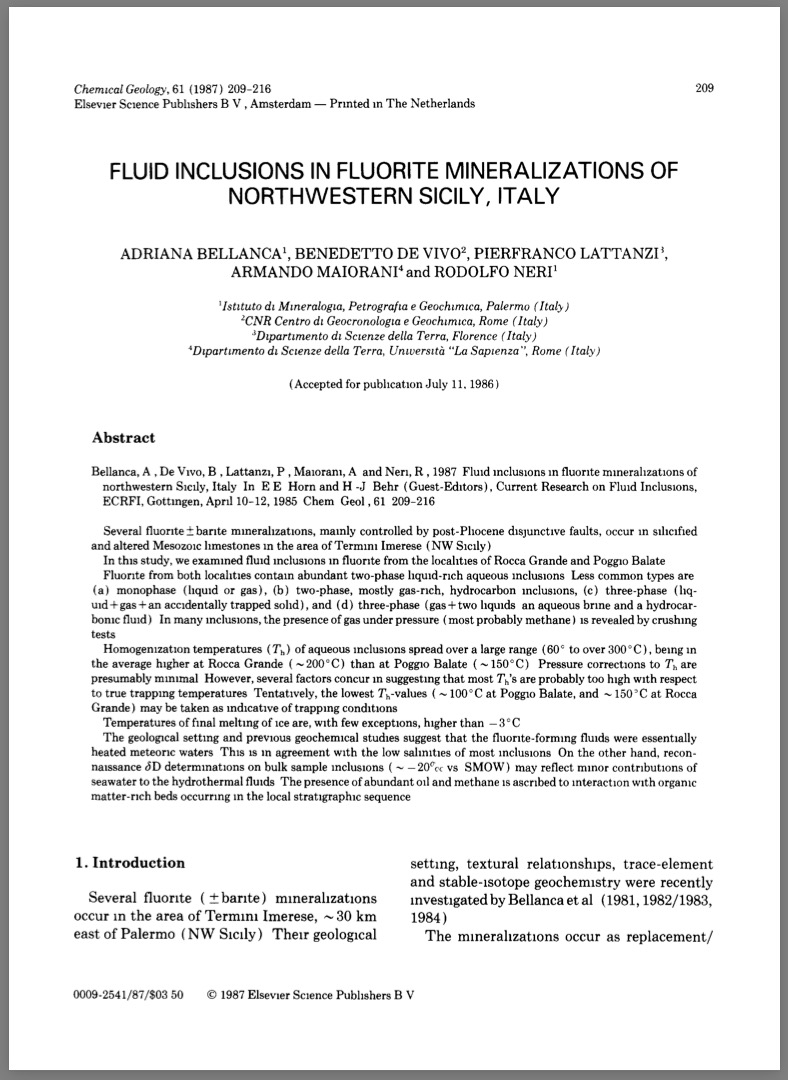
Rare-earth and minor element distribution and petrographic features of fluorites and associated Mesozoic limestones of northwestern Sicily
Journal Article
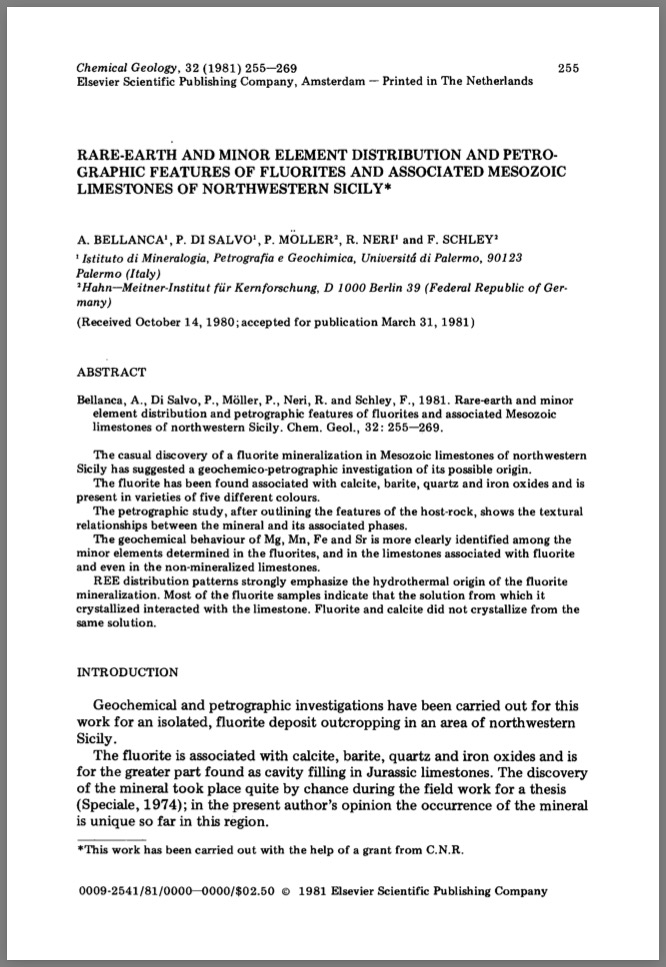
Bellanca, A., De Vito, B., Möller, P., Neri, R. and Schley, F. (1985) Rare-earth and minor element distribution and petrographic features of fluorites and associated Mesozoic limestones of northwestern Sicily. Chemical Geology, Vol. 32, Nos. 1–4, pp. 255–269.
Record No. 27544  |  DOI: https://doi.org/10.1016/0009-2541(81)90148-0  |  Sinkankas/Born No.: NIS/NIB  |  RWHL
The casual discovery of a fluorite mineralization in Mesozoic limestones of northwestern Sicily has suggested a geochemico-petrographic investigation of its possible origin. The fluorite has been found associated with calcite, barite, quartz and iron oxides and is present in varieties of five different colours. The petrographic study, after outlining the features of the host-rock, shows the textural relationships between the mineral and its associated phases. The geochemical behaviour of Mg, Mn, Fe and Sr is more clearly identified among the minor elements determined in the fluorites, and in the limestones associated with fluorite and even in the non-mineralized limestones. REE distribution patterns strongly emphasize the hydrothermal origin of the fluorite mineralization. Most of the fluorite samples indicate that the solution from which it crystallized interacted with the limestone. Fluorite and calcite did not crystallize from the same solution.

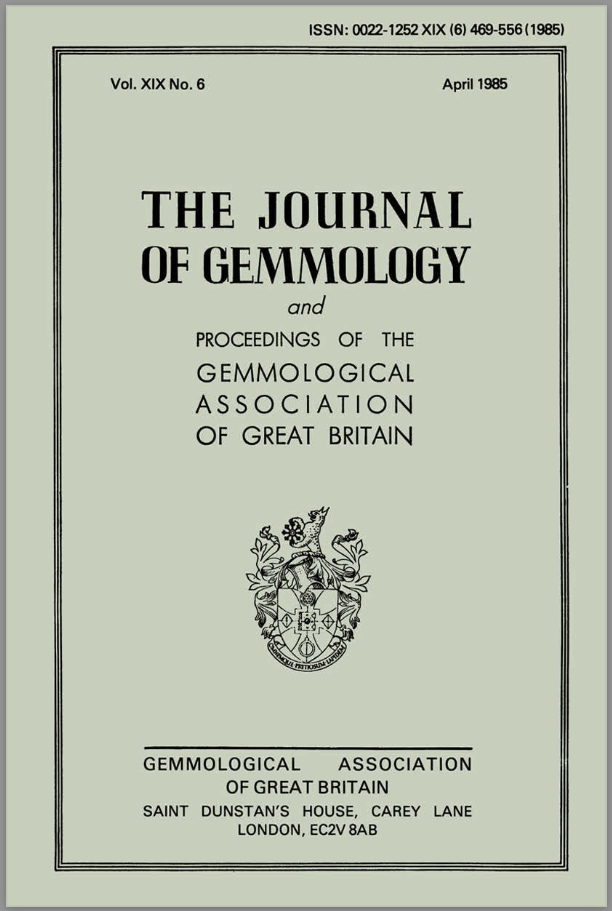
Fluid inclusions in fluorite mineralizations of N-W Sicily
Journal Article
Bellanca, A., De Vito, B., Lattanzi, P., Maiorani, A. and Neri, R. (1985) Fluid inclusions in fluorite mineralizations of N-W Sicily. Chemical Geology, Vol. 32, Nos. 1–4, pp. 209–216.
Record No. 27543  |  DOI: https://doi.org/10.1016/0009-2541(87)90040-4  |  Sinkankas/Born No.: NIS/NIB  |  RWHL
Several fluorite ± barite mineralizations, mainly controlled by post-Pliocene disjunctive faults, occur in silicified and altered Mesozoic limestones in the area of Termini Imerese (NW Sicily). In this study, we examined fluid inclusions in fluorite from the localities of Rocca Grande and Poggio Balate. Fluorite from both localities contains abundant two-phase liquid-rich aqueous inclusions. Less common types are: (a) monophase (liquid or gas); (b) two-phase, mostly gas-rich, hydrocarbon inclusions; (c) three-phase (liquid + gas + an accidentally trapped solid); and (d) three-phase (gas + two liquids: an aqueous brine and a hydrocarbonic fluid). In many inclusions, the presence of gas under pressure (most probably methane) is revealed by crushing tests. Homogenization temperatures (Th) of aqueous inclusions spread over a large range (60° to over 300 °C), being on average higher at Rocca Grande (∼200 °C) than at Poggio Balate (∼150 °C). Pressure corrections to Th are presumably minimal. However, several factors concur in suggesting that most Th’s are probably too high with respect to true trapping temperatures. Tentatively, the lowest Th-values (∼100 °C at Poggio Balate, and ∼150 °C at Rocca Grande) may be taken as indicative of trapping conditions. Temperatures of final melting of ice are, with few exceptions, higher than −3 °C. The geological setting and previous geochemical studies suggest that the fluorite-forming fluids were essentially heated meteoric waters. This is in agreement with the low salinities of most inclusions. On the other hand, reconnaissance δD determinations on bulk sample inclusions (‰ vs. SMOW) may reflect minor contributions of seawater to the hydrothermal fluids. The presence of abundant oil and methane is ascribed to interaction with organic matter-rich beds occurring in the local stratigraphic sequence.

Some aspects of identification of Kashan synthetic rubies
Journal Article
Henn, U. and Schrader, H.-W. (1985) Some aspects of identification of Kashan synthetic rubies. Journal of Gemmology, Vol. 19, No. 6, pp. 469–478.
Record No. 17045  |  ISBN/ISSN: 221252  |  Sinkankas/Born No.: NIS/NIB  |  RWHL
Synthetic rubies by Kashan are characterized by inclusions of melt residues. Cryolite was used as flux. The inclusions can be divided into four types. Even in samples looking apparently free of inclusions, these inclusions can be found by microprobe analysis (15 samples). The increased amounts of sodium found with the help of neutron activation analysis (NAA) in two analysed samples are caused by these inclusions of cryolite.

The eyepiece pointer: A useful microscope accessory
Journal Article
Fryer, C.W. and Koivula, J.I. (1985) The eyepiece pointer: A useful microscope accessory. Gems & Gemology, Vol. 21, No. 2, Summer, pp. 105–107.
Record No. 4780  |  ISBN/ISSN: 0016626X  |  Sinkankas/Born No.: NIS/NIB  |  RWHL
The eyepiece pointer is a highly useful microscope accessory for the gemologist, as it remains in focus and consistently indicates the center of the microscope’s field of view regardless of magnification or the focal plane within the gemstone. It greatly simplifies the task of identifying and showing microscopic features in both mounted and unmounted gems, and it can be easily adapted for use with nearly any microscope.

Geology of World Gem Deposits

Edited Book
VanLandingham, S.L., editor (1985) Geology of World Gem Deposits.. New York, Van Nostrand Reinhold, 406 pp..
Record No. 2605  |  Sinkankas/Born No.: NIS/NIB  |  RWHL
An edited compilation examining the geological origin, occurrence, exploration, and evaluation of gemstone deposits worldwide. The first two sections reproduce 21 contributions covering topics such as diamond formation in kimberlite, jadeite genesis through low-grade metamorphism, agate and thunder egg development, Brazilian topaz deposits, Sri Lankan sedimentary gem deposits, and the structure responsible for precious opal’s colour. Exploration studies consider magnetic characteristics associated with Australian opal deposits, sodium as a geochemical indicator of Colombian emerald mineralization, glacial tracing of Canadian kimberlite, and the economic evaluation of alluvial diamond deposits. Regional accounts describe nephrite, amethyst, agate, and other gem materials in North America. These papers are followed by VanLandingham’s extensive review of the literature and a substantial bibliography, supported by author, mineral and rock name, and subject indexes. The review encompasses gemological research, mineral composition and structure, inclusions, physical properties, and deposit geology. Particular attention is given to the conditions that produce gem-quality material and the difficulties of assessing deposits whose valuable crystals may occur irregularly within a larger mineralized body. Combining technical research with more accessible geological accounts, the volume serves as a reference for geologists, gemologists, prospectors, and collectors investigating gemstone formation and distribution.

Exploring the Literature of Gemstone Inclusions

The literature of gemstone inclusions covers identification, origin determination, treatments, synthesis, mineral inclusions, fluid inclusions and other internal features of natural and synthetic gems.

For a curated selection of important sources, read Inclusions in Gemstones — Hyperion Literature Sources.

About Four Treasures

Four Treasures is Lotus Gemology's freely accessible gemological reference database. Use the full database to search by author, title or keyword and explore literature on gemology, mineralogy, jewelry and related fields. Where available, hyperlinks on titles may lead directly to the full publication.

Search the Complete Four Treasures Database