Gemstone Inclusions Bibliography

Gemstone Inclusions Bibliography

Explore books, articles and historical sources on inclusions in gemstones in Four Treasures, the Lotus Gemology reference database. This bibliography brings together matching records from the collection, with publication details, abstracts and cover images where available.

Gemstone Inclusion References

The list below matches the terms inclusion or inclusions in the database's searchable fields. Some references discuss inclusions as part of a broader subject.
981–1,000 of 1,344 matching references

Gem Trade Lab Notes: Synthetics and Modern" gems in period jewelry"
Journal Article
Hargett, D. (1988) Gem Trade Lab Notes: Synthetics and Modern" gems in period jewelry". Gems & Gemology, Vol. 24, No. 4, Winter, pp. 245—246.
Record No. 3019  |  ISBN/ISSN: 0016626X  |  Sinkankas/Born No.: NIS/NIB  |  RWHL
Over the years, synthetics have been set in jewelry for a variety of reasons, People who could not afford natural stones could at least enjoy the beauty of the less costly synthetics. Syn-thetics or other simulants have been used to replace more valuable stones that were either lost or removed to use the cash value when needed. At one time, synthetics were even set into fine jewelry as a proud symbol of scientific progress. The fine platinum and diamond bracelet shown in figure 17, seen in our East Coast laboratory, was probab-ly made during the 1920s. It is set with flame-fusion synthetic rubies as well as with fine natural rubies with Burma characteristics. We do not know why synthetic and natural stones were mixed in this piece, but because of the ever-present possi-bility of mixed stones, it is always necessary to test all of the stones, even in an antique setting. Evidence of tampering with a setting is the most common indica-tion that a synthetic was used as a replacement stone. The stone shown in figure 18 was set in a lady's ring that also was submitted to our East Coast laboratory. Engraved in the shank of the ring is the date Octo-ber 15, 1922. Although it is possible that this date could have been in-scribed recently, it is not likely. As indicated by the reworked prong tip, as well as the flux inclusions shown in figure 18, a modern flux-grown synthetic ruby has been reset in this period ring.

Gem Trade Lab Notes: Synthetic sapphires
Journal Article
Welch, C. (1988) Gem Trade Lab Notes: Synthetic sapphires. Gems & Gemology, Vol. 24, No. 2, Summer, p. 117.
Record No. 3016  |  ISBN/ISSN: 0016626X  |  Sinkankas/Born No.: NIS/NIB  |  RWHL
In the Lab Notes section of the Summer 1987 issue of Gems & Gemology, we reported on unusually strong curved color banding in a synthetic yellow sapphire. More recently, the East Coast laboratory had the opportunity to examine two synthetic yellow sapphires that were unusual in other ways. When no color zoning or inclusions are present in a yellow sapphire, it is standard procedure to use immersion, magnification, and crossed polarizers to look for Plato lines as proof of synthesis. One of the two stones we examined displayed such strong Plato lines that they were actually visible without magnification or immersion (figure 15). In contrast, the second stone showed no discernible Plato lines at all, which is unusual for a flame-fusion synthetic yellow sapphire. This stone was proved to be synthetic when high magnification revealed the presence of several small gas bubbles. An interesting blue synthetic sapphire, also examined in New York, showed two sets of curved color banding that intersected each other at a very shallow angle. This is clearly indicated in figure 16 by the wedge of blue with its point almost dead center in the photo. The wedge marks the boundary between the two sets of banding, which are probably a result of changes in the growth conditions while the boule was being formed.

Gem Trade Lab Notes: Sapphire, with needles
Journal Article
Welch, C. (1988) Gem Trade Lab Notes: Sapphire, with needles. Gems & Gemology, Vol. 24, No. 1, Spring, p. 51.
Record No. 3015  |  ISBN/ISSN: 0016626X  |  Sinkankas/Born No.: NIS/NIB  |  RWHL
One of the characteristics that proves that a sapphire has not been heat treated is the presence of coarse, well-formed, undisturbed needle-like inclusions and/or their shorter wedge-shaped relatives. Such inclusions often light up with spectral colors when illuminated by a strong overhead or fiber-optic light source, as seen in the approximately 40-ct sapphire shown in figure 15, which was submitted to the New York laboratory for identification. These needles produce asterism when the stone is cut en cabochon. An interesting trick is to place a small drop of methylene iodide (the 3.32 specific gravity liquid) on the surface of a faceted stone and observe the star effect in the bead of liquid.

Gem Trade Lab Notes: Sapphire, color zoned
Journal Article
Hargett, D. (1988) Gem Trade Lab Notes: Sapphire, color zoned. Gems & Gemology, Vol. 24, No. 1, Spring, pp. 50—51.
Record No. 3014  |  ISBN/ISSN: 0016626X  |  Sinkankas/Born No.: NIS/NIB  |  RWHL
A 1.06-ct blue sapphire was submitted to the New York laboratory for identification. A spall cavity, the fire-skinned surface, and discoid fractures clearly indicated that the stone had been heat treated. However, the dark blue hexagonal color zoning seen through the table (figure 14) is unusual. It appears that a “phantom crystal” within the sapphire was affected by the heat treatment, leaving the edges fuzzy and partially diffused into the stone. When the stone was viewed with a Beck handheld spectroscope, the 450-nm (iron) line was quite strong. Perhaps this was originally a very dark sapphire that had been heated to lighten the color, with the perimeter of the “phantom crystal” remaining dark in spite of the treatment.

Characterization of Russian hydrothermally-grown synthetic emeralds
Journal Article
Schmetzer, K. (1988) Characterization of Russian hydrothermally-grown synthetic emeralds. Journal of Gemmology, Vol. 21, No. 3, pp. 145–163.
Record No. 2388  |  ISBN/ISSN: 221252  |  Sinkankas/Born No.: NIS/NIB  |  RWHL
Thirteen faceted Russian hydrothermal synthetic emeralds are characterized through chemical analysis, physical measurements, polarized absorption spectroscopy, infrared spectroscopy, and microscopic examination, with comparisons to natural emeralds and published Russian synthesis research. The specimens range from 0.35 to 2.34 ct and include commercial material and a sample obtained from the Novosibirsk research institute. Their unusual composition combines low magnesium and sodium contents with substantial chromium, iron, nickel, and copper. These transition elements raise refractive indices and specific gravity, partly offsetting the effects of low alkali contents and producing values within the natural emerald range. Ordinary refractive indices are 1.580–1.586, extraordinary indices 1.573–1.579, birefringence 0.006–0.007, and specific gravity 2.68–2.70 for specimens without seed remnants. All samples are inert to long-wave and short-wave ultraviolet radiation, consistent with iron quenching chromium fluorescence. Polarized spectra indicate that chromium and nickel dominate color and pleochroism, with subordinate contributions from iron and copper. Pleochroism ranges from greenish blue to blue parallel to the optic axis and yellow-green to greenish yellow perpendicular to it. This appearance resembles certain natural emeralds but arises from different absorption mechanisms; earlier interpretations invoking an aquamarine component are rejected for the examined material. Infrared spectra reveal both type-I and type-II channel water, demonstrating that their coexistence cannot establish natural origin. Type-II water is attributed principally to association with lithium because sodium concentrations are very low. Microscopy reveals colorless beryl seed remnants in six specimens and growth zoning inclined approximately 31° to the optic axis throughout the sample group. Step-like zoning, cobbled seed boundaries, and characteristic blocks of subparallel crystal subindividuals provide particularly valuable diagnostic features. Inclusions include opaque platelets considered more likely hematite than platinum, birefringent crystals associated with fluid-filled growth tubes, and feathers containing liquid, two-phase, and three-phase inclusions. Some stones contain little foreign material, making growth structures especially important. The observed features are related to growth on specially oriented beryl seeds in steel autoclaves without precious-metal liners. Published industrial conditions include temperatures of 550–620 °C and pressures near 1,000 bar; autoclave corrosion and deliberate additions are considered possible sources of incorporated metals. The study concludes that trace-element composition, polarized ultraviolet-visible spectra, and immersion microscopy together provide effective recognition criteria, despite overlap with natural emeralds in routine physical properties and infrared water spectra.

Feldspars as host and guest minerals

Journal Article
Gübelin, E.J. (1988) Feldspars as host and guest minerals. Indian Gemmologist,
Record No. 2188  |  Sinkankas/Born No.: NIS  |  RWHL

The diagnostic properties of the latest synthetic stones
Journal Article
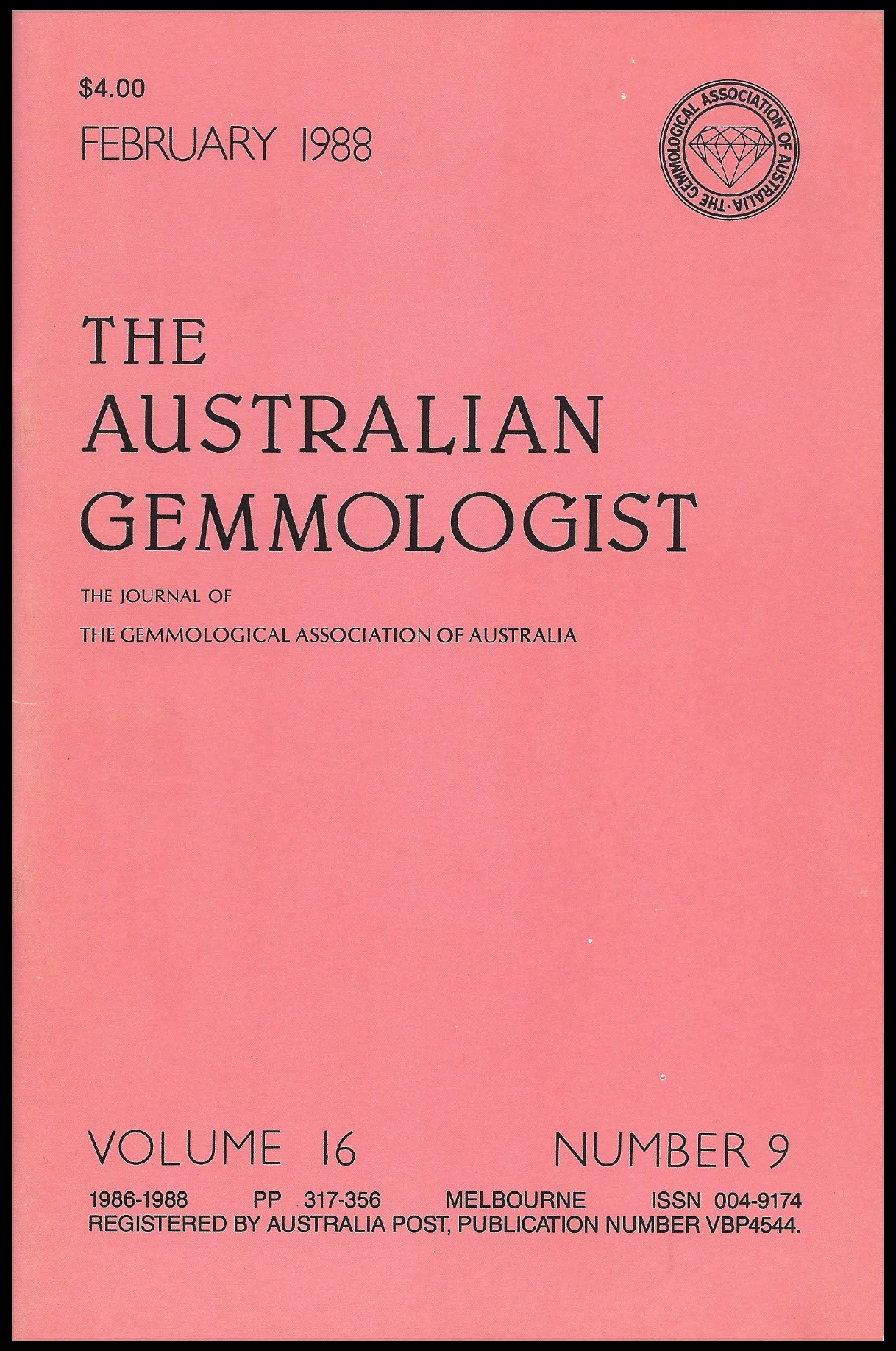
Gübelin, E.J. (1988) The diagnostic properties of the latest synthetic stones. Australian Gemmologist, Vol. 16, No. 9, February, pp. 329–341.
Record No. 2187  |  Sinkankas/Born No.: NIS/NIB  |  RWHL
Reviews diagnostic properties of recently introduced synthetic emeralds and corundums, emphasising microscopic internal features as a practical means of distinguishing them from natural gemstones and from one another. The emerald survey covers Lennix, Biron, Soviet flux-grown and hydrothermal products, and Seiko material. Comparative tables assemble refractive indices, birefringence, density, absorption spectra, ultraviolet reactions, Chelsea-filter responses, inclusions and selected chemical analyses. Lennix emeralds display conspicuous growth channels, dark molybdenum-bearing flux residues, included beryl and phenakite crystals, and wispy or banner-like inclusion patterns. Their variable internal structures are related to changing conditions during flux growth. Biron hydrothermal emeralds contain characteristic granular veils and banners composed of fluid inclusions, sometimes spiralling around growth tubes, together with wedge-shaped inclusions, crystallites and fishbone-like growth inhomogeneities. Gübelin notes that cleaner recent production may lack the abundant inclusions seen in earlier material and cautions that some individual features also occur naturally. Infrared evidence of structurally incorporated water supports identification of hydrothermal growth. Soviet flux-grown emeralds commonly show yellowish-brown flux inclusions, granular fingerprints, phenakite and platinum crystallites, whereas Soviet hydrothermal emeralds may be distinguished by spindle-like growth streaks and intersecting zigzag patterns. Seiko emeralds contain dense layers of fine particles and slender prismatic crystallites whose precise mineral identity remained uncertain. The corundum discussion describes Seiko ruby and sapphire, Lechleitner products and newer Knischka rubies. Seiko ruby may be exceptionally clean, with only subtle swirling growth irregularities and minute flux grains. Hazy patches in Seiko sapphire can resemble the appearance of Kashmir sapphire, requiring careful assessment of their internal character and optical behaviour. Lechleitner corundums consist of natural or synthetic seeds with a synthetic coating; characteristic partly healed fissures repeatedly intersect at right angles, producing square or rectangular patterns, while metallic-looking flux remnants may occur in the coating. The article explains how synthesis procedures generate these structures and illustrates the resulting features with numerous photomicrographs. Its central conclusion is that increasingly sophisticated synthetic products still retain observable differences associated with their formation. Reliable identification therefore depends on combining physical properties and analytical evidence with detailed microscopic interpretation, particularly when familiar features are absent or resemble inclusions in natural stones.

Black slag, moon rock or natural glass?
Journal Article
Kessler, P.F. (1988) Black slag, moon rock or natural glass? Gemological Digest, Vol. 2, Nos. 1 & 2, pp. 15–19.
Record No. 1990  |  Sinkankas/Born No.: NIS/NIB  |  RWHL
This review introduces tektites as silica-rich natural glasses and examines their physical properties, historical uses, geographical distribution, characteristic shapes, and disputed origins. Tektites are described as containing approximately 68–82% silica and exceptionally little water, with an average water content near 0.005%. Reported hardness is 6–7, specific gravity 2.33–2.55, and refractive index 1.475–1.53; the latter two properties decrease as silica content increases. Colours are principally black or dark green, with brown and grey examples less common. The historical discussion traces their use as tools, amulets, and jewellery and reviews changing explanations ranging from artificial glass and volcanic ejecta to lunar or meteorite-related sources. Chemical differences from manufactured glass and obsidian, low water content, sparse bubbles, and distinctive surface features are presented as important evidence in these debates. Four major strewn fields are surveyed: Australasian, Ivory Coast, Central European, and North American. Their distribution is interpreted as recording discrete events rather than unrelated local formation, and possible associations with the Bosumtwi and Ries impact craters are discussed. Morphological categories comprise microtektites, commonly recovered from ocean-bottom cores; blocky, layered Muong Nong material; splash forms resembling spheres, droplets, dumbbells, and discs; and Australian flanged buttons. Surface pits, grooves, flanges, and spalled areas are considered in relation to aerodynamic shaping, atmospheric ablation, and thermal shock. Internal flow structures, compositional variations, and strain birefringence provide further evidence concerning melting and cooling. Particular attention is given to layered Muong Nong tektites and their comparatively high volatile contents, which may preserve information about precursor materials and proximity to deposition sites. The author reviews evidence favouring an impact-related terrestrial origin, including similarities to continental materials, differences from analysed lunar rocks, limited cosmic-ray exposure, and possible meteoritic metal inclusions. A proposed sequence involves impact melting of terrestrial rock or soil, ejection above the atmosphere, volatile loss and solidification, followed by atmospheric re-entry and surface modification. Competing interpretations and unresolved problems are retained within the discussion rather than presented as settled. A concluding aside treats claims of moldavite’s supposed mystical properties with scepticism and notes their connection with jewellery marketing.

Photomicrography of gemstones

Journal Article
Goutiere, A., de (1988) Photomicrography of gemstones. Gemological Digest, Vol. 2, No. 3, pp. 35–36.
Record No. 1970  |  Sinkankas/Born No.: NIS/NIB  |  RWHL
A. de Goutière introduces gemstone inclusion photomicrography through a practical account of equipment, lighting, film handling, and specimen preparation, illustrated with three examples of his own work. Addressing gemologists who may be discouraged by perceived technical difficulty or cost, he explains that a good binocular microscope, a single-lens reflex camera with automatic exposure, and a suitable connecting adapter provide the basic means to begin. Inspired by E. Gübelin’s Internal World of Gemstones, the author adopted a Wetzlar trinocular microscope mounted on an Eichhorst Gemmaster base, allowing an Olympus OM-2 camera to remain attached and ready for use. He identifies the camera’s compact construction, low weight, and off-the-film metering as useful features, with automatic exposure determination freeing attention for composition and focusing. His preferred photographic material is Ektachrome 160 tungsten professional film, prepared in ten-exposure cassettes to shorten the interval between taking photographs and reviewing results and to reduce waste when a partly exposed roll requires immediate processing. Unexposed film is stored under refrigeration. Lighting receives particular emphasis: de Goutière considers fiber-optic pinpoint illumination essential for this work and describes using as many as three light guides together with transmitted illumination. He stresses the need to arrange the lighting carefully, compose the image deliberately, and keep specimens completely clean, since even a small particle of dust can spoil a photograph. The illustrations demonstrate different subjects and combinations of illumination. A thin liquid-film inclusion in colorless Mexican topaz is photographed at 17× using oblique illumination. An insect trapped with a flower in Dominican amber, notable for its bright red eye, is shown at 8× with partially polarized transmitted light combined with oblique illumination. A goethite cluster in amethyst, compared visually with an Apollo spacecraft and bearing a small red crystal on its blunt end, is recorded at 14× using oblique and transmitted illumination. The article recommends the Photoatlas of Inclusions in Gemstones by E.J. Gübelin and J.I. Koivula and lists further reading on microscope photography, inclusion photography, and controllable pinpoint lighting. It presents an accessible starting method grounded in the author’s working practice rather than an exhaustive technical treatment.

Modern application of gemstone inclusions: Detection of colour-enhancement potential of geuda sapphire from Sri Lanka
Journal Article
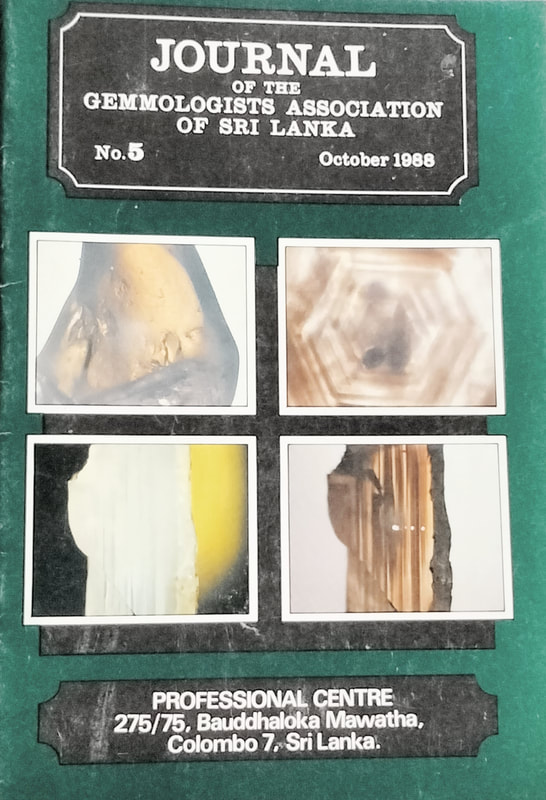
Wijesuriya, G. (1988) Modern application of gemstone inclusions: Detection of colour-enhancement potential of geuda sapphire from Sri Lanka. Journal of the Gemmologists Association of Sri Lanka, No. 5, pp. 28–30.
Record No. 1860  |  Sinkankas/Born No.: NIS/NIB  |  RWHL

Fissures in heated ruby

Journal Article
Themelis, T. (1988) Fissures in heated ruby. Lapidary Journal, Vol. 42, No. 6, September, p. 19.
Record No. 1705  |  Sinkankas/Born No.: NIS/NIB  |  RWHL

Dotted silk

Journal Article
Themelis, T. (1988) Dotted silk. Lapidary Journal, Vol. 41, No. 10, January, p. 19.
Record No. 1704  |  Sinkankas/Born No.: NIS/NIB  |  RWHL

“Diesel” in sapphire

Journal Article
Themelis, T. (1988) “Diesel” in sapphire. Lapidary Journal, Vol. 41, No. 11, February, p. 19.
Record No. 1703  |  Sinkankas/Born No.: NIS/NIB  |  RWHL

Chromophoric impurities in grey sapphire
Journal Article
Themelis, T. (1988) Chromophoric impurities in grey sapphire. Lapidary Journal, Vol. 42, No. 3, June, p. 19.
Record No. 1702  |  Sinkankas/Born No.: NIS/NIB  |  RWHL

Blue spot on ruby

Journal Article
Themelis, T. (1988) Blue spot on ruby. Lapidary Journal, Vol. 42, No. 1, April, p. 19.
Record No. 1701  |  Sinkankas/Born No.: NIS/NIB  |  RWHL

Corundum ‘type’ categories

Journal Article
Sersen, W.J. (1988) Corundum ‘type’ categories. Gemological Digest, Vol. 2, No. 1–2, pp. 3–9.
Record No. 1578  |  Sinkankas/Born No.: NIS/NIB  |  RWHL
Corundum “type” categories are presented as a practical system for describing the overall color appearance of rubies and blue sapphires, teaching colored stone grading and communicating international market preferences. Developed from a classification introduced by Henry Ho in 1981, the system requires consideration of the combined effects of hue, intensity, tone, fluorescence, pleochroism, inclusions, color zoning and cutting proportions. Types describe appearance rather than geographic origin and are not intended as a ranking of relative value. The author argues that traditional geographic descriptions, such as “Burmese” ruby or “Ceylon” sapphire, can identify recognizable appearances shared by stones from several sources; consequently, origin alone should not determine a stone’s category or justify a quality premium. Definitions distinguish hue position and intensity, assessed through flashes of brilliance, from tone, assessed through the overall lightness or darkness of the stone. Windowing, extinction, pleochroism and zoning receive particular attention because they alter the perceived distribution and strength of color. Five ruby categories are described: Type A, predominantly pure red; Type B, pinkish red with lower color intensity; Type C, slightly orangy red, commonly with inclusions that scatter light and reduce extinction; Type D, blackish red with high tone, strong extinction and weak fluorescence; and Type E, fluorescent purplish pink to red, commonly with silk and comparatively little visible extinction. Four blue sapphire categories are distinguished: Type A, intensely colored, slightly violetish “royal blue”; Type B, “milky blue,” with minute particles or silk that diffuse light; Type C, brighter, lower-toned “cornflower blue,” often with visible zoning; and Type D, dark “inky blue,” commonly associated with iron absorption, color banding and conspicuous greenish-blue pleochroism. The categories are then applied to purchasing preferences reported for Japan, France, Germany, England, Italy, Switzerland, the United States, Australia and the Middle East. These descriptions encompass differences in preferred color, clarity, proportions and finish, while recognizing that purchasing patterns also reflect affordability and resale conditions. Japanese and German buyers are described as favoring comparatively lighter appearances, English and Australian buyers as commonly accepting darker material, and French and Italian buyers as placing greater emphasis on color than on clarity or proportions. Despite these market differences, the author reports broad agreement among connoisseurs on exceptional quality: ruby combining intense fluorescent red with a slight yellow component, and sapphire combining intense, slightly violetish blue with good clarity, moderate tone and a bright appearance. A slight milkiness producing a velvety texture is also prized by some sapphire connoisseurs. Type classification is ultimately recommended as an aid to understanding the interacting causes of color appearance and matching stones to particular markets.

Dictionary
Merriam-Webster (1988) Webster’s New Geographical Dictionary. Springfield, MA: Merriam-Webster, 1376 pp.
Record No. 1258  |  Sinkankas/Born No.: NIS/NIB  |  RWHL
Webster’s New Geographical Dictionary provides an alphabetical reference to the world’s places, combining guidance on geographical names with concise descriptions of physical features, political divisions, settlements, economies and history. The volume contains more than 47,000 entries and 218 maps prepared by Hammond, supplemented by approximately 15,000 cross-references connecting alternative spellings, former names and foreign-language variants. Coverage includes independent states, dependencies, major administrative subdivisions, important cities, rivers, mountains, islands, lakes and places of historical significance. Entries generally supply spelling, syllabic division and pronunciation, followed by identification, location and relevant measurements or population figures. Longer treatments add physical geography, principal products and industries, institutions, notable features and historical summaries. Information is adapted to the subject rather than forced into an identical pattern throughout: river entries may describe length and navigability, mountain entries height and mineral resources, and city entries transport connections, manufacturing and historical development. Tables consolidate information on administrative subdivisions and related groups of features, with alphabetical cross-references directing readers to the appropriate main entry. Population figures identify their reference year and distinguish estimates, preliminary census returns and final census results. The editors describe a deliberate emphasis on the United States and Canada, with broader inclusion of smaller communities there than in most other regions. Selection elsewhere reflects varying population thresholds, supplemented by places of regional importance or historical interest. Pronunciations draw on native speakers and specialist advice, and established anglicised forms may accompany local pronunciations. Introductory material explains the arrangement of entries, cross-referencing conventions, abbreviations and pronunciation symbols. Bilingual lists of geographical terms help readers interpret recurring components of place names, including words for physical features, political units, directions and relative position. A discussion of map projections explains their differing distortions and suitability for particular geographical purposes, while a symbol key and map list support use of the cartographic material. By integrating names, descriptive facts, historical context and maps, the dictionary serves as a general reference for identifying places and understanding their geographical relationships.

A doublet made of a natural green sapphire crown and a Verneuil synthetic ruby pavilion
Journal Article
Duroc-Danner, J.M. (1988) A doublet made of a natural green sapphire crown and a Verneuil synthetic ruby pavilion. Journal of Gemmology, Vol. 21, No. 1, January, pp. 12–14.
Record No. 685  |  ISBN/ISSN: 221252  |  Sinkankas/Born No.: NIS/NIB  |  RWHL
With all the concern to recognise the modern synthetics (Knischka, Chatham, Kashan, Ramaura, Inamori) one would tend to give too quickly a natural origin to a stone presenting at first sight unequivocal inclusions, and thus forget to check for a possible doublet. The two rubies received recently by the writer for identification fall into this category.

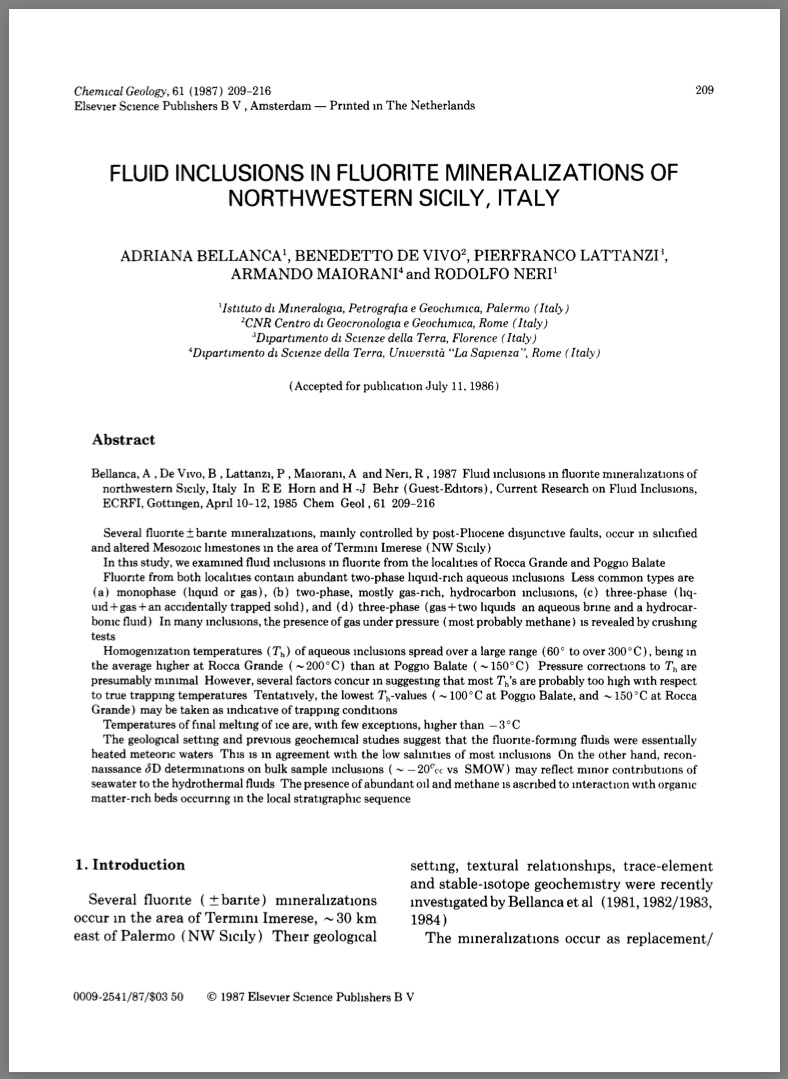
Fluid inclusions in fluorite mineralizations of northwestern Sicily

Journal Article
Bellanca, A., De Vito, B., Lattanzi, P., Maiorani, A. and Neri, R. (1987) Fluid inclusions in fluorite mineralizations of northwestern Sicily. Chemical Geology, Vol. 61, Nos. 1–4, pp. 209–216.
Record No. 27545  |  DOI: https://doi.org/10.1016/0009-2541(87)90040-4  |  Sinkankas/Born No.: NIS/NIB  |  RWHL
Several fluorite ± barite mineralizations, mainly controlled by post-Pliocene disjunctive faults, occur in silicified and altered Mesozoic limestones in the area of Termini Imerese (NW Sicily). In this study, we examined fluid inclusions in fluorite from the localities of Rocca Grande and Poggio Balate. Fluorite from both localities contains abundant two-phase liquid-rich aqueous inclusions. Less common types are: (a) monophase (liquid or gas); (b) two-phase, mostly gas-rich, hydrocarbon inclusions; (c) three-phase (liquid + gas + an accidentally trapped solid); and (d) three-phase (gas + two liquids: an aqueous brine and a hydrocarbonic fluid). In many inclusions, the presence of gas under pressure (most probably methane) is revealed by crushing tests. Homogenization temperatures (Th) of aqueous inclusions spread over a large range (60° to over 300 °C), being on average higher at Rocca Grande (∼200 °C) than at Poggio Balate (∼150 °C). Pressure corrections to Th are presumably minimal. However, several factors concur in suggesting that most Th’s are probably too high with respect to true trapping temperatures. Tentatively, the lowest Th-values (∼100 °C at Poggio Balate, and ∼150 °C at Rocca Grande) may be taken as indicative of trapping conditions. Temperatures of final melting of ice are, with few exceptions, higher than −3 °C. The geological setting and previous geochemical studies suggest that the fluorite-forming fluids were essentially heated meteoric waters. This is in agreement with the low salinities of most inclusions. On the other hand, reconnaissance δD determinations on bulk sample inclusions (‰ vs. SMOW) may reflect minor contributions of seawater to the hydrothermal fluids. The presence of abundant oil and methane is ascribed to interaction with organic matter-rich beds occurring in the local stratigraphic sequence.

Einschlüsse in Mineralen

Inclusions in Minerals
Book
Leeder, O., Thomas, R. and Klemm, W. (1987) Einschlüsse in Mineralen. [Inclusions in Minerals] Leipzig, VEB Deutscher Verlag für Grundstoffindustrie, 180 pp.
Record No. 6060  |  ISBN/ISSN: 3342000880  |  Sinkankas/Born No.: NIS/NIB  |  Language: in German  |  RWHL
Leeder, Thomas and Klemm provide a comprehensive introduction to the study of inclusions in minerals, described as the first German-language book devoted specifically to inclusion research. Following a historical review, they discuss the appearance, classification and genesis of inclusions and establish the physicochemical principles needed for their interpretation. Considerable attention is devoted to fluid inclusions and the H₂O, CO₂, H₂O–NaCl, H₂O–KCl–NaCl, H₂O–CO₂ and CO₂–CH₄ systems. Analytical methods include homogenization measurements, cryometry, pressure determinations and decrepitation, together with determination of solution chemistry, water content, gas composition and isotopic ratios. The authors emphasize the use of inclusions for thermobarometry and reconstruction of mineral-forming conditions, particularly in mineralogy, petrology and economic geology. The book combines theoretical treatment with specimen preparation, instrumentation, measurement procedures and interpretation of results.

Exploring the Literature of Gemstone Inclusions

The literature of gemstone inclusions covers identification, origin determination, treatments, synthesis, mineral inclusions, fluid inclusions and other internal features of natural and synthetic gems.

For a curated selection of important sources, read Inclusions in Gemstones — Hyperion Literature Sources.

About Four Treasures

Four Treasures is Lotus Gemology's freely accessible gemological reference database. Use the full database to search by author, title or keyword and explore literature on gemology, mineralogy, jewelry and related fields. Where available, hyperlinks on titles may lead directly to the full publication.

Search the Complete Four Treasures Database