Gemstone Inclusions Bibliography

Gemstone Inclusions Bibliography

Explore books, articles and historical sources on inclusions in gemstones in Four Treasures, the Lotus Gemology reference database. This bibliography brings together matching records from the collection, with publication details, abstracts and cover images where available.

Gemstone Inclusion References

The list below matches the terms inclusion or inclusions in the database's searchable fields. Some references discuss inclusions as part of a broader subject.
961–980 of 1,344 matching references

Inclusions: nature's artwork

Journal Article
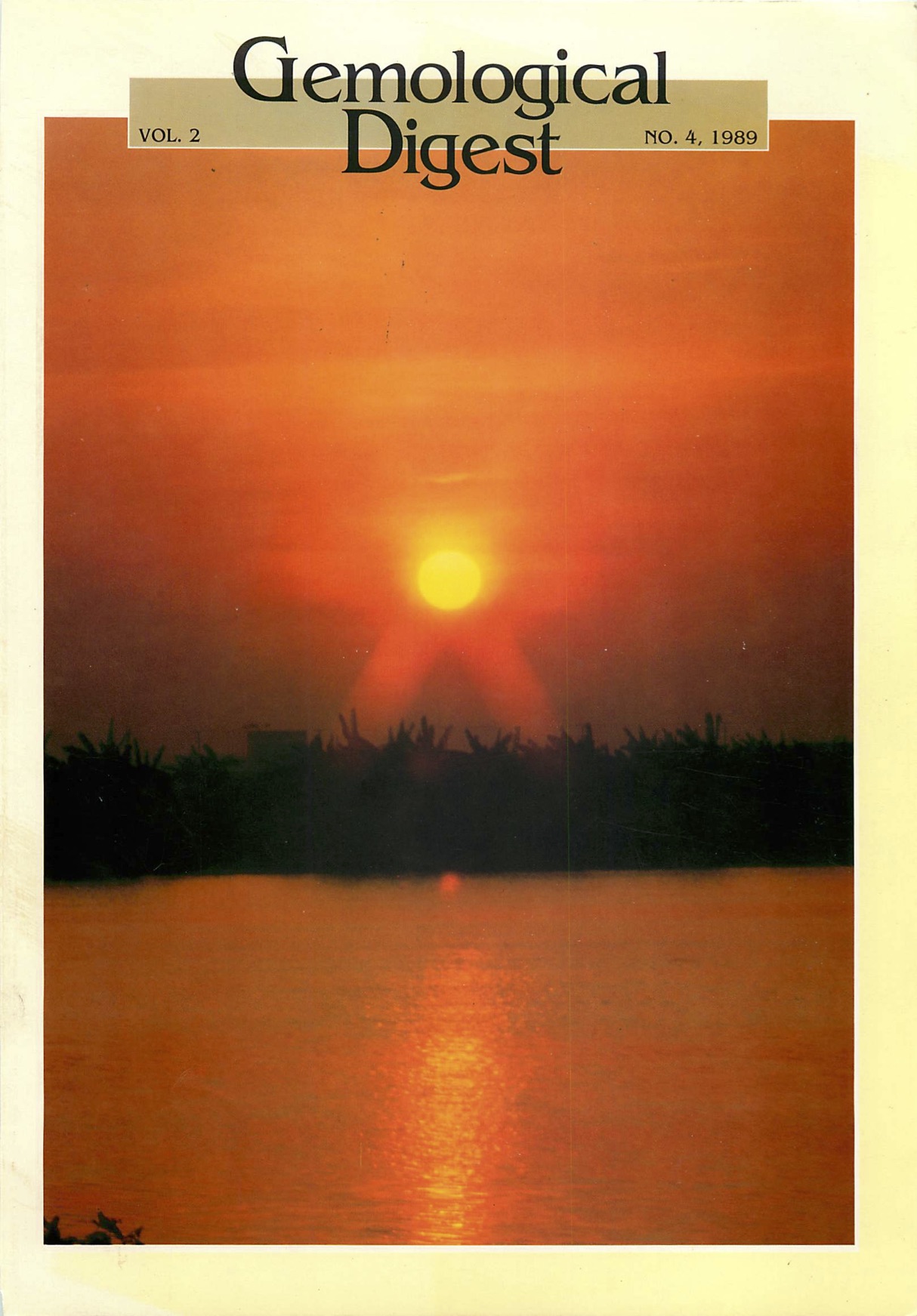
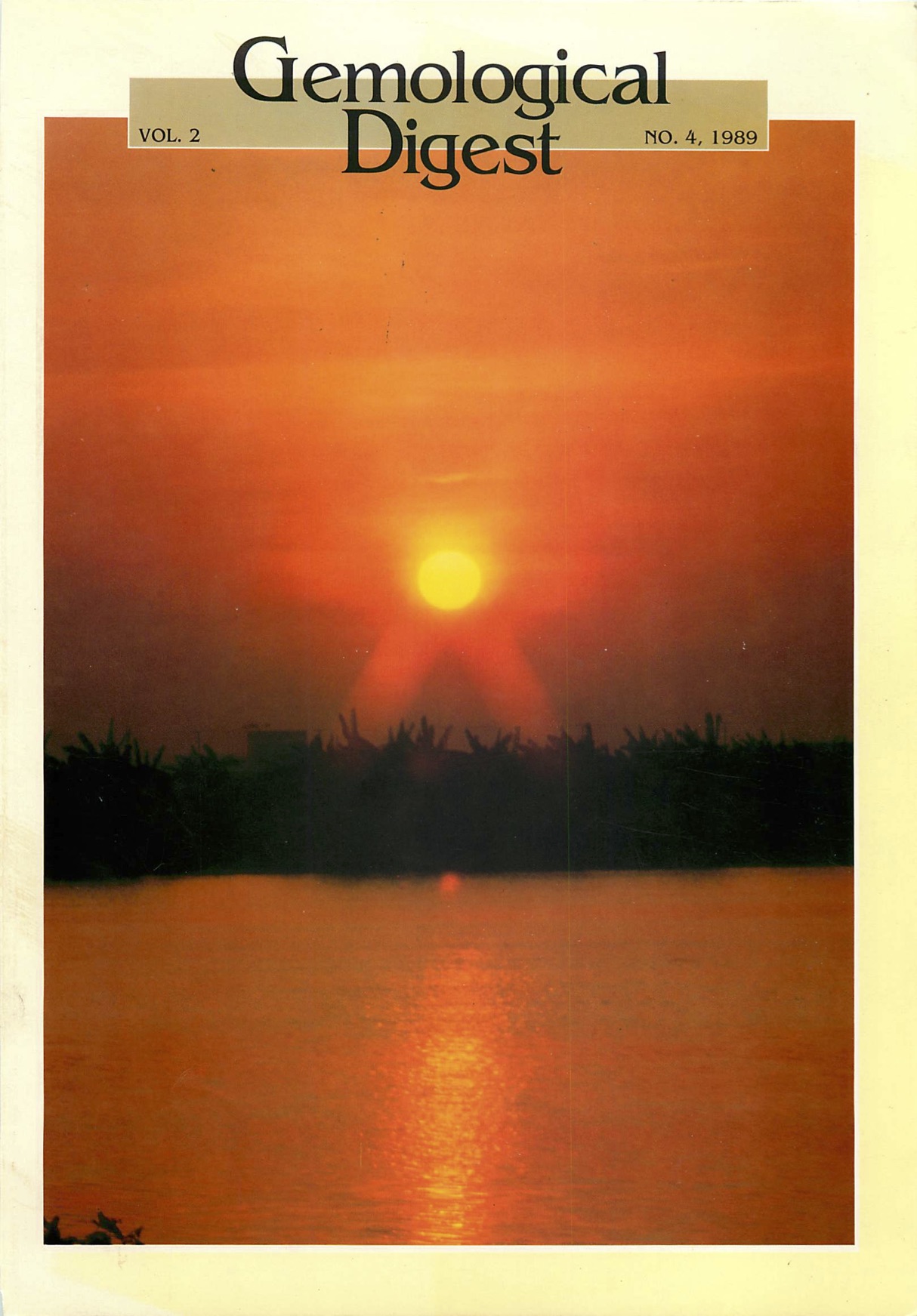
Goutiere, A., de (1989) Inclusions: nature's artwork. Gemological Digest, Vol. 2, No. 4, p. 45.
Record No. 1971  |  Sinkankas/Born No.: NIS/NIB  |  RWHL
De Goutière presents a brief photographic essay celebrating the visual interest of gemstone inclusions through three colour photomicrographs of two specimens. The emphasis is on the striking patterns revealed by microscopic observation and their resemblance to recognizable scenes or abstract compositions. The first photograph shows a thin film within a light green beryl crystal that has been ground to a thickness of 1 mm. Its intricate, multicoloured forms are likened to a tropical garden containing a palm tree and butterflies. Branching and fan-like details occupy a broad field of yellow, blue, green, and violet, with darker areas framing the composition. The comparison concerns the appearance of the photographed inclusion rather than the presence of biological material. The remaining two photographs depict unusual tubular inclusions in a 0.07 ct round brilliant-cut diamond. In one view, bright, angular, tube-like forms appear among the stone’s reflected facet patterns and several dark rounded features. The accompanying caption humorously compares their extraordinary configuration to uncontrolled laser drilling. A second photograph presents a pavilion view of the same diamond, revealing the network from another direction. Here the tubes form a conspicuous labyrinth of straight segments and sharp changes in direction against contrasting bright and dark areas. De Goutière characterizes the effect as natural abstract art, using the change of viewpoint to present a different composition within the same small gemstone. The editorial introduction places these photographs within an ongoing presentation of the author’s work with camera and microscope and frames the specimens as subjects created by nature. The contribution is descriptive and pictorial: it provides the host materials, the preparation thickness of the beryl, and the weight and cut of the diamond, but does not identify the thin film’s composition, explain the tubular inclusions’ formation, or supply magnification and illumination details. Its central purpose is to demonstrate the aesthetic possibilities of inclusions and the distinctive internal images that gem photomicrography can reveal.

Synthetische smaragde aus Australien (synthetische 'Pool emeralds')
Synthetische 'Pool emeralds'
Journal Article
Bank, H., Henn, Ulrich and Lind, T. (1989) Synthetische smaragde aus Australien (synthetische 'Pool emeralds'). [Synthetische 'Pool emeralds'] Zeitschrift der Deutschen Gemmologischen Gesellschaft, Vol. 38, pp. 11–16.
Record No. 1964  |  Sinkankas/Born No.: NIS/NIB  |  Language: In German  |  RWHL
Examines the Australian hydrothermally grown synthetic emerald marketed as the “Pool Emerald.” The authors describe its gemological properties, chemical composition, absorption characteristics and diagnostic internal features, with emphasis on separation from natural emerald. Pool emeralds show features characteristic of hydrothermal growth, including distinctive growth structures and inclusions. Chemical analysis indicates relatively high chlorine and magnesium contents, while alkalis are low or absent—features later studies also found characteristic of this material. The paper provides practical criteria for recognizing Pool synthetic emeralds and documents an important Australian contribution to commercial hydrothermal emerald synthesis during the 1980s.

Expensive thumbsucks or valuable documents? The valuations/assessments/appraisals minefield
Journal Article
Backler, B. (1989) Expensive thumbsucks or valuable documents? The valuations/assessments/appraisals minefield. Gemological Digest, Vol. 2, No. 4, pp. 8–12.
Record No. 1962  |  Sinkankas/Born No.: NIS/NIB  |  RWHL
Backler criticizes inadequately researched jewellery valuations and sets out the knowledge, documentation, equipment, and ethical standards required for a defensible professional appraisal. She treats the valuation report as a legal document that must describe the object fully, substantiate its conclusions, and communicate clearly to both specialists and clients. Insurance valuations are distinguished from probate assessments: the former concern current replacement on a like-for-like basis, while the latter are described as assessments based on material values without workmanship, taxes, or commercial mark-ups. Reliable practice requires gemmological training, continuing education, suitable testing instruments, reference literature, current diamond and coloured-stone prices, and familiarity with precious-metal testing and markets. Appraisers must also understand exchange rates, inflation, import duties, taxation, labour costs, and the successive mark-ups affecting retail replacement. Detailed worksheets and retained records provide the evidence needed to explain conclusions, resolve later disputes, and support testimony in court. Backler condemns valuations altered to accommodate clients’ wishes and deliberate undervaluation intended to discredit competitors or secure goods cheaply. She emphasizes the client’s dependence on professional honesty and the obligation to disclose gemstone treatments, including oiling, glass filling, laser drilling, dyeing, impregnation, heating, and irradiation. Poor valuations can leave clients seriously underinsured, while incomplete descriptions impede identification and encourage disputes over alleged stone substitution. She recommends examination in the client’s presence where practicable and warns that cleaning can markedly change a jewel’s appearance. A case study contrasts a brief, inaccurate retail appraisal with a detailed replacement assessment of a diamond engagement ring and matching wedding band. The deficient report underestimated the principal diamond’s weight, assigned a substantially lower clarity grade, and was followed by an offer to purchase it cheaply. The fuller assessment records metal fineness and weight, construction, gemstone measurements, estimated weights, colour, clarity, fluorescence, finish, identifying marks, and condition. Editorial annotations by R.W. Hughes qualify several of Backler’s assertions. They stress that some treatments are difficult or impossible to detect, that observing an appraisal may introduce security problems and pressure to rush, and that distinctive inclusions or surface features can help establish identity before cleaning. The concluding editorial also cautions against condemning all retail appraisers and emphasizes specialization, practical experience, and candid acknowledgement of uncertainty. Both author and editor ultimately argue that trustworthy valuation depends on documented evidence, sustained professional competence, integrity, and recognition of the limits of one’s expertise.

Calcite in corundum

Journal Article
Themelis, T. (1989) Calcite in corundum. Lapidary Journal, Vol. 42, No. 11; February, p. 31.
Record No. 1711  |  Sinkankas/Born No.: NIS/NIB  |  RWHL

Epiasterism and pseudoasterism

Journal Article
Themelis, T. (1989) Epiasterism and pseudoasterism. Lapidary Journal, Vol. 43, No. 1, April, p. 28.
Record No. 1709  |  Sinkankas/Born No.: NIS/NIB  |  RWHL

Film in corundum

Journal Article
Themelis, T. (1989) Film in corundum. Lapidary Journal, Vol. 43, No. 7, October, p. 19.
Record No. 1708  |  Sinkankas/Born No.: NIS/NIB  |  RWHL

Color distribution in corundum

Journal Article
Themelis, T. (1989) Color distribution in corundum. Lapidary Journal, January, p. 19.
Record No. 1707  |  Sinkankas/Born No.: NIS/NIB  |  RWHL

Gem Trade Lab Notes: Ruby; Verneuil synthetic with needle-like inclusions; Sapphire; A large fine-color star
Journal Article
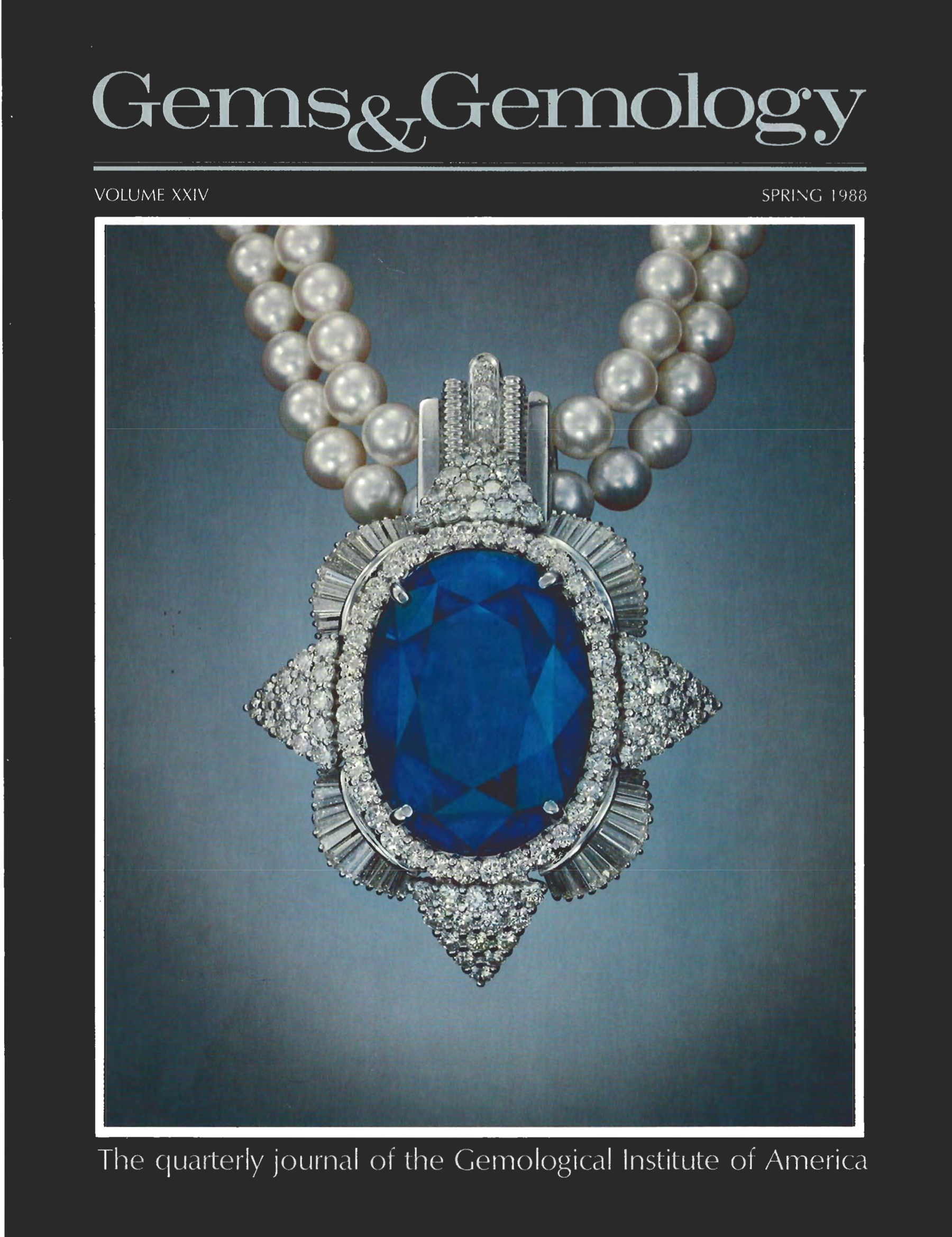
Hargett, D. (1989) Gem Trade Lab Notes: Ruby; Verneuil synthetic with needle-like inclusions; Sapphire; A large fine-color star. Gems & Gemology, Vol. 25, No. 1, Spring, pp. 38–39.
Record No. 934  |  ISBN/ISSN: 0016626X  |  Sinkankas/Born No.: NIS/NIB  |  RWHL

The distinction of natural from synthetic alexandrite by infrared spectroscopy
Journal Article
Stockton, C.M. and Kane, R.E. (1988) The distinction of natural from synthetic alexandrite by infrared spectroscopy. Gems & Gemology, Vol. 24, No. 1, Spring, pp. 44–46.
Record No. 28100  |  Sinkankas/Born No.: NIS/NIB  |  RWHL
Infrared spectroscopy provides a means to distinguish natural from synthetic alexandrites in the range 2000–4200 cm⁻¹, as determined by a study of spectra obtained from 15 natural and 28 synthetic alexandrites from a variety of sources. The technique is nondestructive and, with Fourier transform instrumentation, extremely rapid. It is especially useful for identifying stones that contain no distinguishing inclusions.

As inclusões cristalinas e fluidas da esmeralda de Santa Terezinha de Goiás seu significado geológico
The crystalline and fluid inclusions of the emerald of Santa Terezinha de Goiás their geological meaning
Conference Paper
Mendes, J.C. and Svisero, D.P. (1988) As inclusões cristalinas e fluidas da esmeralda de Santa Terezinha de Goiás seu significado geológico. [The crystalline and fluid inclusions of the emerald of Santa Terezinha de Goiás their geological meaning] ANAIS: XXXV Congresso Brasileiro de Geologia, Belém pp. 398–412.
Record No. 7801  |  Sinkankas/Born No.: NIS/NIB  |  Language: in Spanish  |  RWHL
Emeralds from Santa Terezinha de Goiás, a major global producer, contain a diverse range of primary inclusions identified through X-ray diffraction, energy dispersive analysis, and electron microprobe techniques. These inclusions include chromite, dolomite, magnesite, talc, phlogopite, pyrite, quartz, beryl, barite, patronite, ferropargasite, anthophyllite-cummingtonite, epidote, melanterite, and dumortierite, which reflect the metamorphic nature of the host rocks. Chromite, the most characteristic inclusion, appears as isolated or clustered idiomorphic crystals that exhibit a distinctive red-brown hue under magnification. Carbonates like dolomite and magnesite occur as rhombohedral crystals, while talc is present as dispersed flakes. Other notable inclusions include yellow cubic pyrite, phlogopite (less common than in emeralds from Itabira and Socotó), idiomorphic beryl, and quartz filling fractures. Barite and patronite are rare, while epidote, cummingtonite-anthophyllite, dumortierite, and melanterite were detected only in mixtures via X-ray methods. Fluid inclusions, visible only at high magnifications, contain gas, liquid, and solid phases. The observed inclusions align with the paragenesis of the metamorphic country rocks, and chemical analysis indicates significant variations in the crystallization conditions of these emeralds.

Gem News: Inclusions identified in new Brazilian alexandrites
Journal Article
Koivula, J.I. and Kammerling, R.C. (1988) Gem News: Inclusions identified in new Brazilian alexandrites. Gems & Gemology, Vol. 24, No. 1, Spring, p. 59.
Record No. 6125  |  ISBN/ISSN: 0016626X  |  Sinkankas/Born No.: NIS/NIB  |  RWHL
Two characteristic mineral inclusions observed in the alexandrites from the recent discovery at Hematita in Minas Gerais, Brazil (see the article by K. Proctor in this issue], have been identified by means of detailed chemical analysis. Dr. Henry Hanni found inclusions of fluorite (figure 7) in one of the alexandrites, and Dr. Karl Schmetzer and Mr. Charles Schiffmann confirmed the identification of apatite (figure 8). Dr. Edward Gübelin initiated the study and followed it through to completion. This is the first time that fluorite has been recognized as a mineral inclusion in chrysoberyl.

Emeralds from Somondoco, Colombia: Chemical composition, fluid inclusions and origin
Journal Article
Kozlowski, A., Metz, P. and Jaramillo, H.A.E. (1988) Emeralds from Somondoco, Colombia: Chemical composition, fluid inclusions and origin. Neus Jahrbuch für Mineralogie – Abhandlungen, Vol. 159, No. 1, pp. 23–49.
Record No. 6074  |  Sinkankas/Born No.: NIS/NIB  |  RWHL
Emeralds from the district Somondoco (Colombia) were analyzed by electron microprobe, colorimetry (Be), emission spectrography (Li), and thermogravimetry and infrared absorption (H₂O). They typically show the following atomic substitutions (per 18 oxygens): 0.13–0.21 Al in the SiO₄ tetrahedra, 0.14–0.40 for the sum of Cr, V, Fe, Mg in the AlO₆ octahedra, and 0.02–0.06 Li plus 0.00–0.170 in the BeO₄ tetrahedra; the “channel” alkalis, mostly Na, total 0.13–0.29. Fluid inclusions in these emeralds contain liquid H₂O, liquid CO₂, daughter crystals of halite and calcite (?), and liquid and gaseous hydrocarbons. The behaviour of the fluid inclusions on freezing and heating and their frequent decrepitation, stretching, and leaking are described. Temperatures of homogenization (Th) values are ≥ 470 °C, but only those close to the lower limit seem unaffected by inclusion stretching, etc. A roughly estimated pressure (≤ 1 kbar) would require a pressure correction of about 100 °C to the Th values. The total salt concentration in fluid inclusions is close to 40 wt.%, and the dissolved salt composition inferred from the electron microprobe analyses of the precipitates from decrepitated inclusions is probably: Cl, Na > Ca, Si, Al, (C) > Fe, K, Mg > Mn, Ti. The behaviour of other possible components in the mineral-forming process is also discussed. It is calculated that beryllium fixed in emeralds makes up only 0.2 to 1 wt.% of the total Be in the emerald-bearing rocks and veins. The proposed model of the origin of emeralds involves only components mobilized from the country rocks, without recourse to a deep-seated or magmatic source.

Gem News: New evidence of treatment in Umba sapphires
Journal Article
Koivula, J.I. and Kammerling, R.C. (1988) Gem News: New evidence of treatment in Umba sapphires. Gems & Gemology, Vol. 24, No. 4, Winter, p. 251.
Record No. 5435  |  ISBN/ISSN: 0016626X  |  Sinkankas/Born No.: NIS/NIB  |  RWHL
New evidence of treatment in Umba sapphires. Any evidence that provides absolute proof that a sapphire has or has not been heat treated is always of value to gemologists. A recent investigation done by one of the Gem News editors (JIK), which was published in the Journal of Gemmology (Vol. 20, No. 7, 1987), showed just such evidence in the form of colored halos surrounding solid mineral inclusions in sapphires from Sri Lanka and Montana. The halos result from the heat-induced theft, by the sapphire host, of color-causing ions from the mineral inclusions. After reading the above-mentioned article, Dr. Henry A. Hänni of the University of Basel and the Swiss Foundation for the Research of Gemstones contacted Gem News and reported his discovery of similar internal diffusion halos surrounding tiny mineral inclusions in blue sapphire from the Umba River region in Tanzania, East Africa (figure 6). Dr. Hänni’s observation provides positive evidence that at least some of the sapphires from this locality are being heat treated.

A Verneuil sapphire with induced fractures
Journal Article
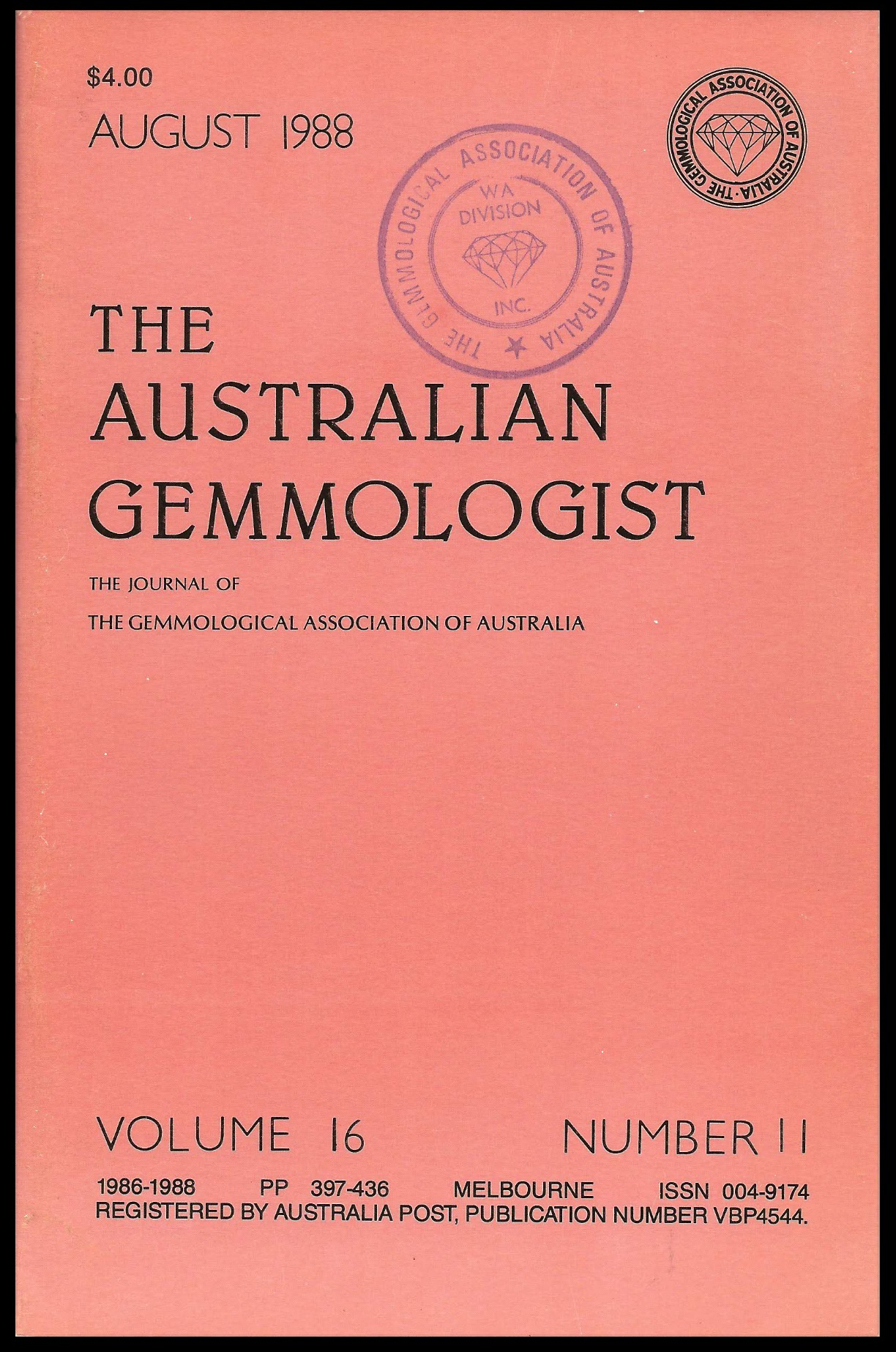
Brown, G. and Kelly, S.M.B. (1988) A Verneuil sapphire with induced fractures. Australian Gemmologist, Vol. 16, No. 11, pp. 419—421.
Record No. 5400  |  Sinkankas/Born No.: NIS/NIB  |  RWHL
Brown and Kelly examine a Verneuil synthetic blue sapphire containing induced fractures that resemble natural fingerprint and veil-like inclusions, and propose that its partial fracture filling resulted from heat treatment rather than controlled flux healing. The specimen is a semi-transparent, mid royal blue, round mixed-cut stone weighing 0.80 ct and measuring approximately 5 mm across the table and 4 mm deep. Its specific gravity is 4, refractive indices are 1.756 and 1.764, and birefringence is 0.008. It shows pale greenish blue and blue dichroism, no long-wave ultraviolet fluorescence, a slightly dusky blue short-wave response, and no diagnostic absorption visible with a spectroscope. Microscopy reveals curved colour banding through both crown and pavilion, internal fractures partly filled by whitish solid material of undetermined composition, and highly iridescent air-filled fractures extending to the polished surface. The authors place this observation within earlier investigations of artificially produced fingerprint inclusions in flame-fusion corundum. Those studies demonstrated that fractures could be modified through molten flux, secondary fusion, or infiltration with a low-melting compound, while some commercial products contained solid flux in their veils. In the present sapphire, the curved zoning has a diffused appearance consistent with previous heating intended to improve colour or reduce visible growth banding. The fracture filling has a soap-scum-like texture resembling material described in earlier experiments using acetanilide, but differs from the wispy appearance illustrated for flux-healed Lechleitner corundum. This resemblance is morphological and does not establish the filling’s chemical identity. Brown and Kelly suggest that it could have originated from a protective chemical coating applied during heating. The absence of solid filling near the external surface provides a further clue: water-soluble constituents, potentially including borax or sodium carbonate, might have been leached from exposed fractures during subsequent repolishing, leaving their outer portions air-filled while deeper portions retained solid material. This explanation remains hypothetical. The report emphasizes identification by low-power microscopy with lateral or diffused transmitted illumination and immersion in methylene iodide. Curved growth or colour bands establish flame-fusion origin when visible, while higher magnification may reveal rounded gas bubbles where prolonged heating has obscured the bands. The study demonstrates that natural-looking fractures cannot independently establish natural origin and that their filling may reflect either deliberate flux treatment or residues associated with earlier heating.

Alexandrit: natürlich oder synthetisch?
Alexandrite: natural or synthetic?
Journal Article
Gübelin, E.J., Bank, H., Henn, U. and Malley, J. (1988) Alexandrit: natürlich oder synthetisch? [Alexandrite: natural or synthetic?] Zeitschrift der Deutschen Gemmologischen Gesellschaft, Vol. 37, No. 1/2, November, pp. 49–52.
Record No. 5064  |  Sinkankas/Born No.: NIS/NIB  |  Language: In German  |  RWHL
Reports the examination of an alexandrite whose internal characteristics made the determination of natural versus synthetic origin problematic. The authors describe the gemological and microscopic features used in reaching an identification, emphasizing the diagnostic significance of inclusions and growth structures and the difficulties that may arise when apparently natural-looking features occur in synthetic material. The study illustrates the need to evaluate the complete combination of internal, optical and other gemological properties rather than relying on a single diagnostic feature when separating natural alexandrite from its synthetic counterparts.

Notes on the inclusions in a greyish kyanite
Journal Article
Gübelin, E.J., Ghera, A. and Graziani, G. (1988) Notes on the inclusions in a greyish kyanite. Journal of Gemmology, Vol. 21, No. 2, April, pp. 83–87.
Record No. 5063  |  ISBN/ISSN: 221252  |  Sinkankas/Born No.: NIS/NIB  |  RWHL
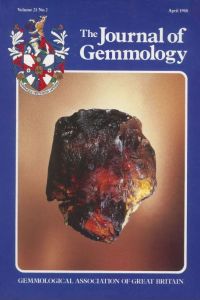
A greyish-blue kyanite measuring 12 × 9 × 3 mm is examined by optical microscopy, X-ray diffraction and electron microprobe analysis to identify its inclusions and investigate their relationship to the host’s physical properties and geological history. The specimen contains numerous transparent crystals, elongated aggregates, fibres, channels and occasional opaque particles. Its uneven greyish coloration forms broad, indistinct darker areas, while channels and fibrous inclusions aligned along the crystallographic c axis produce weak to moderate chatoyancy. The measured density, 3.670 ± 0.004 g/cm³, is appreciably below the value of 3.783 ± 0.004 g/cm³ calculated from the refined unit-cell parameters; this discrepancy is attributed to abundant inclusions of minerals less dense than kyanite, particularly andalusite, calcite and apatite. Euhedral prismatic inclusions, reaching approximately 0.70 × 0.40 mm and commonly oriented roughly parallel to the host’s c axis, have the same aluminium-to-silicon ratio as kyanite. Their morphology suggests andalusite, an identification confirmed by X-ray microdiffraction. They are interpreted as syngenetic inclusions. Other identified minerals include nearly pure calcite, apatite and minute zircon prisms. The apatite contains no detected fluorine and only a small amount of chlorine, suggesting carbonate apatite or hydroxyapatite, although its precise identity remains uncertain. Long, narrow channels contain minute andalusite crystals, transparent kyanite and yellow to reddish-brown material. Chemical analysis indicates that the coloured material consists of iron oxides or hydroxides. Yellow lamellae resemble lepidocrocite, whereas associated red platelets are tentatively assigned to hematite or maghemite. Tiny reddish needles associated with apatite may represent a titanium oxide, but are not conclusively identified. The coexistence of apparently syngenetic andalusite and kyanite is used to discuss formation conditions, with approximate upper limits of 4 kbar and 500°C. The authors stress that uncertainties in the coexistence relationships prevent precise pressure–temperature determination; the absence of pyrophyllite is taken to suggest lower limits around 350–400°C and 2.5–3.0 kbar. Iron-bearing material within the channels is interpreted as evidence of subsequent penetration by an iron-rich fluid. The red oxides may have formed through dehydration of lepidocrocite. The study thus relates the specimen’s appearance and anomalously low density to its inclusion population and distinguishes evidence of mineral growth from indications of later alteration.

Examination of three-phase inclusions in colorless, yellow, and blue sapphires from Sri Lanka
Journal Article
Schmetzer, K. and Medenbach, O. (1988) Examination of three-phase inclusions in colorless, yellow, and blue sapphires from Sri Lanka. Gems & Gemology, Vol. 24, No. 2, Summer, pp. 107–111.
Record No. 4975  |  ISBN/ISSN: 0016626X  |  Sinkankas/Born No.: NIS/NIB  |  RWHL
Three-phrase inclusions i n untreated natural color-less, yellow, and blue sapphires from Sri Lanka were found to consist of liquid and gaseous carbon diox-ide cis well as needle-like to tabular crystals of di-aspore. The identification of diaspore was accom-plished through the use of a microscope-mounted drill system and an improved version of the Gandolfi X-ray camera. Technical details for both methods are given. The conditions under which diaspore forms as a daughter mineral in corundum are briefly dis-cussed.

Rubin: natürlich oder synthetisch?

Ruby: natural or synthetic?
Journal Article
Bank, H., Gübelin, E.J., Henn, U. and Scarratt, K. (1988) Rubin: natürlich oder synthetisch? [Ruby: natural or synthetic?] Zeitschrift der Deutschen Gemmologischen Gesellschaft, Vol. 37, No. 1/2, November, pp. 27–30.
Record No. 4700  |  Sinkankas/Born No.: NIS/NIB  |  Language: In German  |  RWHL
Describes the examination of an unusual 1.288 ct faceted ruby from Nepal whose identification as natural or synthetic was initially difficult because several internal features resembled those of flux-grown synthetic ruby. Microscopy revealed dark inclusion veils, negative crystals, unusual growth structures and inclusions showing interference colors; its absorption spectrum and strong red to orange-red fluorescence also appeared compatible with synthetic material. Microprobe analysis, however, identified exposed dark inclusions as phlogopite rather than flux residue. Further examination revealed very thin fluid films, some two-phase, together with twinned mineral crystals and twin lamellae in the host ruby, establishing its natural origin. The paper illustrates the danger of relying upon individual inclusion features when distinguishing natural from synthetic ruby and demonstrates the value of combining microscopy with chemical and spectroscopic examination.

An unusual ruby from Nepal

Journal Article
Bank, H., Gübelin, E., Harding, R.R., Henn, U., Scarratt, K. and Schmetzer, K. (1988) An unusual ruby from Nepal. Journal of Gemmology, Vol. 21, No. 4, October, pp. 222–226.
Record No. 4699  |  ISBN/ISSN: 221252  |  Sinkankas/Born No.: NIS/NIB  |  RWHL
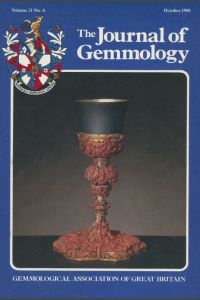
Bank and colleagues describe a high-quality faceted ruby reportedly from Nepal whose unusual growth structures and inclusions initially raised doubts about its natural origin. The 1.288 ct stone, cut as an approximately equilateral octagon measuring 6.00 × 6.00 × 4.15 mm, combined excellent transparency with a desirable red colour, contrasting with the predominantly cabochon-quality Nepalese material previously available. Routine measurements gave refractive indices of 1.770 and 1.762, birefringence of 0.008, density of 3.98 g/cm³, and the normal chromium absorption spectrum, properties compatible with both natural and synthetic ruby. Ultraviolet–visible spectrophotometry showed similarities to previously studied Nepalese corundum but lacked significant iron–titanium charge-transfer absorption in the red region, accounting for the absence of a purplish sapphire component. Immersion microscopy revealed a dark red centre, opposing near-colourless marginal zones, and broad alternating red and colourless bands parallel to the basal pinacoid. Boundaries associated with prism and dipyramidal growth formed angles of approximately 90° and 85° with the basal zoning. Although superficially comparable to nearly rectangular zoning in Ramaura synthetic ruby, these structures involved different crystallographic forms. Spindle-like growth features within the red centre also resembled structures encountered in flux-grown synthetics, while fine dust-like striations recalled inclusions in Kashan synthetic ruby. These similarities made straightforward microscopic classification unreliable. Electron microprobe examination of surface-reaching inclusions at the girdle and near the culet identified phlogopite, a mica already known in association with Nepalese ruby and pink and violet sapphire. Further microscopy disclosed feathers comprising irregular cavities and negative crystals containing liquid, two-phase fillings, and probable three-phase solid–liquid–gas inclusions. Some solid components displayed interference colours under crossed polarizers. These feathers could resemble residual flux in synthetic ruby, but comparable features had previously been recorded in lower-quality Nepalese specimens. Extremely thin fluid films, sometimes containing both liquid and gas, provided additional evidence of natural formation and showed interference colours under suitable illumination. The authors conclude that the combined presence of phlogopite, multiphase inclusions, and ultrafine fluid films establishes natural origin and confirms the reported Nepalese provenance. The case demonstrates how exceptional natural growth structures can imitate familiar synthetic features, requiring crystallographic interpretation, inclusion identification, and multiple complementary observations rather than reliance on superficial resemblance.

Oriented lath-like inclusions of a new type of spinel

Journal Article
Schmetzer, K. (1988) Oriented lath-like inclusions of a new type of spinel. Journal of Gemmology, Vol. 21, No. 2, pp. 69–72.
Record No. 3873  |  ISBN/ISSN: 221252  |  Sinkankas/Born No.: NIS/NIB  |  RWHL
A bluish-violet spinel from Sri Lanka with oriented inclusions was examined using microscopy, X-ray single-crystal diffraction, and electron microprobe analysis. The specimen displays four sets of lath-like, double-refracting crystal inclusions aligned parallel to the threefold axes of the host spinel. The inclusions are identified as one of the Al₂SiO₅ polymorphs, most likely sillimanite. The study also includes a general literature review on oriented inclusions and asterism in spinel.

Exploring the Literature of Gemstone Inclusions

The literature of gemstone inclusions covers identification, origin determination, treatments, synthesis, mineral inclusions, fluid inclusions and other internal features of natural and synthetic gems.

For a curated selection of important sources, read Inclusions in Gemstones — Hyperion Literature Sources.

About Four Treasures

Four Treasures is Lotus Gemology's freely accessible gemological reference database. Use the full database to search by author, title or keyword and explore literature on gemology, mineralogy, jewelry and related fields. Where available, hyperlinks on titles may lead directly to the full publication.

Search the Complete Four Treasures Database