Gemstone Inclusions Bibliography

Gemstone Inclusions Bibliography

Explore books, articles and historical sources on inclusions in gemstones in Four Treasures, the Lotus Gemology reference database. This bibliography brings together matching records from the collection, with publication details, abstracts and cover images where available.

Gemstone Inclusion References

The list below matches the terms inclusion or inclusions in the database's searchable fields. Some references discuss inclusions as part of a broader subject.
881–900 of 1,354 matching references

The Cheapside Hoard confusion

Journal Article
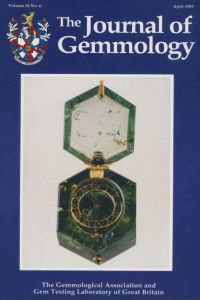
Gosling, J.G. (1995) The Cheapside Hoard confusion. Journal of Gemmology, Vol. 24, No. 6, April, pp. 395–400.
Record No. 838  |  ISBN/ISSN: 221252  |  Sinkankas/Born No.: NIS/NIB  |  RWHL
Reviews conflicting accounts of the discovery and recovery of the Cheapside Hoard, a collection of approximately 340 jewellery items unearthed in London in 1912, and combines this historical investigation with descriptions of exceptional gemstones and workmanship. The hoard is interpreted as the stock of a Jacobean goldsmith, pawnbroker or dealer, buried under unknown circumstances in the early seventeenth century. Gosling compares museum catalogues, historical studies, newspaper tributes and recollections that disagree over the precise location, date, container and manner of recovery. Reports variously describe a decayed wooden box, a bucket, or jewels embedded in lumps of clay, while the absence of a direct account of the actual excavation prevents a definitive reconstruction. Central to the story is G.F. Lawrence, known as “Stony Jack”, whose relationships with building labourers enabled him to recover archaeological objects for London museums. Accounts portray him purchasing finds from workmen and receiving successive deliveries of clay-encrusted jewellery at his Wandsworth premises. The article highlights both his contribution to preserving the hoard and the unresolved details surrounding ownership, payments and Treasure Trove claims. Institutional disputes delayed agreement until 1916, when the collection was divided principally between the London and Guildhall museums, with smaller holdings elsewhere. Their later amalgamation reunited most of the material in the Museum of London. Gemmological notes describe a watch enclosed in Colombian emerald, identified by characteristic multiphase inclusions; a table-cut diamond estimated at three to four carats with a modified scissors-cut pavilion; and a hexagonal sapphire displaying rutile silk, pronounced growth zoning and an unusual combination of crown facets and a stepped pavilion. The sapphire’s appearance and setting are compared with those of the Stuart Sapphire. Amethyst and emerald grape pendants illustrate sophisticated lapidary methods, apparently involving intersecting annular drillings followed by removal of intervening material and rounding of the exposed ends. Gosling also considers how damp clay beneath a chalk cellar floor could explain decay of the container and dispersal of its contents. He concludes that the surviving uncertainties justify a new authoritative illustrated catalogue and consideration of further reunification of the collection, while recognising its importance as evidence of Elizabethan and Jacobean jewellery, gem cutting and material culture.

Inclusion of the Month: In the Star of Bombay
Journal Article
Feather, R.C. (1995) Inclusion of the Month: In the Star of Bombay. Lapidary Journal, Vol. 48, No. 12, March, p. 14.
Record No. 739  |  Sinkankas/Born No.: NIS/NIB  |  RWHL

Gem Trade Lab Notes: Synthetic ruby, with diffusion-induced “fingerprint” inclusions and asterism
Journal Article
Crowningshield, G.R. (1995) Gem Trade Lab Notes: Synthetic ruby, with diffusion-induced “fingerprint” inclusions and asterism. Gems & Gemology, Vol. 31, No. 2, Summer, p. 126.
Record No. 640  |  ISBN/ISSN: 0016626X  |  Sinkankas/Born No.: NIS/NIB  |  RWHL

A high-chromium corundum (ruby) inclusion in diamond from the São Luiz alluvial mine, Brazil
Journal Article
Watt, G.R., Harris, J.W., Harte, B. and Boyd, S.R. (1994) A high-chromium corundum (ruby) inclusion in diamond from the São Luiz alluvial mine, Brazil. Mineralogical Magazine, Vol. 58, No. 392, pp. 490–493.
Record No. 27263  |  ISBN/ISSN: 0026461X  |  DOI: https://doi.org/10.1180/minmag.1994.058.392.16  |  Sinkankas/Born No.: NIS/NIB  |  RWHL
An exceptionally chromium-rich ruby inclusion is described from a type II diamond recovered from the São Luiz alluvial deposit in Mato Grosso, Brazil. Diamonds from this locality contain diverse inclusions interpreted to sample mantle environments ranging from eclogitic assemblages extending to approximately 400 km depth to ferropericlase–magnesiowüstite assemblages indicative of lower-mantle conditions below approximately 650 km. The ruby is red, subhedral, approximately 100 μm long, and chemically homogeneous. Eight electron-microprobe analyses yield an average composition of 90.37 wt.% Al₂O₃ and 8.58 wt.% Cr₂O₃, together with minor SiO₂, MgO, FeO, and TiO₂. Its chromium content greatly exceeds that of previously reported mantle corundum, including the only earlier documented corundum inclusion in diamond, which contained 1.30 wt.% Cr₂O₃. Comparisons with corundum from eclogite, grospydite, corganite, and corgaspinite assemblages emphasize the unusual chemistry: these known mantle occurrences generally contain much less chromium. Although such assemblages provide plausible mineralogical associations for the inclusion, their normally low chromium contents imply that the São Luiz ruby originated in material with an unusual bulk composition; the nature of its protolith remains unresolved. The host diamond has variable δ¹³C values from −11.56 to −15.21‰ relative to PDB, substantially lighter than the approximately −6‰ value cited for normal mantle carbon and consistent with an eclogitic association. However, similarly depleted diamonds occur in both lithospheric and asthenospheric settings, so carbon isotopes alone cannot establish the inclusion’s depth of origin. A possible origin below the lithosphere is proposed by analogy with chromium-bearing kyanite. Experimental evidence indicates that chromium solubility in kyanite increases with pressure, and highly chromian kyanite is known from mantle xenoliths. If corundum responds similarly, the ruby’s exceptional chromium enrichment could reflect formation at greater depth than typical corundum-bearing eclogitic xenoliths. This interpretation agrees with evidence for deep origins among other São Luiz diamond inclusions but remains tentative. A more precise depth estimate requires discovery of corundum together with another mineral in a two-mineral inclusion assemblage.

Gem News: More on peridot from Pakistan
Journal Article
Koivula, J.I., Kammerling, R.C. and Fritsch, E. (1994) Gem News: More on peridot from Pakistan. Gems & Gemology, Vol. 30, No. 4, Winter, p. 275.
Record No. 26782  |  Sinkankas/Born No.: NIS/NIB  |  RWHL
Following the Fall 1994 Gem News report on a new peridot source in Pakistan’s far western Himalayas, further study of both rough and cut stones from the deposit has been conducted. The orthorhombic peridot crystals may initially appear hexagonal due to the symmetry of “columnar” and “pyramidal” faces, with face types identified using Goldschmidt’s Atlas der Krystallformen. Prominent faces included basal pinacoid (001), columnar (010) and (110), and pyramidal (021) and (111), with striations visible along the c-axis on the (010) and (110) faces, though many crystals, as confirmed by Laura Thompson of Shades of the Earth, also exhibit well-formed, lustrous faces. Two faceted stones—a 5.23 ct rectangular mixed cut and an 18.37 ct cushion modified brilliant—showed gemological properties consistent with known peridot: medium yellowish green color, transparent diaphaneity, R.I. values of α = 1.651, β = 1.669, γ = 1.687 (birefringence 0.036), specific gravity of 3.35, weak pleochroism, inert fluorescence, and distinct absorption bands at ~453, 477, 497 nm, and a weaker one at ~529 nm. These values suggest a composition of ~90% forsterite and 10% fayalite. No inclusions were visible under magnification in the faceted stones, though black rod-like inclusions, identified as ludwigite via X-ray diffraction, were noted in some cabochon-grade rough.

Four hessonite occurrences in Orissa, India
Journal Article
Kanis, J. and Redmann, M. (1994) Four hessonite occurrences in Orissa, India. Journal of Gemmology, Vol.  24, No. 2, April, pp. 75–83.
Record No. 26742  |  ISBN/ISSN: 221252  |  Sinkankas/Born No.: NIS/NIB  |  RWHL
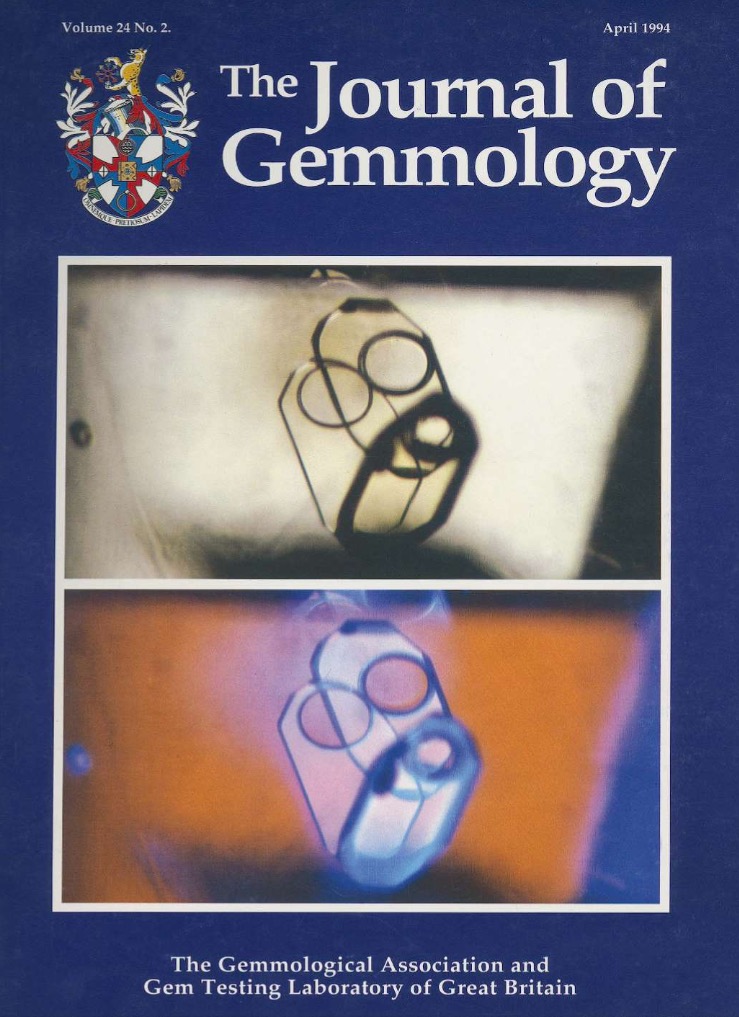
Hessonite garnets from the villages of Ghatpara, Dahikbala, Budhido, and Burubura in Orissa, India, are located in the high-grade metamorphic khondalite suite and occur either in calc-silicate lenses or in quartzite-amphibolite contact zones. The paragenesis of Orissa’s hessonite is linked to regional metamorphic processes, probably during Middle Proterozoic times. The colours of the stones range from pale yellowish and orange to brown, with refractive indices and densities for each locality as follows: Ghatpara: n = 1.738–1.752, D = 3.56–3.64 g/cm³; Dahikbala: n = 1.750–1.756, D = 3.58–3.64 g/cm³; Budhido: n = 1.751–1.758, D = 3.60–3.63 g/cm³; Burubura: n = 1.759–1.763, D = 3.60–3.66 g/cm³. In addition to calcium, aluminium, and silicon, chemical analyses reveal a distinct content of iron and traces of manganese and titanium. Microscopical study shows that the hessonite from Ghatpara is characterized by mineral inclusions, healing cracks with two- or three-phase inclusions, and growth marks which sometimes display strong interference colours under crossed polarizers. The inclusions in stones from Burubura are mainly healing cracks with two- or three-phase inclusions and growth marks. Budhido hessonite exhibits a strong oily appearance and mineral inclusions, while Dahikbala stones are marked by needle-like inclusions, growth marks, and some mineral inclusions.

Sequential nature of the formation of emerald and alexandrite in micaite-type deposits
Journal Article
Ustinov, V.I. and Chizhik, O.Y. (1994) Sequential nature of the formation of emerald and alexandrite in micaite-type deposits. Geochemistry International, Vol. 31, No. 7, pp. 115–118.
Record No. 8102  |  ISBN/ISSN: 00167029/94/00070115  |  Sinkankas/Born No.: NIS/NIB  |  RWHL
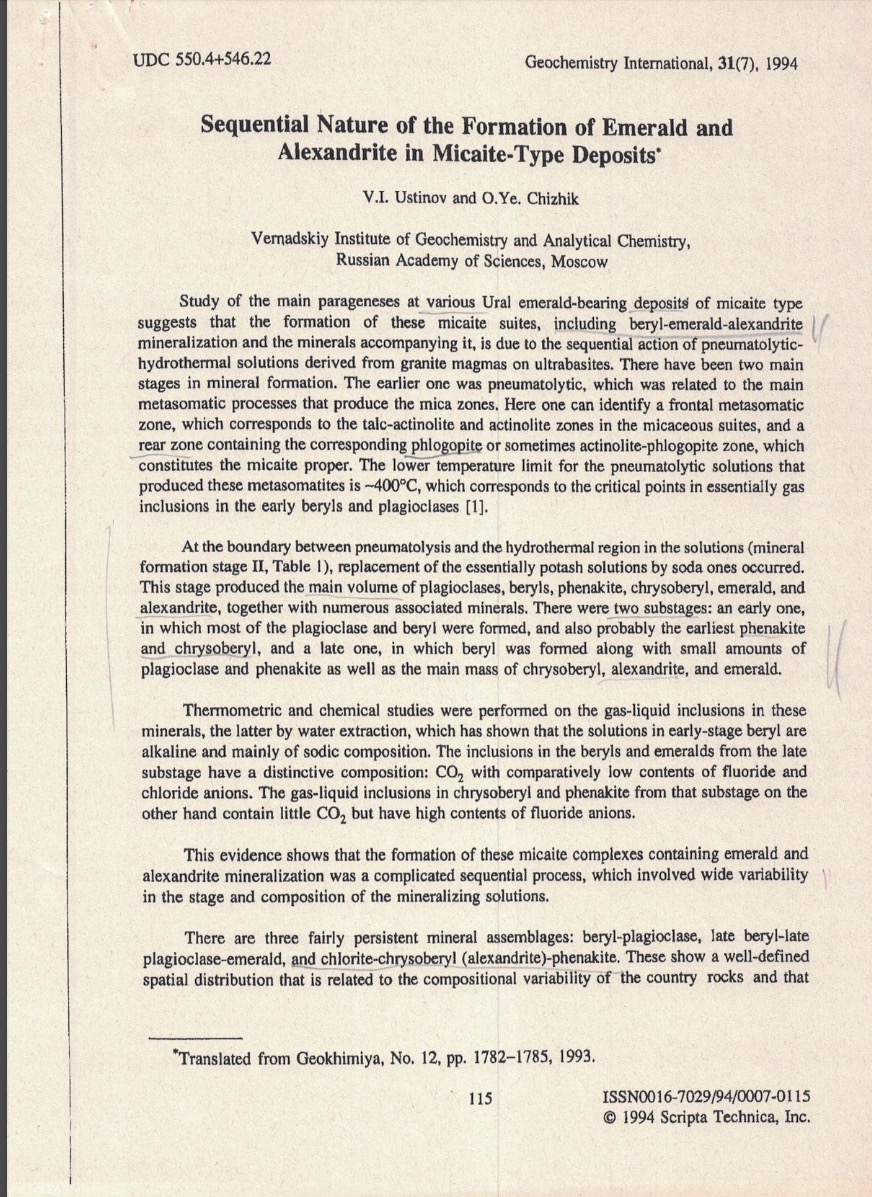
Oxygen-isotope analyses, fluid-inclusion thermometry, and inclusion chemistry are used to examine the sequence and conditions of emerald and alexandrite formation in micaite-type deposits of the Ural emerald-bearing belt. The deposits are interpreted as products of successive interactions between granite-derived pneumatolytic–hydrothermal fluids and ultrabasic rocks. An early pneumatolytic stage generated metasomatic zoning, with frontal talc–actinolite and actinolite zones and a rear phlogopite or actinolite–phlogopite zone constituting the micaite proper. Its lower temperature limit is placed near 400 °C. During the subsequent transition to hydrothermal conditions, predominantly potassium-bearing solutions gave way to sodium-bearing solutions, producing most of the plagioclase and beryllium minerals. Early assemblages were dominated by plagioclase and beryl, whereas later assemblages included the main chrysoberyl, alexandrite, and emerald mineralization. Late beryl and emerald contain carbon-dioxide-bearing inclusions relatively poor in fluoride and chloride, while associated chrysoberyl and phenakite contain little carbon dioxide but abundant fluoride. Oxygen-isotope measurements were made on phlogopite, chlorite, successive generations of beryl, plagioclase, and chrysoberyl, and on phenakite, alexandrite, and emerald. Calculated fluid compositions define five characteristic δ¹⁸O values: approximately 1.3 ± 0.2‰ for plagioclase-forming water, 3.6 ± 0.2‰ for beryl, 6.7‰ for emerald, 9.4 ± 0.3‰ for phenakite, chrysoberyl, alexandrite, and chlorite, and 15.1‰ for phlogopite. Fractionation factors for phenakite and chrysoberyl were approximated from structurally comparable minerals because experimental calibrations were unavailable. Mean inclusion homogenization temperatures fall between 350 and 400 °C and are interpreted as indicating broadly stable thermal conditions within measurement uncertainties of ±25–30 °C. The authors reject simple closed-system evolution of a single solution and instead infer infiltrating fluids whose properties varied through space and time. Host-rock composition strongly influenced fluid salinity and mineral deposition: comparatively unreactive aluminosilicate rocks favoured lower-salinity plagioclase–beryl assemblages, ultrabasic rocks favoured higher-salinity phenakite–chrysoberyl–alexandrite–chlorite assemblages, and contacts generally provided intermediate conditions suitable for emerald. The fluoride-rich assemblage represents a genetically distinct association that may overprint emerald-bearing assemblages or occur separately. Successive chrysoberyl and alexandrite formation involved no qualitative change in fluid character, whereas the beryl-to-emerald transition involved isotopically heavier water, tentatively linked to increased carbon dioxide. These distinctions refine the interpretation of associated minerals used in prospecting and evaluating emerald-bearing micaite complexes. Translated from Geokhimiya, No. 12, pp. 1782-1785, 1993.

A cobalt-rich spinel inclusion in a sapphire from Bo Ploi, Thailand
Journal Article
Guo, J., Griffen, W.L. and O’Reilly, S.Y. (1994) A cobalt-rich spinel inclusion in a sapphire from Bo Ploi, Thailand. Mineralogical Magazine, Vol. 58, No. 391, June, pp. 247–258.
Record No. 7658  |  Sinkankas/Born No.: NIS/NIB  |  RWHL
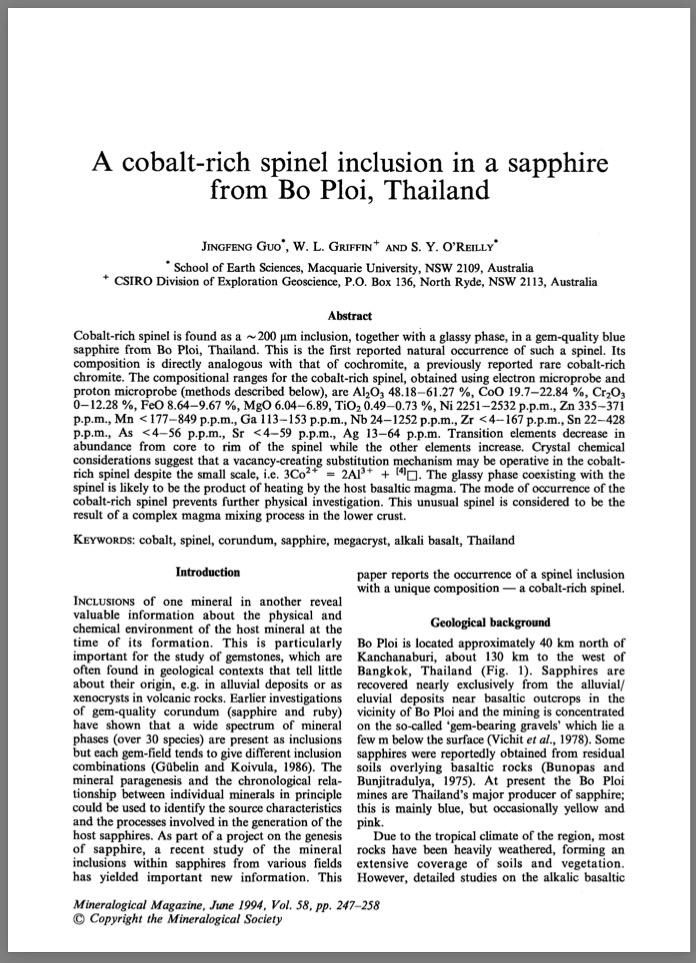
A cobalt-rich spinel has been discovered as a ~200 µm inclusion, alongside a glassy phase, within a gem-quality blue sapphire from Bo Ploi, Thailand, marking the first reported natural occurrence of such a spinel. Its composition closely resembles that of cochromite, a rare cobalt-rich chromite, with electron and proton microprobe analyses revealing A1₂O₃ (48.18–61.27%), CoO (19.7–22.84%), Cr₂O₃ (0–12.28%), FeO (8.64–9.67%), MgO (6.04–6.89%), TiO₂ (0.49–0.73%), and trace elements such as Ni (2251–2532 ppm), Zn (335–371 ppm), and Mn (<177–849 ppm), among others. Notably, transition elements decrease from core to rim, while other elements increase, suggesting a vacancy-creating substitution mechanism (3Co²⁺ = 2Al³⁺ + [□]). The coexisting glassy phase likely formed due to heating by the host basaltic magma. Although further physical investigation is limited by the spinel’s mode of occurrence, this unusual mineral is believed to result from a complex magma mixing process in the lower crust.

Gem News: “Teal” blue cobalt-colored spinel
Journal Article
Koivula, J.I., Kammerling, R.C. and Fritsch, E. (1994) Gem News: “Teal” blue cobalt-colored spinel. Journal of Gemmology, Vol. 30, No. 4, Winter, pp. 276–277.
Record No. 5991  |  ISBN/ISSN: 221252  |  Sinkankas/Born No.: NIS/NIB  |  RWHL
An unusually coloured natural spinel examined after the 1994 Tucson gem show provides evidence that nickel can contribute to the colour of natural spinel. The 4.88-carat cushion-cut stone, reportedly from Myanmar, displayed a slightly greenish blue or “teal” colour rather than the saturated royal blue more commonly associated with natural cobalt-bearing spinel. Standard gemmological testing gave a refractive index of 1.714, anomalous double refraction, and a specific gravity of 3.60. The specimen was inert to long-wave and short-wave ultraviolet radiation, fluoresced red under visible light, and showed a moderate red reaction through a colour filter. A handheld spectroscope revealed broad absorption bands near 460, 550, and 585 nm, together with total absorption above 610 nm, consistent with natural cobalt-blue spinel. Microscopic examination found the stone essentially clean apart from elongated yellow stains in surface-reaching fractures near a corner of the table; these could be mistaken for flux inclusions. Energy-dispersive X-ray fluorescence analysis supported natural origin through substantial zinc and gallium contents typical of natural spinel. In addition to magnesium and aluminium, the analysis detected abundant iron, trace manganese, and an unusually high nickel content compared with other natural blue spinels in the laboratory’s database. Cobalt was not detected, as its usual concentration in natural cobalt-blue spinel lies below the instrument’s detection limit. Ultraviolet–visible absorption spectroscopy identified a transmission window near 500 nm, compared with approximately 490 nm in typical royal-blue cobalt-bearing spinel. This shift towards greenish blue was attributed to a broad absorption underlying the principal cobalt feature. Absorption at 480 nm was also approximately as intense as that at 460 nm, whereas the former is usually weaker in other natural cobalt-blue spinels. Comparison with a Russian flux-grown synthetic spinel doped with divalent nickel suggested that nickel caused the additional absorption, consistent with the chemical analysis. The authors regarded the specimen as the first reported example of nickel contributing to the colour of natural spinel.

Dyed natural star corundum as a ruby imitation
Journal Article
Schmetzer, K. and Schupp, F.-J. (1994) Dyed natural star corundum as a ruby imitation. Journal of Gemmology, Vol. 24, No. 4, October, pp. 253–255.
Record No. 4979  |  ISBN/ISSN: 221252  |  Sinkankas/Born No.: NIS/NIB  |  RWHL
Sixteen red cabochons purchased from a German dealer as natural star rubies were identified as dyed natural star corundum. The specimens measured approximately 7–12 mm, displayed intense red body color and sharp six-rayed stars, and, according to information supplied by the seller, were probably imported from India. Standard gemological tests established that the material was corundum. Microscopic examination revealed growth zoning associated with prism faces and hexagonal dipyramids, natural inclusions, and, in some specimens, parting parallel to the positive rhombohedron, supporting a natural origin. In several cabochons, the star rays ran perpendicular to traces of the observed growth planes, an orientation described as typical of Indian star corundum containing oriented rutile needles. Differences in the concentration of these needles between growth sectors produced variations in the milky-white appearance of the stones under reflected light. The red coloration, however, was concentrated unevenly within fissures and cracks traversing the crystals, demonstrating that the apparent ruby color was artificial. Neither the corundum nor the coloring material in the fissures fluoresced under long-wave or short-wave ultraviolet radiation. Immersion of one specimen in acetone removed part of its red color, and red spots subsequently appeared on the stone’s wrapping material, providing further evidence of dye treatment. The absence of fluorescence distinguished these samples from previously reported dyed corundum beads and faceted stones, in which the coloring agent produced strong yellow-orange fluorescence under long-wave ultraviolet radiation, and indicated the use of a different dye. The Mysore–Karnataka region of southern India is suggested as a possible source of the starting material because it had supplied substantial quantities of pale-colored star corundum and dyed material from that area had previously been reported. This geographic attribution remains tentative. The study demonstrates that natural inclusions and genuine rutile-induced asterism can coexist with artificially introduced red coloration. Identification depends principally on recognizing the irregular concentration of dye in fractures, a feature visible microscopically and sometimes with a hand lens.

Flux-induced fingerprint patterns in synthetic ruby: An update
Journal Article
Schmetzer, K. and Schupp, F.-J. (1994) Flux-induced fingerprint patterns in synthetic ruby: An update. Gems & Gemology, Vol. 30, No. 1, Spring, pp. 33–38.
Record No. 4978  |  ISBN/ISSN: 0016626X  |  Sinkankas/Born No.: NIS/NIB  |  RWHL
Flux treatment of synthetic ruby is reviewed, and a previously uncharacterised inclusion pattern is described in stones encountered in the gem trade, often represented as natural rubies from Afghanistan. Conventional treatment involves immersing Verneuil flame-fusion synthetic ruby in an aluminium oxide-bearing flux, which penetrates fractures and promotes partial healing, leaving residual flux arranged in fingerprint-like patterns that can resemble healed fractures in natural ruby. Such treatment can also obscure curved growth striations. Products associated with Chatham, Knischka, and Lechleitner are discussed, although the authors note that preliminary heating and quench cracking have not been experimentally demonstrated for every product. Treatment may produce a flux-grown synthetic ruby overgrowth on the Verneuil core; remnants can reveal distinct boundaries, parallel growth lines, coarse flux inclusions, or small synthetic corundum crystals. Identification may depend on curved growth striations, gas bubbles following curved growth layers, or trace-element detection of molybdenum, lead, or tungsten derived from the flux. Since 1989, the authors had encountered approximately 60 treated synthetic rubies with a different inclusion structure. Twenty were examined by standard gemmological methods, and two, weighing 1.99 and 9.93 carats, underwent scanning electron microscopy with energy-dispersive spectroscopy and energy-dispersive X-ray fluorescence analysis. These stones contained thin, continuous, three-dimensional networks of flux-filled fractures, producing a honeycomb-like cellular appearance in transmitted light and whitish to colourless surface-reaching networks in reflected light. Their refractive indices, specific gravities, ultraviolet fluorescence, and absorption spectra fell within ranges that overlap those of natural and synthetic ruby. Extremely weak curved striations were resolved in one sample, but were insufficient to establish Verneuil growth conclusively; Czochralski growth remained possible. Analysis of the fracture fillings detected calcium and lead but no aluminium. The authors infer treatment in a flux possibly containing lead fluoride and calcium fluoride, while emphasising that the precise procedure remains unknown. The absence of dissolved aluminium oxide, insufficient treatment duration, or a different treatment process could account for the lack of conventional partial-healing patterns. Unlike the discontinuous fingerprints typical of earlier treated synthetics, the continuous cellular networks generally do not resemble natural ruby inclusions and permit ready identification with a gemmological microscope or even a hand lens.

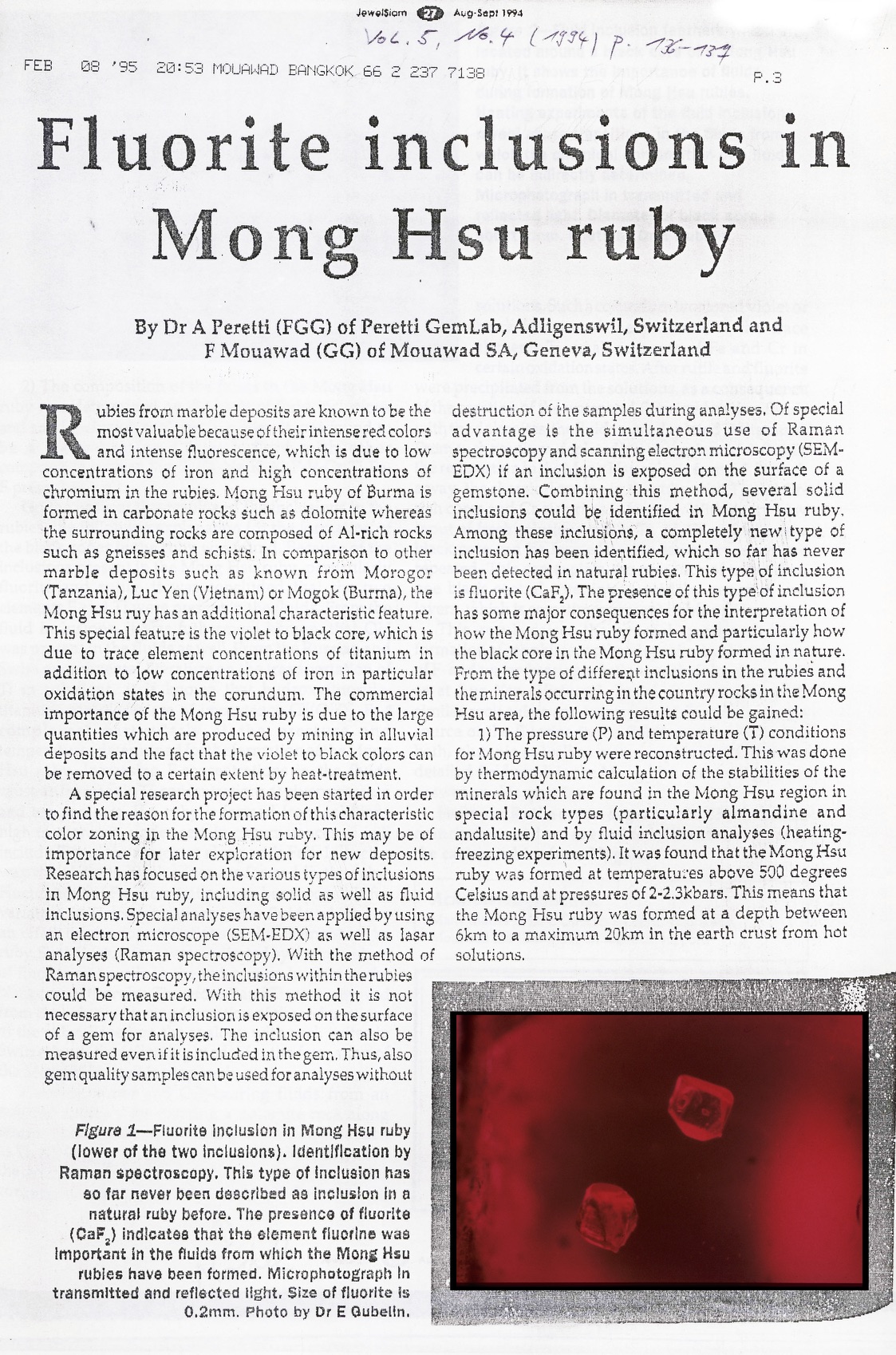
Fluorite inclusions in Mong Hsu ruby

Journal Article
Peretti, A. and Mouawad, F. (1994) Fluorite inclusions in Mong Hsu ruby. JewelSiam, Vol. 5, No.  4, Aug/Sept, pp. 136–137.
Record No. 4939  |  ISBN/ISSN: 8581843  |  Sinkankas/Born No.: NIS/NIB  |  RWHL
Fluorite inclusions are reported in ruby from Mong Hsu, Myanmar, and their implications for ruby formation and characteristic violet-to-black core zoning are examined. The authors describe fluorite as an inclusion not previously identified in natural ruby and relate its occurrence to fluorine-bearing fluids involved in crystallisation within dolomitic host rocks. Solid inclusions were investigated by Raman spectroscopy and scanning electron microscopy with energy-dispersive X-ray analysis. Raman spectroscopy permitted identification of inclusions enclosed within intact gemstones, while the complementary electron microscope method was applicable to inclusions exposed at the surface. Mineral stability calculations involving associated rocks, particularly almandine and andalusite, together with heating and freezing experiments on fluid inclusions, indicated formation above 500 °C at pressures of approximately 2–2.3 kbar. The mineralising fluid is interpreted as water-bearing and rich in carbon dioxide, with dissolved components including fluorine, titanium, aluminium, chromium and vanadium. Fluorite and rutile inclusions provide evidence for fluorine and titanium in this fluid; rutile is described as discrete grains approximately 0.05 mm across rather than the exsolved silk familiar in Mogok ruby. Drawing on experimental studies of titanium transport, the authors propose that hydroxyl–fluoride complexes enabled titanium to be carried in solution under the inferred conditions. Changes in fluorine concentration would consequently affect titanium transport and incorporation into growing corundum. In the proposed model, externally derived fluids entered fractures in dolomite and reacted with the host rock, precipitating corundum containing titanium, chromium, vanadium and minor iron. Titanium and iron in particular oxidation states are invoked to explain the violet-to-black zones. Subsequent precipitation of rutile and fluorite depleted the fluid in titanium, allowing red ruby to grow from fluid that remained rich in chromium. Renewed influxes of titanium-bearing fluid could repeat the sequence, producing several dark zones separated by red growth. The observations therefore connect inclusion mineralogy with changing fluid chemistry as a possible explanation for Mong Hsu colour zoning. The authors suggest that related processes may be relevant to sapphire formation elsewhere, while leaving the ultimate plutonic or metamorphic source of the fluorine unresolved pending further field investigation.

Heat treated corundums of Sri Lanka: Their heat treatment
Journal Article
Pemadasa, T.G. and Danapala, M.V. (1994) Heat treated corundums of Sri Lanka: Their heat treatment. Australian Gemmologist, Vol. 18, No. 11, August, pp. 346–347.
Record No. 4935  |  Sinkankas/Born No.: NIS/NIB  |  RWHL
Heat-treatable Sri Lankan corundum is classified according to its appearance, color distribution, and response to heating under reducing or oxidizing conditions. The account draws on the authors’ experience using a Sri Lankan Lakmini furnace fueled by butane and oxygen. Gueda, commonly understood as semitransparent to translucent rough corundum with a silky, milky, or smoky appearance, was frequently discarded before Thai buyers began purchasing it for conversion into valuable blue sapphire. By the time of publication, more than 200 treatment furnaces were operating in Sri Lanka. Two principal treatment groups are distinguished. Group I comprises gueda and ottu, heated under reducing conditions to develop or redistribute blue coloration. Gueda is divided into silky, milky, waxy, dun, and diesel varieties, although treatment details are provided for only the first four. Silky gueda contains finely dispersed rutile and must also show a brownish appearance in transmitted light to produce good blue sapphire; the recommended treatment is one hour at 1,900 °C. Milky gueda is treated for 30 minutes at 1,850 °C, while nearly transparent dun gueda is treated for 10 minutes at 1,750 °C. Waxy gueda is recognized by its waxy luster and brownish internal impurities. Ottu denotes clear corundum with localized blue coloration that may spread through the stone during treatment, typically for 20 minutes at 1,750 °C. Sharply bounded blue areas are considered favorable indicators, whereas blurred boundaries predict a poorer response. Ottu subdivisions distinguish internal blue dots, lines, or larger patches from coloration restricted to the surface. Group II comprises bluish ruby, red gueda, and Kowangu yellow sapphire, treated under oxidizing conditions to remove blue coloration, reduce inclusions, or enhance yellow color. Bluish ruby is heated at 1,000 °C for one hour, extended to two hours for stones containing dark blue patches. Red gueda is treated at 1,500 °C for two hours, or four hours when distinct silk is present, to improve ruby or pink sapphire. Kowangu sapphire is heated for approximately 30 minutes at 1,800 °C to produce yellow sapphire; initially orange material may yield orange or occasionally padparadscha coloration. The classification links practical selection criteria with treatment schedules tailored to particular varieties of Sri Lankan corundum.

Gem News: Feldspar with ruby inclusions
Journal Article
Koivula, J.I., Kammerling, R.C. and Fritsch, E. (1994) Gem News: Feldspar with ruby inclusions. Gems & Gemology, Vol. 30, No. 4, Fall, p. 274.
Record No. 4891  |  ISBN/ISSN: 0016626X  |  Sinkankas/Born No.: NIS/NIB  |  RWHL

An examination of Chatham flux-grown synthetic pink sapphires
Journal Article
Kammerling, R.C., Koivula, J.I. and Fritsch, E. (1994) An examination of Chatham flux-grown synthetic pink sapphires. Journal of Gemmology, Vol. 24, No. 3, July, pp. 149–154.
Record No. 4824  |  ISBN/ISSN: 221252  |  Sinkankas/Born No.: NIS/NIB  |  RWHL
The gemological, spectroscopic, and chemical characteristics of newly marketed Chatham flux-grown synthetic pink sapphires are documented through examination of four faceted stones weighing 2.73–4.19 ct and microscopic study of an 884 ct crystal. The material is essentially a lighter-toned counterpart of Chatham synthetic ruby. The faceted specimens are transparent, evenly colored, and medium light to medium purplish pink with fairly high saturation; the large crystal has comparable hue and saturation but a darker tone. Refractive indices are 1.768 and 1.759, birefringence is 0.009, and specific gravity ranges from 3.99 to 4.00. Dichroic colors are purplish pink and orange-pink. All specimens appear strongly red through a Chelsea filter and show absorption lines consistent with natural and synthetic ruby and pink sapphire. Long-wave and short-wave ultraviolet radiation produce essentially equally strong orange-red fluorescence with a weakly to moderately chalky overtone, without phosphorescence. This response differs from Chatham synthetic ruby, which generally fluoresces more strongly under long-wave radiation. Flux inclusions near the crystal’s surface fluoresce green, while deeper inclusions appear yellow, probably through combination with the host’s red fluorescence. Microscopic examination reveals primary flux inclusions ranging from large, granular masses to rows of minute droplets along growth steps. In two faceted stones, apparent primary flux particles form delicate intersecting rows producing a grid-like pattern, previously undocumented by the authors in synthetic gem materials and resembling arrangements of negative crystals in some natural spinels. Secondary flux inclusions occur as partially healed fingerprints, predominantly with undulating forms. Metallic inclusions include individual platelets, clusters of small rods and platelets, and dendritic formations; one stone contains a phantom layer of triangular and hexagonal platelets. Energy-dispersive X-ray fluorescence detects chromium, trace iron, and platinum in addition to aluminum. Platinum is attributed to the growth crucible and supports identification of the metallic inclusions. Chromium concentrations range from 0.027 to 0.200 wt.% Cr₂O₃, without an obvious relationship to specimen color, even after considering size differences. Most properties resemble those of other Chatham flux-grown corundums, while the ultraviolet response and unusual grid-like inclusions are noteworthy distinctions. Inclusions provide diagnostic evidence for separating these synthetic pink sapphires from natural material.

Synthetische Rubine aus Griechenland

Synthetic rubies from Greece
Journal Article
Henn, U. and Milisenda, C.C. (1994) Synthetische Rubine aus Griechenland. [Synthetic rubies from Greece] Zeitschrift der Deutschen Gemmologischen Gesellschaft, Vol. 43, No. 1/2, pp. 15–17.
Record No. 4811  |  Sinkankas/Born No.: NIS/NIB  |  Language: In German  |  RWHL
Describes a newly marketed synthetic ruby produced by the Douros firm in Piraeus, Greece. The material has the physical properties of corundum, while microscopic examination reveals residual flux inclusions characteristic of growth by the flux method. These internal features provide evidence of its synthetic origin.

Jadeitites, albitites and related rocks from the Motagua Fault Zone, Guatemala
Journal Article
Harlow, G.E. (1994) Jadeitites, albitites and related rocks from the Motagua Fault Zone, Guatemala. Journal of Metamorphic Geology, Vol. 12, pp. 49–68.
Record No. 4406  |  Sinkankas/Born No.: NIS/NIB  |  RWHL
Jadeitites from Guatemala occur as weathered blocks within tectonized serpentinite in a 15-km zone north of the Motagua Fault Zone. Rock types associated with jadeitite include albitites, albite-mica rocks, omphacite/taramitic amphibole-bearing metabasites, chlorite-actinolite schists, talc-carbonate rocks and antigorite schists. In addition to the predominant jadeitic (Jd₉₃–₁₀₀) pyroxene, common phases in jadeitite include micas (paragonite and/or phengite ± rarer phlogopite), omphacite, albite, titanite, zircon, apatite and graphite. Conditions of jadeitite formation are 100–400°C, 5–11 kbar with 0.0 > log₁₀ aSiO₂ ≥ −0.7. Fluid inclusions, coarse textures, vein structures and rhythmic zoning of pyroxene indicate that an aqueous fluid was involved. Jadeitites are either (1) metasomatic modifications of former felsic-to-pelitic inclusions that have undergone silica depletion plus efficient soda exchange and enrichment, or (2) solution precipitates derived from such a source. The close spatial relationship of faults and shear zones, serpentinites and jadeitites suggests that jadeitites formed in a relatively high-P/T setting with substantial flow of sodic fluid in a tectonized zone. Most Guatemalan jadeitites are extensively altered to analcime, albite, taramitic amphibole, (clino)zoisite ± nepheline and preiswerkite. This alteration reflects depressurization/heating to below the jadeite + fluid = analcime reaction at high aNa. With progressive alteration, analcime and nepheline are replaced by albite; the increase in silica content may result from fluid flowing up a tectonized zone reaching saturation with an albite assemblage. Albitite phases, albite, actinolite, zoisite, chlorite, phengite, K-feldspar and quartz record conditions of c. 3–8 kbar at T < 400°C, indicating a clockwise P–T trajectory of the blocks. Barium aluminosilicates—banalsite, celsian, cymrite and hyalophane—are common minor late-stage phases in jadeitites and albite-rich rocks. Barian phengite is common in albite-mica rocks.

Kashan makes a comeback

Journal Article
Laughter, T. (1994) Kashan makes a comeback. JewelSiam, Vol. 5, No. 1, February/March, pp. 79–83.
Record No. 1174  |  ISBN/ISSN: ISSN: 08581843  |  Sinkankas/Born No.: NIS/NIB  |  RWHL
The renewed availability of Kashan flux-grown synthetic ruby in Bangkok is reported through a laboratory encounter with Steve Ruyle of Kuruvinda Corporation, who stated that his company had purchased the remaining stock from Trueheart Brown and his wife, Nancy. The material included tabular rough with V-shaped notches left by removal of seed crystals, together with faceted stones in colours ranging from pink and purplish red to orange-red and deep red. Laughter highlights the risk that synthetic rubies matching natural material in colour and size may enter parcels of small stones or jewellery without disclosure. Anecdotes concerning the sale of synthetic rough to cutters and substitution within a Bangkok jewellery factory illustrate the practical difficulty of detecting such mixing when individual examination is neglected or considered uneconomic. A historical account describes the development of Kashan ruby under Brown, its promotion by Aris A. Mallas, and the company’s bankruptcy in 1984 following internal disputes. Particular attention is given to ambiguous marketing terminology and promotional claims that cast doubt on gemmologists’ ability to distinguish Kashan products from natural ruby. An illustrated identification section counters these claims by showing characteristic inclusions that usually permit separation with a microscope and fibre-optic illumination, while acknowledging that exceptionally clean specimens may require more sophisticated testing. Directional lighting reveals fine flux particles arranged in nearly parallel streams, described as “rain”, and concentrations forming “comet tails”. Although these particles may superficially resemble natural rutile silk, their arrangement differs from the intersecting orientations at 60° and 120° typical of silk in natural ruby. Other illustrated features include aligned flux-filled cavities with crazed surface textures, occasional gas bubbles enclosed in solid flux, and gaps in flux linings that can mimic bubbles in two-phase inclusions. Straight or angular colour zoning and narrow, straight growth lines are also documented, together with a large primary flux-filled negative inclusion. The article combines a warning about undisclosed synthetic ruby in the marketplace with practical photomicrographic guidance, emphasising that characteristic internal features commonly provide an effective means of identification.

A new type of synthetic ruby from Russia
Journal Article
Henn, U. (1994) A new type of synthetic ruby from Russia. Australian Gemmologist, Vol. 18, No. 11, pp. 362–364.
Record No. 964  |  Sinkankas/Born No.: NIS/NIB  |  RWHL
A Russian synthetic ruby submitted in 1993 to the German Foundation for Gemstone Research is characterised by standard gemmological testing, microscopy, visible absorption spectroscopy, and chemical analysis. Although reportedly produced hydrothermally in Novosibirsk, the specimen is identified as a product of flux synthesis. The investigation is placed within the expanding supply of Russian synthetic gemstones following the political and economic changes in the former Soviet Union, with a table summarising materials and production methods previously reported from the region. Earlier Russian rubies had included both flux-grown and hydrothermal products. The examined crystal weighed 138 carats, had a boule-like shape, and was dark red, showing distinct purplish-red and orange-red pleochroism. Macroscopic examination revealed dark dendritic inclusions and a metallic coating over a small surface area. Measured refractive indices were 1.762 and 1.770, with birefringence of 0.008 and specific gravity of 4.00. Fluorescence was strong red under long-wave ultraviolet radiation and weak red under short-wave radiation. Immersion microscopy revealed opaque black flux residues with characteristic dendritic forms; dark-field illumination showed their polycrystalline nature. A second inclusion type consisted of clouds of bubble-like flux residues within partly healed cavities, resembling features described in Knischka synthetic rubies from Austria. Polarised visible absorption spectra displayed pronounced chromium-related lines and bands, including a line at 692 nm. Broad absorption maxima occurred at 545 and 409 nm for light polarised parallel to the crystallographic c-axis, and at 554 and 400 nm for perpendicular polarisation. Scanning electron microscopy with energy-dispersive X-ray analysis gave a composition of 98.61 wt.% aluminium oxide and 1.39 wt.% chromium oxide. Tungsten and molybdenum were detected in the metallic surface coating and in fractures where dendritic inclusions reached the surface. These flux-related elements and the diagnostic inclusion structures establish flux growth despite the reported hydrothermal origin. The physical properties and chemical composition otherwise fall within the ranges of synthetic rubies from other producers, making the microscopic and inclusion-chemical evidence central to recognising the material’s growth method.

Origin determination for gemstones: Possibilities, restrictions and reliability

Journal Article
Hänni, H.A. (1994) Origin determination for gemstones: Possibilities, restrictions and reliability. Journal of Gemmology, Vol. 24, No. 3, July, pp. 138–148.
Record No. 954  |  ISBN/ISSN: 221252  |  Sinkankas/Born No.: NIS/NIB  |  RWHL
Examines the scientific basis, practical requirements and limitations of determining the geographical origin of gemstones, emphasising that locality names should describe provenance rather than colour or quality. Hänni distinguishes a gemstone’s deposit of origin, whether primary or secondary, from commercial associations attached to names such as Myanmar, Kashmir or Pailin. Deposits produce variable material, and visually similar stones can occur in different regions; consequently, appearance alone cannot establish origin. Reliable attribution requires characteristics that support a proposed source while excluding alternatives, preferably through at least three independent diagnostic features involving inclusions, spectroscopy and trace-element composition. The paper relates such characteristics to the conditions of crystal formation, including available constituents, growth rate, fluid chemistry, oxidation state, temperature, pressure and deformation history. These processes influence growth zoning, twinning, colour distribution, mineral and fluid inclusions, healed fissures and trace-element patterns. Methods reviewed include microscopy in air and immersion, microthermometry, ultraviolet–visible and infrared spectroscopy, energy-dispersive X-ray fluorescence, electron-microprobe analysis, scanning electron microscopy, Raman spectroscopy and magnetic-resonance techniques. Their complementary roles range from documenting internal structures to identifying enclosed minerals and measuring chemical differences among gemstone populations. Particular importance is assigned to comprehensive reference collections of securely sourced specimens, analytical records, geological information and current literature. Ideally, comparison material should be collected directly from deposits; where this is impossible, reliable museum or historical collections may provide alternatives. Reference collections must represent variation within individual sources as well as differences between them. Examples demonstrate that features once regarded as exclusive can lose diagnostic status: three-phase inclusions formerly associated principally with Colombian emeralds also occur in material from Australia and Nigeria, requiring additional chemical evidence. Attribution is restricted when stones lack diagnostic features, properties overlap among deposits, jewellery settings obstruct examination, source information is inadequate or heating has destroyed useful evidence. Political borders may divide geological deposits, while individual countries may contain several distinct sources, complicating the wording of conclusions. Origin determinations therefore remain expert opinions expressing the most probable interpretation of available evidence. Their reliability depends on equipment, experience, continually revised reference data and prudent interpretation. Where observations are insufficient or ambiguous, the author argues that a definite origin report should not be issued.

Exploring the Literature of Gemstone Inclusions

The literature of gemstone inclusions covers identification, origin determination, treatments, synthesis, mineral inclusions, fluid inclusions and other internal features of natural and synthetic gems.

For a curated selection of important sources, read Inclusions in Gemstones — Hyperion Literature Sources.

About Four Treasures

Four Treasures is Lotus Gemology's freely accessible gemological reference database. Use the full database to search by author, title or keyword and explore literature on gemology, mineralogy, jewelry and related fields. Where available, hyperlinks on titles may lead directly to the full publication.

Search the Complete Four Treasures Database