Gemstone Inclusions Bibliography

Gemstone Inclusions Bibliography

Explore books, articles and historical sources on inclusions in gemstones in Four Treasures, the Lotus Gemology reference database. This bibliography brings together matching records from the collection, with publication details, abstracts and cover images where available.

Gemstone Inclusion References

The list below matches the terms inclusion or inclusions in the database's searchable fields. Some references discuss inclusions as part of a broader subject.
861–880 of 1,354 matching references

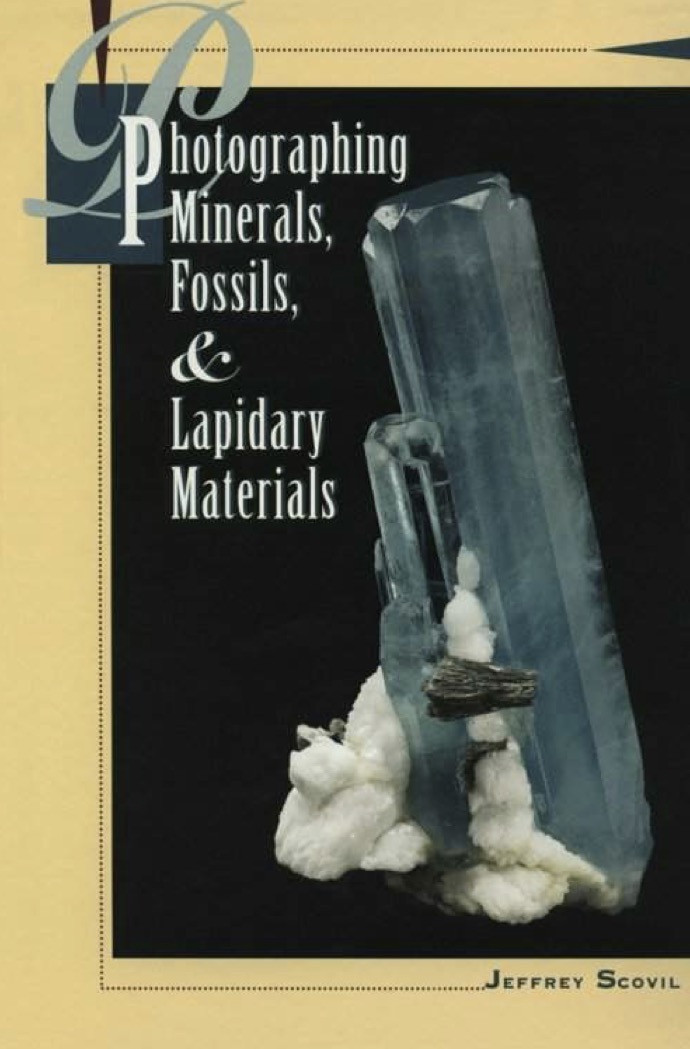
Photographing Minerals, Fossils, and Lapidary Materials
Book
Scovil, J.A. (1996) Photographing Minerals, Fossils, and Lapidary Materials. Tucson, Geoscience Press, 224 pp.
Record No. 16794  |  ISBN/ISSN: 09450052I0  |  Sinkankas/Born No.: NIS/NIB  |  RWHL
J.A. Scovil provides a practical guide to photographing mineral specimens, fossils, gemstones, jewellery and other lapidary objects, integrating technical instruction with aesthetic considerations and the requirements of accurate documentation. The book begins by distinguishing photography intended primarily for identification or cataloguing from more interpretive presentation, while showing how careful composition can serve both purposes. Specimen selection, orientation, framing, cleaning, support and scale establish the foundation for successful images. Equipment chapters address cameras, lenses, vibration control, medium- and large-format systems, film selection, exposure measurement and filtration within a predominantly film-based workflow. Lighting receives sustained attention as the principal means of revealing crystal form, surface texture, colour, transparency and internal features. Direct, transmitted, darkfield and coaxial illumination are explained alongside scanning-light techniques and light painting, with guidance on combining main and fill lights, reflectors, highlights and background illumination. Background materials and their placement are considered in relation to reflections, shadows, contrast and visual separation. Close-up methods cover macro lenses, supplementary lenses, extension tubes, bellows and reversed lenses, emphasizing the relationships among magnification, working distance, perspective, depth of field and specimen orientation. Separate chapters extend these principles to photomicrography, stereophotography and ultraviolet-excited fluorescence photography. Fluorescence work requires particular attention to excitation and barrier filters, unwanted reflected light, exposure bracketing and film colour shifts during long exposures. Applications to lapidary materials address the reflective surfaces of carvings, cabochons, faceted gems and jewellery, together with specialized methods for recording inclusions, optical effects and growth features. The fossil chapter places greater emphasis on unambiguous scientific illustration, using lighting direction to reveal relief and texture and discussing ways to improve contrast between specimens and matrix. Practical advice includes recording dimensions and carat weights, protecting delicate or valuable subjects, organizing equipment for work away from the studio and preparing clear slide presentations. Photographs, diagrams and examples demonstrate how changes in orientation, illumination and setup alter the information communicated by an image. Appendices describe useful homemade devices and supply sources, supplemented by a glossary, bibliography and index. Throughout, Scovil advocates deliberate experimentation and control of individual variables, treating the photographer as an interpreter whose choices should convey the specimen’s distinctive character without compromising the intended accuracy of its representation.

New inclusions in Pakistani peridot: Vonsenite-luwigite needles
Journal Article
Peretti, A. and Gübelin, E.J. (1996) New inclusions in Pakistani peridot: Vonsenite-luwigite needles. JewelSiam, January/February, pp. 68–69.
Record No. 5483  |  Sinkankas/Born No.: NIS/NIB  |  RWHL

Compositional characteristics of sapphire from a new find in Madagascar
Journal Article
Milisenda, C. and Henn, U. (1996) Compositional characteristics of sapphire from a new find in Madagascar. Journal of Gemmology, Vol. 25, No. 3, July, pp. 177–184.
Record No. 5158  |  ISBN/ISSN: 221252  |  Sinkankas/Born No.: NIS/NIB  |  RWHL
Milisenda and Henn describe the geological setting, gemological properties, inclusions and chemical composition of blue sapphires from the newly commercialized Andranondambo occurrence in southeastern Madagascar. The deposit lies approximately 100 km north of Fort Dauphin, within altered marbles and calc-silicate gneisses of the Tranomaro formation. These rocks belong to a high-grade metamorphic terrain extensively reworked during the Pan-African event. Regional geochronological evidence leads the authors to infer that corundum formation accompanied granulite-facies metamorphism approximately 600 million years ago. Sapphires are recovered with simple hand tools from small pits in residual gravels, and the occurrence is considered promising for commercial development. Studied samples are slightly to moderately included and commonly display conspicuous colour zoning, with intense blue concentrated in broad central bands. Alternating darker and paler layers and growth structures follow basal and bipyramidal planes. Heat treatment can substantially reduce the visible zoning and improve appearance. Crystal fragments preserve rhombohedral and pyramidal forms consistent with metamorphic sources, contrasting with the etched or partly dissolved surfaces often associated with basalt-transported corundum. Refractive indices are 1.761–1.763 and 1.769–1.771, maximum birefringence is approximately 0.008, and specific gravity ranges from 3.91 to 3.98. Distinct to strong dichroism combines green-blue and violet-blue hues. All samples are inert under long-wave ultraviolet radiation; most are also inert under short-wave radiation, although weak greenish-blue or uneven orange fluorescence occurs occasionally. Polarized absorption spectra show ferric-iron features and iron–titanium intervalence charge transfer responsible for blue colour. The approximately 850 nm absorption commonly observed in sapphires from basaltic sources is absent. Preliminary microprobe work identifies apatite, calcite, dolomite and an incompletely characterized clay mineral among the inclusions. Other features include probable mica platelets, apatite associated with parallel hollow tubes, negative crystals, healed fractures containing fluid inclusions and occasional lamellar twinning. Electron microprobe analyses of three sapphires identify iron as the principal trace constituent, followed by titanium, with smaller measurable amounts of silicon, gallium and chromium. The combined evidence closely resembles that of metamorphic sapphires from Sri Lanka and Myanmar, supporting the classification of Andranondambo as a significant new source of metamorphic blue sapphire.

Alkali basalts and associated volcaniclastic rocks as a source of sapphire in eastern Australia
Journal Article
Oakes, G.M., Barron, L.M. and Lishmund, S.R. (1996) Alkali basalts and associated volcaniclastic rocks as a source of sapphire in eastern Australia. Australian Journal of Earth Sciences, Vol. 43, pp. 289–298.
Record No. 4930  |  Sinkankas/Born No.: NIS/NIB  |  RWHL
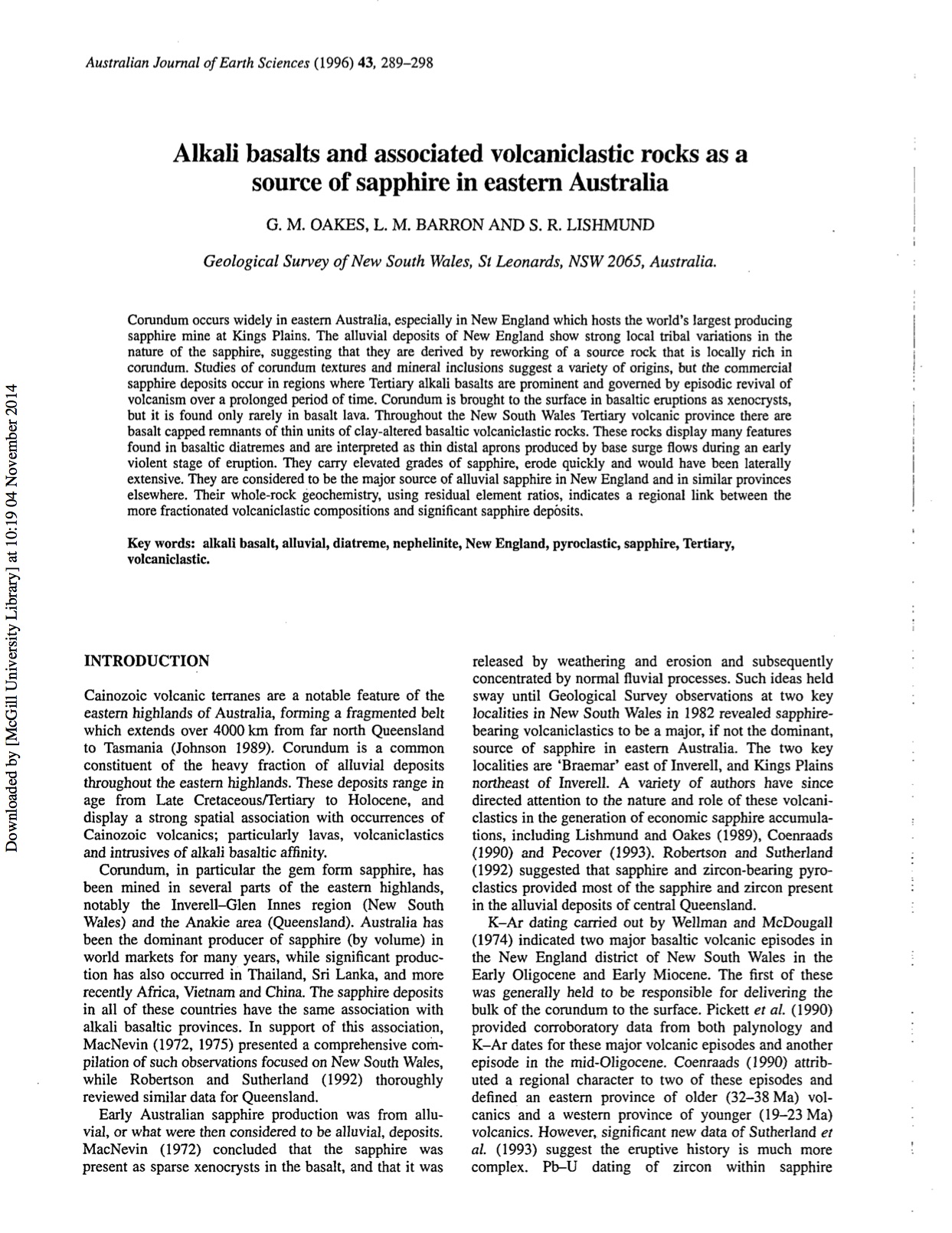
Corundum occurs widely in eastern Australia, especially in New England which hosts the world's largest producing sapphire mine at Kings Plains. The alluvial deposits of New England show strong local tribal variations in the nature of the sapphire, suggesting that they are derived by reworking of a source rock that is locally rich in corundum. Studies of corundum textures and mineral inclusions suggest a variety of origins, but the commercial sapphire deposits occur in regions where Tertiary alkali basalts are prominent and governed by episodic revival of volcanism over a prolonged period of time. Corundum is brought to the surface in basaltic eruptions as xenocrysts, but it is found only rarely in basalt lava. Throughout the New South Wales Tertiary volcanic province there are basalt capped remnants of thin units of clay-altered basaltic volcaniclastic rocks. These rocks display many features found in basaltic diatremes and are interpreted as thin distal aprons produced by base surge flows during an early violent stage of eruption. They carry elevated grades of sapphire, erode quickly and would have been laterally extensive. They are considered to be the major source of alluvial sapphire in New England and in similar provinces elsewhere. Their whole-rock geochemistry, using residual element ratios, indicates a regional link between the more fractionated volcaniclastic compositions and significant sapphire deposits.

An unusual ruby-sapphire-sapphirine-spinel assemblage from the Tertiary Barrington volcanic province, New South Wales, Australia
Journal Article
Sutherland, F.L. and Coenraads, R.R. (1996) An unusual ruby-sapphire-sapphirine-spinel assemblage from the Tertiary Barrington volcanic province, New South Wales, Australia. Mineralogical Magazine, Vol. 60, pp. 623–638.
Record No. 4904  |  Sinkankas/Born No.: NIS/NIB  |  RWHL
Ruby–sapphire–sapphirine–spinel forms small, corroded, crystalline aggregates in corundum-bearing alluvials shed from the Tertiary Barrington basalt shield volcano. Sapphirine is near a 7:9:3 (MgO–Al₂O₃–SiO₂) composition and, together with the corundum, shows reaction rims of pleonaste spinel. Spinel in the aggregates has a compositional range Sp 68–73 Hc 27–29 Cm 0–3. The aggregates give new insights into the ruby–sapphire source rocks. Potential origins include metamorphic recrystallization of aluminous material (below 1460 °C) or high temperature–high pressure crystallization reactions related to lamprophyric or basaltic magmas (up to 1300 °C and 20 kbar). Sapphirine–spinel thermometry suggests final crystallization temperatures for the aggregates around 780 to 940 °C and reaction with host magmas at over 1000 °C. The Barrington gemfield includes two distinct corundum suites. One, typical in eastern Australia, is dominated by blue–green, well-crystallized, growth-zoned sapphire, commonly containing rutile silk and Fe-rich spinel inclusions (Hc 51–73, Mt 18–35, Mf 6–8, Usp 2–6). The other, an unusual suite, is dominated by ruby and pastel-coloured sapphires, with little crystal shape or growth zonation and restricted mineral inclusions, mostly chromian pleonaste and pleonaste. The ruby–sapphire–sapphirine–spinel aggregates provoke new thoughts on the origin of rubies and sapphires and their indicator minerals in eastern Australian and southeastern Asian volcanic gemfields.

Zircon inclusions in corundum megacrysts: I. Trace element geochemistry and clues to the origin of corundum megacrysts in alkali basalts
Journal Article
Guo, J., O’Reilly, S.Y. and Griffin, W.L. (1996) Zircon inclusions in corundum megacrysts: I. Trace element geochemistry and clues to the origin of corundum megacrysts in alkali basalts. Geochemica et Cosmochimica Acta, Vol. 60, No. 13, pp. 2347–2363.
Record No. 4819  |  Sinkankas/Born No.: NIS/NIB  |  RWHL
Zircons enclosed in corundum megacrysts from basalts exhibit a short prismatic habit dominated by the {110} prism over {100}, consistent with crystallization from alkaline–peralkaline environments. Occasional zircon decomposition textures hint at the presence of a primary SiO₂ phase in the source paragenesis. These zircons are geochemically distinctive, with elevated contents of Y (up to 1.2%), U (UO₂ to 1.7 wt%), Th (ThO₂ exceeding 2 wt%), Hf (up to 3.4 wt%), and total REEs (up to 5000 ppm), and they show extreme REE fractionation, particularly enriched in HREEs (30–100× chondritic Sm and 5000–20000× chondritic Lu). Evaluated zircon/silicate melt partition coefficients indicate that the parental melts of these zircon inclusions had concave-down REE patterns peaking near 100× chondritic Sm, reflective of highly evolved melts formed after extensive low-Ca feldspar fractionation. These findings support that corundum megacrysts crystallized from highly evolved, alkaline melts under very reducing conditions, and were not high-pressure phenocrysts crystallized directly from mafic host magmas.

Nuclear microscopy of rubies: Trace-elements and inclusions
Journal Article
Osipowicz, T., Tay, T.S., Orlic, I., Tang, S.M. and Watt, F. (1995) Nuclear microscopy of rubies: Trace-elements and inclusions. Nuclear Instruments and Methods in Physics Research B, Vol. B104, pp. 590–594.
Record No. 27061  |  DOI: https://doi.org/10.1016/0168-583X(95)00433-5  |  Sinkankas/Born No.: NIS/NIB  |  RWHL
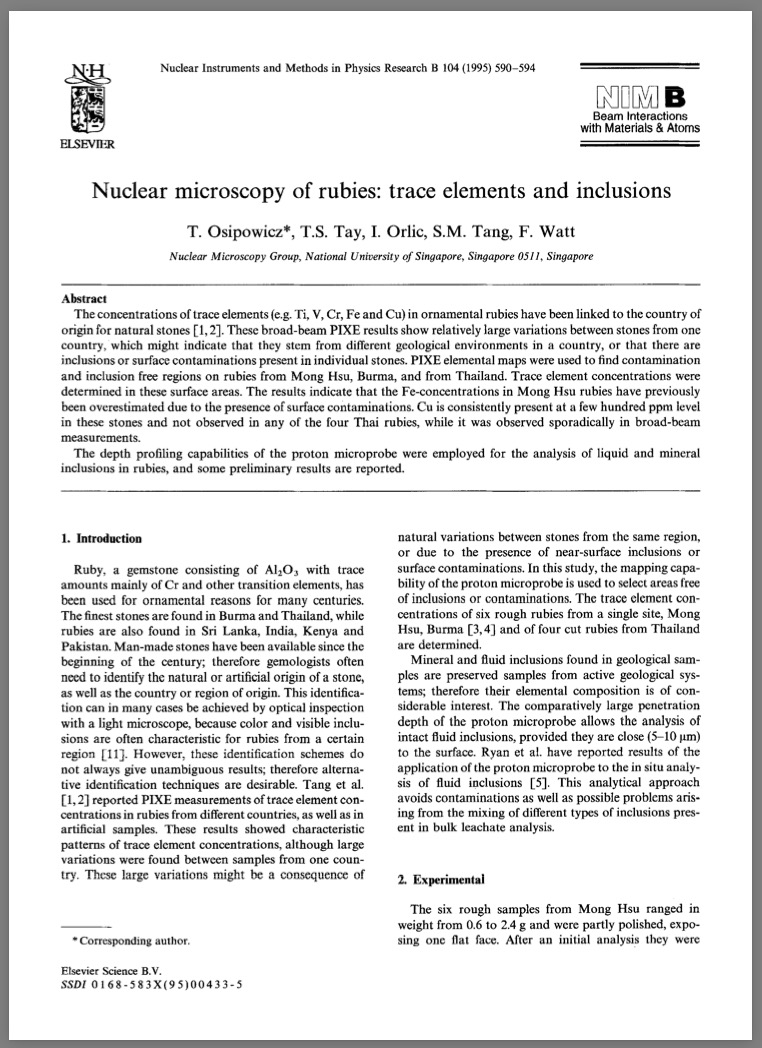
The concentrations of trace elements (e.g. Ti, V, Cr, Fe, and Cu) in ornamental rubies have been linked to the country of origin for natural stones [1,2]. These broad-beam PIXE results show relatively large variations between stones from one country, which might indicate that they stem from different geological environments in a country, or that there are inclusions or surface contaminations present in individual stones. PIXE elemental maps were used to find contamination- and inclusion-free regions on rubies from Mong Hsu, Burma, and from Thailand. Trace element concentrations were determined in these surface areas. The results indicate that the Fe concentrations in Mong Hsu rubies have previously been overestimated due to the presence of surface contaminations. Cu is consistently present at a few hundred ppm level in these stones and not observed in any of the four Thai rubies, while it was observed sporadically in broad-beam measurements. The depth profiling capabilities of the proton microprobe were employed for the analysis of liquid and mineral inclusions in rubies, and some preliminary results are reported.

A Roman signet-ring set with an emerald from Brackley, Northamptonshire
Journal Article
Babb, L. and Henig, M. (1995) A Roman signet-ring set with an emerald from Brackley, Northamptonshire. Journal of the British Archaeological Association, Vol. 148, No. 1, pp. 171–172.
Record No. 26471  |  DOI: https://doi.org/10.1179/jba.1995.148.1.171  |  Sinkankas/Born No.: NIS/NIB  |  RWHL
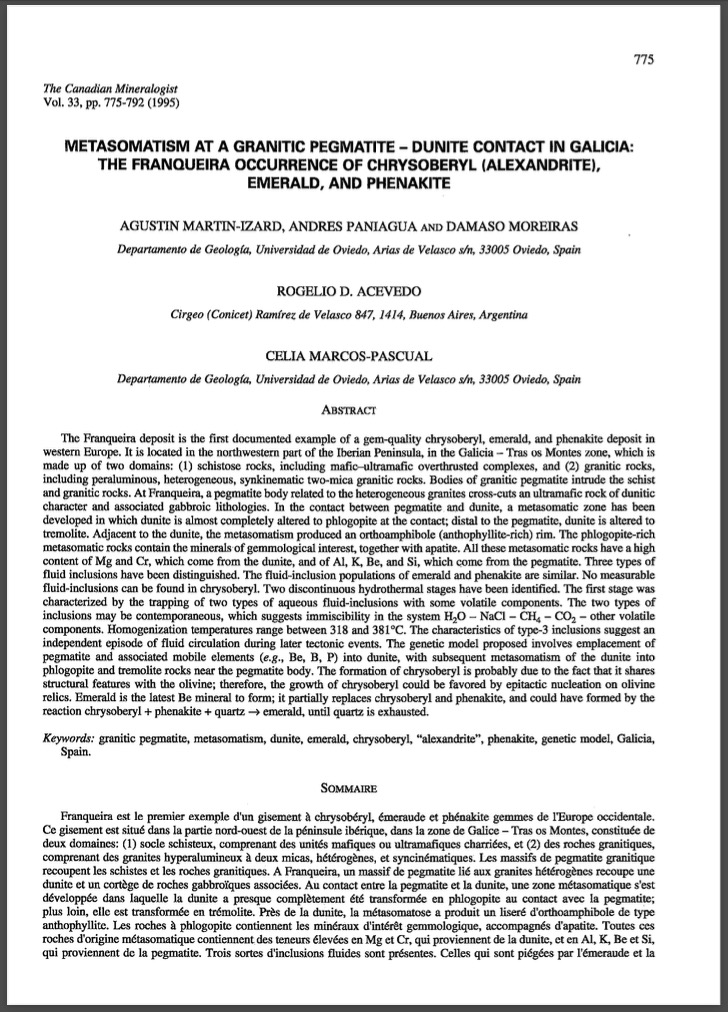
A Roman gold signet-ring (Pl. XXb) was discovered in 1974 in a garden at Brackley, Northamptonshire, and was later submitted by the finder for examination at the Buckinghamshire County Museum, Aylesbury. The find-spot, located in Watery Lane, lies just north of a building that has yielded pot-sherds, tile, brick, slate, tesserae, and flint—suggesting a possible villa, though Roman activity appears widespread in the area, indicating the building may have been part of a larger settlement. The ring is made of high-purity ancient gold and features a hoop with a rounded section that expands from 3 mm at its narrowest point to 6.5 mm at the bezel; its external width is 18 mm (internal width 12 mm) and its height, including the stone, is 16 mm (internal height 11 mm). Set into the bezel is a green translucent stone with dark inclusions, initially believed to be a chrome-rich chalcedony (plasma), as is common in Britain, but identified through X-ray fluorescence analysis by the British Museum Research Laboratory as an emerald. Known in antiquity as smaragdus, emeralds were highly prized though rarely engraved due to their hardness—making this the first known emerald intaglio from Roman Britain. The gem, which has a convex profile and measures 8 mm by 5 mm, is engraved with the image of the corn-goddess Ceres (Greek, Demeter), sometimes conflated with the Roman Fides Publica on coins. She is depicted standing frontally, dressed in a belted chiton, holding two heads of corn in her left hand and a dish of fruit in her right—an image that would appear in reverse in impression (Pl. XXc).

Metasomatism at a granitic pegmatite-dunite contact in Galicia: The Franqueira occurrence of chrysoberyl (alexandrite), emerald, and phenakite
Journal Article
Martin-Izard, A., Paniagua, A., Moreiras, D., Acevedo, R.D. and Marcos-Pascual, C. (1995) Metasomatism at a granitic pegmatite-dunite contact in Galicia: The Franqueira occurrence of chrysoberyl (alexandrite), emerald, and phenakite. Canadian Mineralogist, Vol. 33, pp. 775–792.
Record No. 8108  |  Sinkankas/Born No.: NIS/NIB  |  RWHL
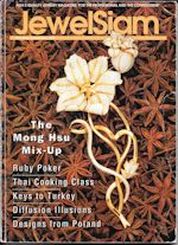
The Franqueira occurrence in Galicia, northwestern Spain, is described as the first documented western European deposit containing gem-quality chrysoberyl (alexandrite), emerald, and phenakite. Mineralogical, whole-rock geochemical, electron-microprobe, and fluid-inclusion studies establish its geological setting, metasomatic zonation, and probable formation conditions. Narrow granitic pegmatite dikes associated with peraluminous, synkinematic, heterogeneous two-mica granites intrude dunite and associated gabbroic rocks interpreted as remnants of overthrust ophiolitic complexes. Interaction between pegmatite-derived fluids and dunite produced phlogopitite adjacent to the dikes, tremolitite farther away, and an anthophyllite-rich zone near the remaining dunite. The dunite supplied magnesium and chromium, whereas the pegmatite supplied water, silicon, aluminium, potassium, beryllium, boron, and phosphorus. Chrysoberyl, phenakite, and emerald occur in the phlogopitite with apatite and other accessory minerals. Alexandrite crystals reach approximately 1 cm and display the characteristic change from green in daylight to reddish under incandescent illumination; colourless phenakite crystals reach 3 cm, and emerald crystals reach 30 cm. Textural relationships indicate that chrysoberyl and phenakite formed before emerald, which partially replaces both minerals and encloses their skeletal remnants. Early chrysoberyl growth may have been favoured by epitactic nucleation on residual olivine because of structural similarities between the two minerals. Emerald formation is interpreted in terms of increasing silica activity, potentially involving reaction between chrysoberyl, phenakite, and quartz until quartz was exhausted. This interpretation remains qualified because the natural system involved fluid addition, competing mineral reactions, and conditions departing from equilibrium. Microthermometry of 125 fluid inclusions in emerald and phenakite distinguishes three inclusion types and two separate hydrothermal episodes; inclusions in chrysoberyl were too small for measurement. The earlier episode involved methane-bearing and carbon-dioxide-bearing aqueous fluids, with homogenization temperatures of 318–381 °C. Their characteristics suggest contemporaneous trapping of immiscible fluids in a complex water–salt–volatile system. Combined fluid-inclusion and phase-equilibrium considerations favour gemstone formation at approximately 380–420 °C and pressures of 1–2 kbar. A later episode is recorded by secondary aqueous inclusions containing mixed salts, with homogenization temperatures of 160–265 °C, and is attributed to fluid circulation during subsequent tectonic events. Possible contributions from magmatic, metamorphic, connate, or meteoric waters require isotopic confirmation. The proposed genetic model emphasizes transfer of pegmatitic components into dunite and places Franqueira among suture-zone emerald deposits. Comparable contacts between beryllium-bearing pegmatites and chromium-rich ultramafic rocks elsewhere in the Galicia–Trás-os-Montes zone are identified as promising exploration targets.

Lab Report: Cat’s eye blue sapphire; synthetic ruby crystal; irradiated orange star sapphire
Journal Article
Du Toit, G., Charoensrithanakul, S., Dunaigre, C., Gawenuntavong, S., Phattayakul, J. and Virunhapol, V. (1995) Lab Report: Cat’s eye blue sapphire; synthetic ruby crystal; irradiated orange star sapphire. JewelSiam, Vol. 6, No. 5, Oct–Nov, pp. 62–63.
Record No. 4760  |  ISBN/ISSN: 8581843  |  Sinkankas/Born No.: NIS/NIB  |  RWHL

Lab Report: Synthetic flux rubies; color change sapphires; irradiated yellow star sapphire; synthetic hydrothermal ruby
Journal Article
Du Toit, G., Charoensrithanakul, S., Dunaigre, C., Gawenuntavong, S., Phattayakul, J. and Virunhapol, V. (1995) Lab Report: Synthetic flux rubies; color change sapphires; irradiated yellow star sapphire; synthetic hydrothermal ruby. JewelSiam, Vol. 6, No. 4, Aug–Sept, pp. 106–110.
Record No. 4758  |  ISBN/ISSN: 8581843  |  Sinkankas/Born No.: NIS/NIB  |  RWHL

Lab News: Spinel, natural with a dendritic inclusion
Journal Article
Johnson, M.L. (1995) Lab News: Spinel, natural with a dendritic inclusion. Gems & Gemology, Vol. 31, No. 1, Spring, p. 58.
Record No. 4137  |  ISBN/ISSN: 0016626X  |  Sinkankas/Born No.: NIS/NIB  |  RWHL

GIA Gem Trade Lab Notes: Spinel, with högbomite(?) inclusions
Journal Article
Johnson, M.L. (1995) GIA Gem Trade Lab Notes: Spinel, with högbomite(?) inclusions. Gems & Gemology, Vol. 31, No. 4, Winter, p. 272.
Record No. 4134  |  ISBN/ISSN: 0016626X  |  Sinkankas/Born No.: NIS/NIB  |  RWHL

Mineralogy, Geochemistry, and Geochronology of the Yogo Dike Sapphire Deposit, Montana
Thesis
Gauthier, G. (1995) Mineralogy, Geochemistry, and Geochronology of the Yogo Dike Sapphire Deposit, Montana. University of British Columbia, 303 pp.
Record No. 2771  |  Sinkankas/Born No.: NIS/NIB  |  RWHL
The Yogo dike in Montana, part of the ultramafic lamprophyre group, hosts gem-quality blue sapphires and has a complex mineralogy, including phlogopite, clinopyroxene, calcite, analcime, magnetite, and apatite. The sapphires are believed to be xenocrysts—foreign crystals incorporated during magma ascent—due to their resorbed appearance, disequilibrium rims of pleonaste spinel, and supporting mineral inclusions and xenoliths. The dike’s geochemistry aligns most closely with ouachitite but shares traits with damkjernite and aillikite. Sapphires owe their blue color to Fe²⁺–Ti⁴⁺ charge transfer and purple hues to minor Cr. A K-Ar date indicates emplacement around 48 Ma. High-temperature reactions between the magma and Al-rich contaminants likely produced pleonaste. Sapphire grades range from 1–20 ppm, with sizes from 0.33 to 8 carats.

Australian ruby

Journal Article
Webb, G. (1995) Australian ruby. Australian Gemmologist, Vol. 19, No. 2, pp. 61, 63.
Record No. 1821  |  ISBN/ISSN: 49174  |  Sinkankas/Born No.: NIS/NIB  |  RWHL
Webb reports two unusual ruby specimens from the Inverell district of New South Wales, documenting the occurrence of ruby in an Australian gemfield better known for sapphire. The principal specimen is a faceted ruby weighing 1.41 ct, recovered by a fossicker panning in Swan Brook and subsequently retained in the private collection of its cutter. Staff of the Mineral Section of the Australian Museum examined the stone and regarded its combination of colour, quality and size as exceptional for the locality. The accompanying photograph illustrates the finished gem. Webb places this find in the context of other Australian ruby occurrences. Most Australian rubies were reported to come from the Harts Range, where the material is generally opaque and suitable for beads and cabochons. Faceting-quality ruby had also been found in the Barrington Tops area, although mining there had not been consistent. Ruby was described as a rare discovery in the sapphire fields of both Inverell and Anakie, making an attractive faceted example from either district a collector’s item. Examination of the Swan Brook stone established gemmological properties normal for ruby. It showed moderate fluorescence under long-wave ultraviolet radiation and was inert under short-wave ultraviolet radiation. A diffraction-grating spectroscope revealed a characteristic ruby spectrum, including three narrow bands in the blue region. The only inclusions observed were several partially healed fractures confined to a corner of the stone. The note also records an unusually large piece of pale ruby rough from Frazer’s Creek, Inverell, which museum staff had inspected a few weeks before examining the faceted specimen. This second ruby weighed 11.30 ct and was held by a local property owner. Together, the two specimens provide examples of the uncommon ruby component of the Inverell sapphire fields: one notable as a finished gem of unusual quality and the other for its relatively large size as rough. The report documents individual finds rather than sustained ruby production from the district.

Visual characteristics of heat treated corundum
Journal Article
Sechos, B. (1995) Visual characteristics of heat treated corundum. Australian Gemmologist, Vol. 19, No. 2, pp. 69–72.
Record No. 1571  |  ISBN/ISSN: 49174  |  Sinkankas/Born No.: NIS/NIB  |  RWHL
The visual identification of heat treatment in ruby and sapphire is reviewed through changes in ultraviolet fluorescence and the microscopic appearance of inclusions, illustrated by eight photomicrographs. Heating is used to improve clarity by dissolving rutile silk, modify or enhance colour, and sometimes develop asterism in titanium-rich material. Because treatment produces no appreciable changes in refractive index, birefringence, specific gravity, dichroism, or visible absorption spectra, examination of internal features provides the principal means of recognition. Ultraviolet responses offer supplementary evidence. The apricot fluorescence commonly observed in untreated yellow-orange, yellow, and colourless Sri Lankan sapphires is reduced or eliminated by heating. Some heated blue sapphires display patchy, chalky green fluorescence under short-wave ultraviolet light, potentially resembling Verneuil synthetic blue sapphire. In heated natural stones, however, this fluorescence is confined to colourless areas, while blue zones remain inert; the synthetic material is described as fluorescing evenly across its surface. Heated rubies may exhibit unusual patches of chalky white short-wave fluorescence in addition to their normal red response. Microscopic indicators include partial dissolution of rutile needles, thermal alteration of included crystals, and modification of secondary fluid inclusions. Long, continuous rutile needles oriented in the characteristic directions of corundum are presented as evidence of an untreated stone, although remnants of silk may survive heating. Unequal thermal expansion can produce roughly circular, glassy tension fractures around included crystals, sometimes with rims indicating incipient healing. Crystals may become white, rounded “snowballs”, develop surrounding zones of melted material, or form negative crystals containing colourless or brown glass. In rubies, these altered inclusions may occur within partially healed fractures. Heating can also remove reddish orange staining from secondary fluid inclusions and transform their tubular liquid channels into strings of droplets that follow the original pathways. Surface diffusion treatment is considered separately because its colour is concentrated in a shallow surface layer that may be removed by repolishing. Diagnostic features include stronger colour at the girdle and facet edges, unequal colour concentration between facets, and colour extending into surface-reaching fractures or around inclusions connected to them. These features are most readily examined by immersion in methylene iodide under a microscope with diffused illumination; a dark-field arrangement fitted with a diffuser can reveal many of the same characteristics when immersion is unavailable. The article emphasises practical recognition using ordinary gemmological magnification, ultraviolet examination, and immersion techniques.

GIA Gem Trade Lab Notes: Large synthetic ruby
Journal Article
Reintiz, I. (1995) GIA Gem Trade Lab Notes: Large synthetic ruby. Gems & Gemology, Vol. 31, No. 3, Fall, p. 203.
Record No. 1474  |  ISBN/ISSN: 0016626X  |  Sinkankas/Born No.: NIS/NIB  |  RWHL
This past summer, a manufacturer of synthetic corundum shared the Czochralski-pulled synthetic ruby shown in figure 20 with staff mem-bers of the East Coast lab. The modi-fied triangular mixed cut weighed 115.56 ct and was completely trans-parent, with a strong red color that had no purple or brown components. Although natural ruby may be found in large sizes, it usually contains so many inclusions that the diaphaneity is translucent rather than transparent, One area of the pavilion of this large synthetic showed fine curved striae, but otherwise it was free of inclusions or variations in color. Because of the large size and trans-parency, a slight doubling of the pavilion facet junctions-a rare sight in corundum, which has low birefrin-gence-was visible through the table. The manufacturer of this synthetic ruby reports that he is using a new process in which growth is controlled on a scale of several inches, with the goal of producing material that is entirely free of inclusions or disrup-tions of the crystal structure (such as twinning or graining) up to sizes as large as 500+ ct.

Gem Trade Lab Notes: Synthetic sapphire, color-change with twin lamellae
Journal Article
Kammerling, R.C. (1995) Gem Trade Lab Notes: Synthetic sapphire, color-change with twin lamellae. Gems & Gemology, Vol. 31, No. 2, Summer, p. 127.
Record No. 1075  |  ISBN/ISSN: 0016626X  |  Sinkankas/Born No.: NIS/NIB  |  RWHL
An unusual colour-change synthetic sapphire demonstrates that twin lamellae, although commonly associated with natural corundum, cannot independently establish natural origin. The specimen, examined at the GIA Gem Trade Laboratory’s West Coast facility in November 1994, was a transparent emerald-cut stone weighing 1.43 ct and measuring approximately 6.85 × 5.73 × 3.80 mm. It appeared bluish green under daylight-equivalent fluorescent illumination and pinkish purple under incandescent light. This behaviour resembled that of the vanadium-doped, flame-fusion synthetic sapphires frequently submitted to the laboratory, sometimes in the mistaken belief that they are natural or synthetic alexandrite. Such synthetic corundum is normally identified without difficulty by a vanadium-related absorption band near 474 nm and curved growth striae visible under magnification with darkfield illumination. In the reported specimen, initial binocular microscopic examination revealed neither solid mineral inclusions nor cavities such as gas bubbles or negative crystals. Instead, a conspicuous series of laminated twin planes was readily visible through the table facet. Although the author emphasises that twinning does not prove natural origin, its presence could have encouraged that interpretation because it is an uncommon feature in flame-fusion synthetic corundum. Continued examination from different directions resolved the apparent contradiction: observation through the pavilion facets revealed curved striae, establishing the stone’s synthetic origin. The note places this finding alongside earlier published accounts of polysynthetic twinning in Verneuil corundum and reviews other atypical internal features that can complicate identification. These include undissolved alumina, triangular cavities containing gas bubbles and needle-like inclusions. Their occurrence shows that synthetic corundum may contain features that differ from the familiar curved striae and rounded bubbles expected in routine examination. The principal diagnostic lesson is therefore methodological: an identification should not rest on the first inclusion or structural feature observed. All internal characteristics must be evaluated together, and the gemstone should be examined from several viewing angles before a conclusion is reached. In this case, the combination of unusual twinning with diagnostic curved growth striae illustrates the importance of a thorough microscopic investigation.

Gem Trade Lab Notes: Cat’s-eye sapphire
Journal Article
Kammerling, R.C. (1995) Gem Trade Lab Notes: Cat’s-eye sapphire. Gems & Gemology, Vol. 31, No. 2, Summer, pp. 126–127.
Record No. 1074  |  ISBN/ISSN: 0016626X  |  Sinkankas/Born No.: NIS/NIB  |  RWHL
An unusual natural cat’s-eye sapphire examined by the GIA Gem Trade Laboratory demonstrates chatoyancy produced by aligned fluid inclusions rather than the rutile needles commonly responsible for asterism in corundum. The specimen, submitted to the West Coast laboratory for identification in early 1995, was a semitransparent oval cabochon weighing 1.91 ct and measuring 13.99 × 5.19 × 2.54 mm. It had a mottled greenish blue colour and displayed a distinct cat’s-eye effect across its domed surface. Standard gemmological testing established its identity as natural sapphire. The note places the observation in the context of the relative frequency of optical phenomena in corundum: asterism is fairly common, whereas chatoyancy is encountered only rarely. In the laboratory’s experience, an apparent cat’s-eye effect in either natural or synthetic corundum usually results from the orientation chosen during cutting of an asteriated stone. When the star’s axis is positioned off-centre, only one ray extends across the cabochon dome, giving the appearance of a single eye. Microscopic examination of the submitted sapphire revealed a different explanation. The stone contained almost no needle-like rutile crystals, prompting investigation of other internal features capable of producing the observed effect. Instead, it contained numerous approximately planar, mutually parallel, liquid-filled inclusions described as fingerprints. The accompanying photomicrograph illustrates these as parallel liquid-filled channels. Light scattering from this aligned inclusion system was identified as the cause of chatoyancy. Examination also revealed diffuse colour halos surrounding crystal inclusions, which were interpreted as evidence that the sapphire had undergone heat treatment. The report therefore documents both an uncommon inclusion-related optical effect and microscopic evidence of treatment in the same natural stone. Its principal finding is that a distinct eye in sapphire can originate from parallel fluid-filled structures, providing an alternative to the more usual explanation involving the cutting orientation of a star-bearing corundum cabochon.

New extension of Mong Hsu ruby deposit

Journal Article
U Tin Hlaing (1995) New extension of Mong Hsu ruby deposit. Australian Gemmologist, Vol. 19, No. 2, p. 51.
Record No. 991  |  ISBN/ISSN: 49174  |  Sinkankas/Born No.: NIS/NIB  |  RWHL
A newly discovered ruby occurrence approximately 10 km north of the intensively worked Mong Hsu deposit in Myanmar is described as a possible extension of that field. The unnamed locality lies about two and a half hours’ walking distance from Mong Hsu along mountain ranges. Preliminary information derives from specimens collected in mid-December 1994 by a gemmology student from Taunggyi University, together with subsequent reports from the area. A bulk sample weighing 570 carats contained ruby and several associated minerals. Tourmaline accounted for approximately 10% of the sample, while quartz, pyrite, tremolite and bismutite were also recorded. Reports of pegmatite veins dipping westwards at approximately 25–30° contrast with the eastward dips of 20–25° cited for Mong Hsu. The note records this structural difference without establishing the geological relationship between the two occurrences. Two promising ruby specimens were fashioned into cabochons and produced attractive stones of better quality than initially anticipated. No characteristic inclusions had been recognised in the specimens examined at the time of reporting. Most ruby crystals were broken and sharp-edged, ranging from flesh red to brick red and from translucent to nearly opaque. Their surfaces displayed pits and etched lines filled with iron oxides. Dark cores resembling those familiar in Mong Hsu ruby were observed, providing one point of comparison with the established deposit. The sample also included complete, dark, lustrous prismatic crystals. Accessory crystals occurred on ruby prism faces, predominantly oriented parallel to those faces, although some projected outwards. Green tourmaline was recovered as an additional component of the assemblage, with the largest reported piece weighing three carats. As of April 1995, an exploratory party from the government Department of Geological Survey and Mineral Exploration was investigating the locality to assess its potential as a future ruby resource. The account presents an early description of the material’s appearance, associated minerals and reported structures, while leaving the proposed extension and its commercial significance subject to further exploration.

Exploring the Literature of Gemstone Inclusions

The literature of gemstone inclusions covers identification, origin determination, treatments, synthesis, mineral inclusions, fluid inclusions and other internal features of natural and synthetic gems.

For a curated selection of important sources, read Inclusions in Gemstones — Hyperion Literature Sources.

About Four Treasures

Four Treasures is Lotus Gemology's freely accessible gemological reference database. Use the full database to search by author, title or keyword and explore literature on gemology, mineralogy, jewelry and related fields. Where available, hyperlinks on titles may lead directly to the full publication.

Search the Complete Four Treasures Database