Explore books on gems, gemology, jewelry and mineralogy in Four Treasures, the Lotus Gemology reference database. This bibliography brings together matching book records from the collection, with publication details, abstracts and cover images where available.
Gemology Book References
The list below matches books concerning gemology and related subjects in the database's searchable fields. Some works cover several branches of gems, jewelry or mineralogy.
2,841–2,860 of 3,630 matching references
Gemstone inclusions
Journal Article
Gübelin, E.J. (1944–46) Gemstone inclusions.Gems & Gemology, Vol. 4–5, Vol. 4, No. 10, Summer, pp. 142–149 (sapphire); No. 11, Fall, pp. 158–163 (ruby); No. 12, Winter, pp. 174–179 (emerald); Vol. 5, No. 1, Spring, pp. 205–210 (diamond); No. 5, Spring, p. 294–300; No. 6, Summer, pp. 318–323 (various gems).
This illustrated series presents gemstone inclusions as practical evidence for identification, distinguishing natural from synthetic stones, and interpreting the conditions under which gems formed. Drawn from Gübelin’s photomicrographic studies and a collection of Kodachrome transparencies supplied to the Gemological Institute of America, the installments combine explanatory text with photographs and descriptive captions. Microscopic examination, particularly with dark-field illumination, reveals structures that may be overlooked or misinterpreted with a loupe. The sapphire section illustrates oriented needles and silk, angular growth zoning, mineral crystals, fluid cavities, and featherlike networks. Examples include hematite plates, enclosed corundum crystals, and cavities containing liquid and gas. These features are compared with curved growth striae and gas bubbles in synthetic sapphire. Gübelin cautions that appearances can be deceptive: natural cavities may resemble bubbles, while the curvature of synthetic growth lines may be difficult to recognize within a small field of view. The ruby installment similarly contrasts natural rutile arrangements, straight structural features, mineral inclusions, and fluid-related formations with curved striae and concentrations of gas bubbles in synthetic material. Zircon inclusions surrounded by halos and intersecting rutile needles illustrate characteristic internal features of individual specimens from Sri Lanka and Myanmar. The emerald section describes enclosed crystals, irregular cavities, and inclusions containing liquid, gas, and a solid phase, while comparing these with wispy formations and other internal features observed in synthetic emeralds. The diamond installment demonstrates the importance of illumination when interpreting dark inclusions: objects commonly regarded as black or carbonaceous may prove to be transparent crystals when examined appropriately. Photographs show enclosed crystals, including diamond, together with cleavage features and fractures associated with inclusions or extending inward from the surface. Subsequent installments broaden the survey to additional sapphires and other gem materials. Illustrated examples include fine networks of channels, negative crystals, mineral plates, zircon-associated halos, liquid inclusions with mobile bubbles, and cavities containing separate liquids. Topaz and tourmaline provide further examples of fluid-bearing inclusions, while the concluding selection extends the illustrated material to emerald, peridot, quartz, garnet, and moldavite. Biotite flakes in peridot and fibrous actinolite in quartz demonstrate the variety of solid inclusions; a fluid-bearing negative crystal in citrine reproduces the host’s prismatic form. Throughout the series, the diagnostic value lies in the combined character, arrangement, and appearance of internal features rather than in an isolated resemblance. Gübelin advocates making inclusion study an early part of gem examination, potentially preceding routine measurements of physical and optical properties. The series also emphasizes the scientific and aesthetic interest of microscopic structures, presenting gemstone interiors as records of mineral growth and subsequent events as well as aids to identification.
American-made synthetic crystals
Journal Article
Seemann, A.K. (1944) American-made synthetic crystals.Gems & Gemology, Vol. 4, No. 9, Spring, pp. 129–133.
Gübelin investigates microscopic criteria for distinguishing emeralds from Colombia and Russia’s Ural Mountains, arguing that color alone provides an unreliable indication of origin. Although Colombian emeralds are associated with a velvety green and Russian stones with more yellowish hues, examples from either source may resemble those from the other, particularly in small sizes. A comparative table records their appearances through several colored filters, but the author emphasizes that interpreting these subtle differences requires considerable experience, a sensitive eye, and suitable comparison material. Seeking more objective evidence, he examined numerous emeralds of known provenance, including specimens supplied by the Colombian Consulate in Paris. He identifies minute fluid inclusions, rather than conspicuous fractures or cloudy areas, as the most useful distinguishing features. Colombian emeralds are described as containing scattered, irregular groups of delicate, frequently tail-like cavities. Their boundaries are faint, suggesting that the enclosed liquid has a refractive index relatively close to that of the host. The liquid’s composition was not established, although behavior during heating and considerations of formation led the author to suggest water. The cavities show no consistent crystallographic orientation and remain separate even when grouped. Almost every cavity is reported to contain a tiny cubic crystal, commonly adjoining a rounded gas bubble with a dark outline, so that solid, liquid, and gaseous phases coexist within one inclusion. Carbon dioxide is proposed as the gas, while the solid’s chemical identity remains unresolved. Gübelin regards the cubic form of this solid inclusion as the principal diagnostic feature of Colombian material. Russian emeralds likewise contain multiphase inclusions, but their distribution, cavity shapes, and enclosed crystals differ. Their cavities are more closely associated with fractures and moss-like internal features, lack the characteristic Colombian tails, and contain solid crystals displaying lozenge-shaped or rhombic outlines rather than clearly rectangular cubic forms. The author presents this contrast as a dependable means of separating the two sources and supplies a mnemonic linking Colombian origin with cubic crystals and Russian origin with rhombic crystals. He recommends photomicrography to document the observations and notes that the features can also be examined with a diamondscope. The concluding discussion separates geographical interest from intrinsic quality: identifying a fine emerald as Russian need not diminish its value, while knowledge of provenance may increase an owner’s appreciation of either a Colombian stone or an unusually fine-colored Ural specimen.
Medieval American Art
Book
Kelemen, P. (1943)Medieval American Art. New York, Macmillan, 2 Vols., 414, 33 pp., 306 plates
Record No. 28775 | Sinkankas/Born No.: 3348; NIB | RWHL
Sinkankas: Ch. 8, p. 283–311, on “Jade and other semiprecious stones,” with illustrations for the same being in the plates volume, Pls. 235–58 (not seen). Most of this text treats jade, its nature, types, and artistic significance, then describes the many objects depicted according to their artistic merits. Other gemstones are rock crystal, turquoise, obsidian, serpentine, amber, calcite onyx, and cryptocrystalline quartz varieties.
Explorations in the Motagua valley, Guatemala
Journal Article
Smith, A.L. and Kidder, A.V. (1943) Explorations in the Motagua valley, Guatemala.American Anthropology and History, Contributions to American Anthropology and History, No. 41, pp. 101–182.
Record No. 28425 | Sinkankas/Born No.: NIS/NIB | RWHL
Gübelin presents a schematic introduction to gemstone formation and deposits, using a circular diagram and an element-based table to make geological relationships more accessible to students of gemology. He emphasizes that such summaries necessarily simplify a complex subject but can clarify the individuality of gemstones, guide the practical study of deposits, and provide a foundation for further investigation. The classification distinguishes primary mineral formation from ascending solutions, termed magmatic in a broad sense, from secondary growth and concentration associated with decomposition, sedimentation, and metamorphism. Primary processes are subdivided into liquid-magmatic, pegmatitic and pneumatolytic, and hydrothermal and volcanic-exhalative categories. Secondary categories comprise chemical sediments derived from the atmosphere or hydrosphere, residual deposits produced through decomposition and metamorphism, and mechanically concentrated sediments, particularly alluvial deposits. The circular diagram places deposit types outside the circumference and representative gem materials within the corresponding sectors. Minerals occurring in more than one geological setting cross sector boundaries; corundum, spinel, and garnet are specifically identified as examples with multiple modes of occurrence. Related minerals are grouped according to chemical composition or paragenesis, while the more important gem materials receive typographical emphasis. Gübelin explains that the diagram favors practical usefulness over strict genetic classification. Thus, amber and jet are placed among metamorphic formations, while pearls and corals appear among chemical sediments, although he explicitly recognizes their organic origin. The accompanying table develops the survey through chemical elements, linking important minerals with magmatic, sedimentary, residual, and metamorphic settings. It includes familiar gems such as spodumene, tourmaline, beryl, chrysoberyl, corundum, diamond, quartz, opal, zircon, turquoise, and garnet, together with less common ornamental minerals and several metallic minerals. Separate columns indicate the different processes through which these materials may form or become concentrated. Notes draw attention to the production of aluminum-rich residues by weathering and their subsequent metamorphic transformation, the role of atmospheric carbon in carbonates and organic materials, and the redistribution of certain minerals into alluvial deposits. The inclusion of rare elements requires reference to some uncommon gem materials, but the author stresses that neither the mineral list nor the deposit classification is exhaustive. Together, the diagram and table offer a condensed teaching aid connecting gemstone chemistry, mineral associations, formation processes, and economically relevant occurrences, intended as a starting point for more detailed geological study.
The chemical compounds of some liquid inclusions
Journal Article
Gübelin, E.J. (1943) The chemical compounds of some liquid inclusions.Gems & Gemology, Vol. 4, No. 6, Summer, pp. 82–86; No. 7, Fall, pp. 98–100.
Gübelin investigates the composition of fluid inclusions in gemstones through microscopic observation during heating and cooling, relating their phase behavior to the conditions of gem formation. He reviews earlier work by David Brewster, R.Th. Simmler, H. Vogelsang, H. Geissler, H.C. Sorby, and P.J. Butler, emphasizing evidence for water and carbon dioxide in cavities within quartz, corundum, beryl, topaz, and other minerals. The experimental method uses heat from a diamondscope’s illuminator, regulated through its transformer, together with temperature measurements; further investigations employ a special electric heating furnace attached to a microscope. Inclusions containing a mobile gas bubble are particularly suitable because changes in the liquid–gas boundary can be followed directly. A large negative-crystal inclusion in smoky quartz provides the principal example. As the stone warms, the curved meniscus progressively flattens, the liquid expands, and the bubble diminishes. At a reported temperature of 29.9 ± 0.1 °C, the boundary disappears abruptly; cooling restores the two-phase appearance, sometimes after a transient mist develops within the cavity. Gübelin interprets this behavior as evidence of nearly pure carbon dioxide with minor impurities, comparing the observed transition with the approximately 31 °C critical temperature of pure carbon dioxide. He reports comparable behavior in selected inclusions in Colombian emerald, Ceylon ruby, sapphire, and alexandrite, other beryls, topaz, phenakite, and several quartz varieties. The same response was absent from the tourmaline and chrysoberyl specimens examined, certain topaz inclusions, and some solid-bearing three-phase inclusions in Colombian and Ural emeralds. The continuation discusses cavities containing two distinguishable liquids and a gas bubble. Heating experiments lead the author to identify the liquids as water and liquid carbon dioxide, with water wetting the cavity walls and occupying marginal extensions, while carbon dioxide occupies the central region and contains the gas bubble. From these observations, he proposes a model in which crystals initially grow from aqueous solutions saturated with carbon dioxide under pressure. A sudden pressure release, possibly caused by tectonic movement, induces boiling and the separation of bubbles containing water vapor and carbon dioxide. Rapid subsequent crystal growth traps these bubbles against crystal surfaces. Larger cavities may reproduce an earlier crystal outline, whereas smaller inclusions preserve rounded or elongated bubble shapes. Gübelin also proposes pressure and temperature limits for formation from the phase relationships, presenting these as deductions from his interpretation. He considers the occurrence of carbon dioxide particularly consistent with gems associated with limestone and dolomite. The study presents thermal microscopy as a practical means of investigating inclusion chemistry and developing hypotheses about gemstone genesis.
U.S. develops synthetic sapphire industry
Journal Article
Linde Air Products Co. (1943) U.S. develops synthetic sapphire industry.Gems & Gemology, Vol. 4, No. 6, Summer, pp. 88–91.
This company release describes the establishment of American synthetic sapphire production in response to wartime disruption of European supplies and increasing demand for jewel bearings in military and industrial instruments. Previously dependent on manufacturers in Switzerland, France, and Germany, the United States faced shortages despite stockpiling during 1939 and 1940. In autumn 1940, the government invited qualified domestic companies to develop production, and Linde Air Products Company undertook experimental work leading from a single laboratory furnace to commercial manufacture. The article reports that, eighteen months after beginning, Linde informed the War Production Board that it could supply colorless sapphire in any reasonable quantity. Production was then devoted entirely to essential industrial and military requirements. The manufacturing account outlines the Verneuil process, in which purified alumina powder passes through an oxygen–hydrogen flame and accumulates on a pedestal as a crystalline boule. Appropriate coloring agents produce ruby or colored sapphire, while controlled growth and slow cooling are necessary to obtain usable material. The company describes its progress through experimentation without European specialists available to supervise the work. An illustrated sequence contrasts a shattered, opaque 14-carat boule from December 1940 with the first clear 20-carat product, a representative commercial boule of approximately 200 carats, and an exceptional recent example weighing about 350 carats. Synthetic corundum’s principal advantages for bearings are presented as high hardness, uniformity, and resistance to wear, supporting prolonged accuracy in delicate mechanisms. Regular boule dimensions and relatively defect-free material permit standardized cutting, reduce waste, and offer economies compared with natural sapphire. A comparative table gives Mohs hardness and Knoop microhardness values for several materials, including natural and synthetic sapphire, and records differences according to crystal orientation. The discussion also notes that natural and synthetic corundum share the same basic chemical composition and that coloring agents have little effect on refractive index or specific gravity; small hardness differences require specialized equipment to measure. Although colorless sapphire dominated wartime production, ruby had also been manufactured, and fine colored material had been produced experimentally. Broader production of colored sapphire and synthetic spinel was anticipated after the war. Proposed peacetime applications extend beyond jewelry and bearings to electrical insulators, injector and burner nozzles, thread guides, and special abrasives, drawing on sapphire’s chemical resistance, thermal properties, and dielectric behavior. The release concludes with the expectation that expanded mechanization, domestic cutting, and a growing skilled workforce would establish a lasting American sapphire manufacturing industry.
Archaeological specimens from Yucatan and Guatemala
Journal Article
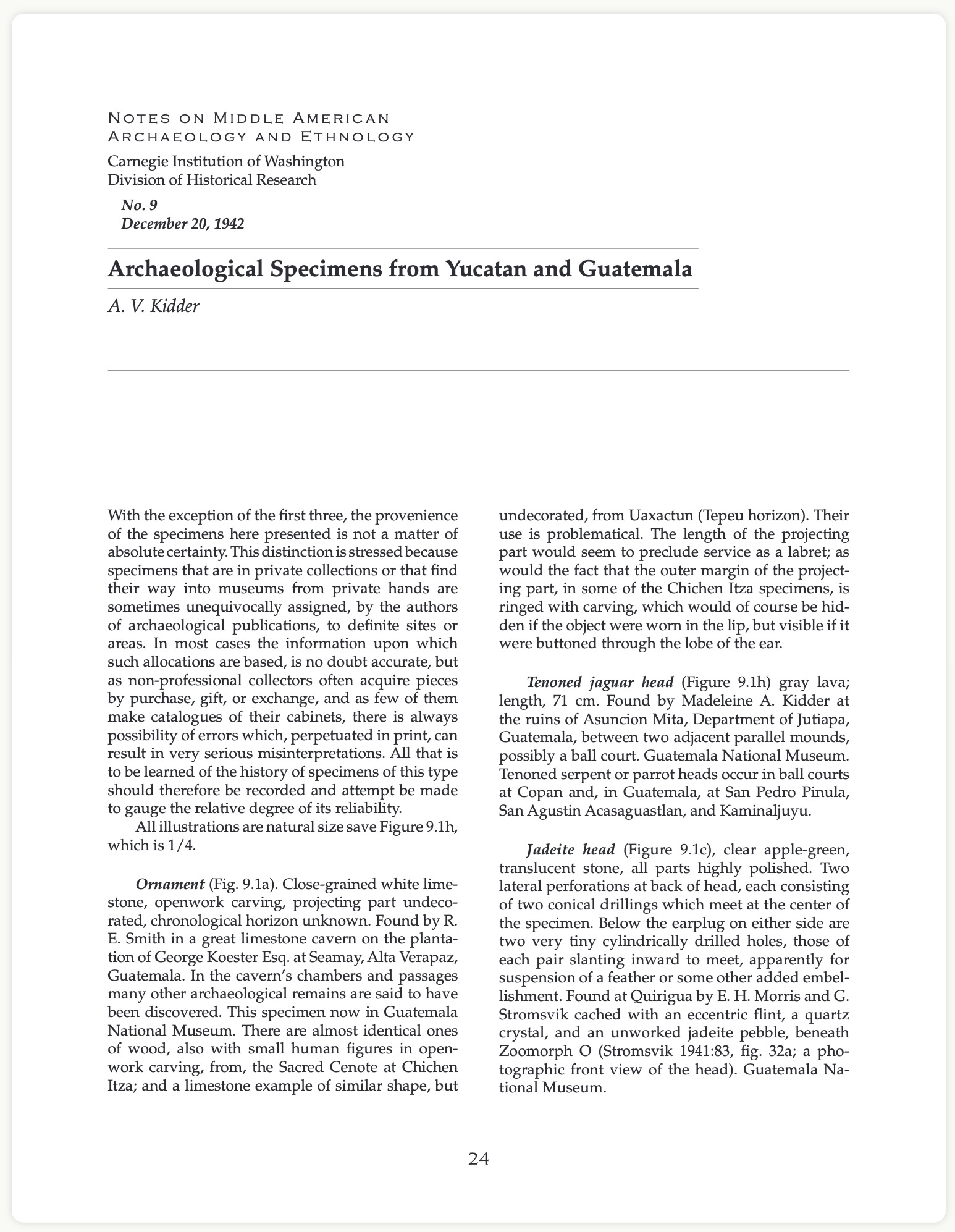
Kidder, A.V. (1942) Archaeological specimens from Yucatan and Guatemala.Notes on Middle American Archaeology and Ethnology, December 20, pp. 24–27.
Record No. 28610 | Sinkankas/Born No.: NIS/NIB | RWHL
With the exception of the first three, the provenience of the specimens here presented is not a matter of absolute certainty. This distinction is stressed because specimens that are in private collections or that find their way into museums from private hands are sometimes unequivocally assigned, by the authors of archaeological publications, to definite sites or areas. In most cases the information upon which such allocations are based, is no doubt accurate, but as non-professional collectors often acquire pieces by purchase, gift, or exchange, and as few of them make catalogues of their cabinets, there is always possibility of errors...
gems, history of gemology, Roman, Rome, Greek, Greece, history of mineralogy, history of science, Arabic mineralogy
Rackham’s Loeb Classical Library edition presents Books 3–7 of Pliny the Elder’s Natural History in parallel Latin and English texts. These books comprise Pliny’s geographical and ethnographical survey of the known world: Books 3–6 describe Europe, Africa, and Asia, including the Mediterranean lands, the Near East, India, and regions beyond, while Book 7 turns to humanity, discussing human characteristics, unusual peoples, remarkable births, longevity, exceptional physical and intellectual abilities, inventions, and other notable features of human life. Pliny draws extensively upon earlier Greek and Roman authorities, travelers, administrators, and geographical writings, preserving a large body of ancient geographical and ethnographic information, often intermingled with reports of marvels and fabulous peoples. For the history of gems and precious materials, these books provide geographical context for the regions from which luxury goods and mineral products reached the Roman world, although Pliny’s systematic treatment of stones and gemstones occurs later in Book 37.
In the Geographical journal for August 1940 I published a brief summary of the ‘Evidence for Ancient Mining’, one illustration for which was taken from a Japanese colour-print by Hiroshigi of the interior of a gold mine. As a result of reading this article, Dr H. J. Osborne White, a well-known geologist, sent me the scroll which forms the subject of the present paper. It is about 22 feet long and I foot broad and illustrates, in a series of attractively coloured drawings, every process from the extraction of gold-ore in the mine on Sado Island to the minting of refined gold. Mr Matsumoto of the Japanese Embassy kindly examined the scroll and was able to translate most of the captions to the pictures and other writings. Though the archaic script sometimes puzzled him, the fact that his family had been connected with mining for several generations was a compensating advantage.
corundum, inclusions.5, Burma.12, Sri Lanka.12, Thailand.12, gems
Gübelin’s three-part study investigates the geographical identification of sapphires from Kashmir, Burma, Siam, and Ceylon, emphasizing microscopic inclusions as records of differing geological conditions. Reference specimens were obtained from selected dealers trading directly with the producing regions, while Ceylon’s fancy-colored sapphires supplied additional comparative material. The introductory discussion reviews characteristic colors, chemical differences, luminescence, refractive indices, and density, but cautions that these properties generally provide indications rather than certain determinations of origin. Comparative emission spectra of Burmese and Ceylon sapphires are interpreted in relation to their iron and titanium contents. Luminescence under cathode rays and ultraviolet radiation varies among the four sources, although exceptions and inconsistent responses limit its diagnostic value. Small differences in refractive index and specific gravity are likewise considered insufficient for confident identification alone. Microscopic examination forms the principal basis of the regional comparisons. Kashmir sapphires exhibit a characteristic haze that resolves under magnification into delicate veils of wavy, intersecting filaments arranged in hexagonal patterns. Gübelin distinguishes these from rutile needles, describing them instead as minute fissures or hollow tubes. Other Kashmir inclusions comprise thin films bordered by irregular networks of liquid-filled channels extending into individual droplets; their appearance changes as the stone is tilted. Burmese sapphires are characterized chiefly by short rutile needles densely distributed or grouped into patches, clouds, and zones. These follow the host’s crystallographic directions and intersect at 60° and 120° when viewed along the optic axis. Larger, well-formed rutile crystals and occasional curved liquid-filled cavities containing mobile gas bubbles are also described. Siamese sapphires are reported to lack rutile and instead contain broad, flat, loop-like fluid inclusions associated with opaque, approximately hexagonal features interpreted as resorbed crystals or negative crystals. Additional characteristics include brown material attributed to iron compounds, recrystallized inclusions in hexagonal arrangements, checkered twinning lamellae, and rows of script-like or arabesque fluid inclusions. Ceylon sapphires display a greater variety and generally less orderly distribution of inclusions. Their rutile needles are notably longer, sparser, and more widely spaced than those in Burmese material. Characteristic fluid feathers and flags comprise numerous tubular or wormlike cavities extending into isolated droplets, often with mobile gas bubbles; Gübelin identifies their liquid as carbon dioxide on the basis of his own investigations. He also describes scattered minute mineral inclusions, broad irregular fluid-filled tubes, and brown zircon crystals surrounded by pleochroic radiation halos. These zircons are regarded as particularly useful indicators of Ceylon origin, whereas accessory minerals occurring across several sources provide less decisive evidence. The study concludes that reliable interpretation requires extensive experience with numerous specimens and that photomicrographs offer a useful means of documenting the observed characteristics.
Genuine type inclusions in new European synthetics
Journal Article
Gübelin, E.J. (1942) Genuine type inclusions in new European synthetics.Gems & Gemology, Vol. 4, No. 2, Summer, pp. 18–21.
Gübelin describes unusual gas inclusions in synthetic corundum and spinel that closely resemble fluid inclusions in natural gems, emphasizing the need to examine their contents and optical behavior rather than identify origin from shape alone. Natural and synthetic corundum have closely similar chemical and physical properties, while differences in refractive index and luminescence may be too small or overlapping to provide decisive evidence. Microscopic characteristics therefore assume particular importance. The author reviews natural corundum’s oriented rutile needles, other mineral inclusions, fluid cavities, and growth structures, contrasting these with the curved striae and rounded gas bubbles commonly associated with synthetic material. He cautions that twinning occasionally occurs in synthetics and that internal cracks near facet junctions can result from strain in either natural or synthetic stones. Recent examinations revealed rare, irregular gas cavities, particularly in blue synthetic sapphires, with elongated, tubular, wormlike, dendritic, and mesh-like forms. Some resemble coarse liquid feathers in natural corundum so closely that they could lead to misidentification. Small accompanying spherical bubbles and, in one illustrated specimen, curved striae exposed by closing the microscope’s iris diaphragm provide additional evidence of synthetic origin. Dark, hazy areas in another sapphire are attributed to localized concentrations of coloring material. Gübelin distinguishes the illustrated gas-filled cavities from natural liquid inclusions by rotating the stone in an immersion cell: the gas inclusions remain black, whereas liquid-filled cavities appear transparent when viewed through their flat sides and may contain a separate gas bubble. He notes that such deceptive forms were uncommon at the time but might become more frequent as manufacturing improved. The discussion then turns to synthetic spinel, whose variable excess of aluminum oxide affects refractive index and specific gravity, limiting reliance on these properties alone. Although curved striae are absent, occasional gas inclusions may likewise be elongated, wormlike, sharply outlined, or apparently oriented. Anomalous double refraction caused by internal strain offers a further means of recognition. Under polarized examination, synthetic spinel displays incomplete extinction and irregular bright and dark patterns, including cloudy, fibrous, feathery, and crosshatched appearances. The author contrasts these with the weaker, indistinct, blotchy anomalous double refraction sometimes observed in natural spinel, commonly associated with solid or fluid inclusions. He also distinguishes the latter from the more checkered patterns seen in garnet. The article concludes that characteristic strain patterns, considered together with inclusion morphology, cavity contents, and other microscopic evidence, permit recognition of synthetic material despite its potentially deceptive resemblance to natural gems.
gems, early lapidaries, early gemology, early mineralogy, Chaucer, history of gemology, nomenclature, lore, medicinal use
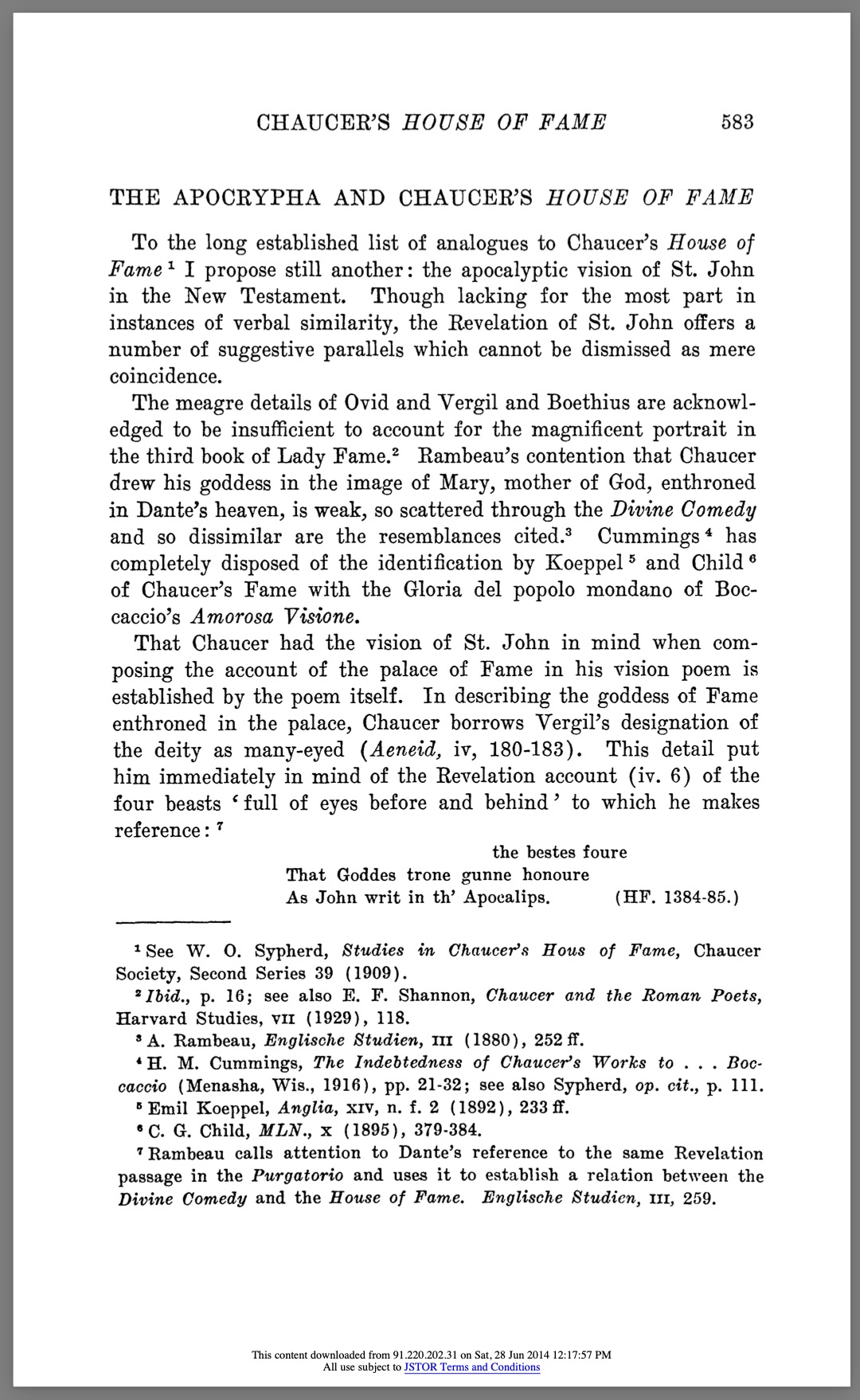
To the long-established list of analogues to Chaucer’s House of Fame, I propose still another: the apocalyptic vision of St. John in the New Testament. Though largely lacking in direct verbal similarities, the Revelation of St. John presents numerous compelling parallels that cannot be dismissed as mere coincidence. The sparse details from Ovid, Vergil, and Boethius are acknowledged to fall short of accounting for the grandeur of Chaucer’s portrayal of Lady Fame in Book III. Rambeau’s argument that Chaucer modeled his goddess on the Virgin Mary as depicted in Dante’s heaven is unconvincing, given how scattered and dissimilar the cited resemblances are. Cummings has thoroughly refuted the identifications by Koeppel and Child of Chaucer’s Fame with the Gloria del popolo mondano in Boccaccio’s Amorosa Visione. Evidence from the poem itself supports the view that Chaucer had the vision of St. John in mind when composing the palace of Fame. In describing the enthroned goddess, Chaucer draws on Vergil’s image of the many-eyed deity (Aeneid IV, 180–183), a detail that recalls the Revelation’s account (IV.6) of the four beasts “full of eyes before and behind,” which Chaucer explicitly references: “the bestes foure / That Goddes trone gunne honoure / As John writ in th’ Apocalips” (House of Fame, 1384–85).
al-Hilālī, T.e.-D. (1941)Die Einleitung zu al-Bīrūnīs Steinbuch: mit Erläuterungen übersetzt. [Introduction To Al-Biruni's Stone Book] Leipzig, Otto Harrassowitz, 41 pp.
Record No. 4571 | Sinkankas/Born No.: NIS/NIB | Language: in German | RWHL
Al-Hilālī presents a German translation, with explanatory notes, of the introduction to al-Bīrūnī’s Kitāb al-Jamāhir fī maʿrifat al-jawāhir (Book of the Multitudes on the Knowledge of Precious Stones), al-Bīrūnī’s major work on gemstones, minerals, and related substances. The introduction sets out al-Bīrūnī’s conception of wealth and precious materials and the principles underlying his treatment of stones and metals, placing their desirability and value within a broader discussion of human needs, luxury, exchange, and the social use of valuable objects. Al-Hilālī supplies philological and explanatory commentary intended to clarify al-Bīrūnī’s terminology and references. The work originated as al-Hilālī’s doctoral dissertation and provides an important German-language study and translation of the introductory portion of one of the principal medieval Islamic sources on gemology and mineralogy.
More about asterism
Journal Article
Halford-Watkins, J.F. (1941) More about asterism.The Gemmologist, Vol. 11, No. 125, December, p. 34.
Record No. 2452 | Sinkankas/Born No.: NIS/NIB | RWHL
Gübelin and Robert M. Shipley, Jr., examine the identification of synthetic emerald following its introduction into the American jewelry trade, including reports of synthetic stones mixed with natural emeralds. Their account draws on five specimens studied by Gübelin and ten examined at the Gemological Institute of America’s Los Angeles laboratory. It discusses the German product marketed by I.G. Farbenindustrie as “Igmerald,” while an editorial note states that the American laboratory’s specimens came from an agent claiming independent manufacture in the United States. Synthetic emerald resembles natural material in color, luster, chemical composition, and crystal form. Unlike the pear-shaped boules associated with synthetic corundum and spinel, it develops as groups of well-formed hexagonal crystals, sometimes large enough to yield fashioned stones exceeding one carat. Straight growth bands parallel to the basal plane may occur, but external appearance and crystal habit provide little assistance in identification. The authors instead advocate combining optical measurements with microscopic examination. Their synthetic specimens show lower refractive indices and birefringence than the natural emeralds tabulated for comparison; representative synthetic values are 1.562–1.564 for the ordinary ray and 1.559–1.561 for the extraordinary ray, giving birefringence of approximately 0.003. Recent synthetic material displays relatively weak dichroism, contrasting with earlier reports of strong dichroism and indicating changes accompanying manufacturing progress. Pronounced anomalous double refraction produces birefringent patches and interference colors, attributed to internal strain probably associated with rapid growth. Previously published Laue photographs are cited as additional evidence of strain. Igmerald also exhibits absorption bands at 594 and 606 nm beyond the chromium-related features discussed for emerald; the authors propose these as diagnostic of that product and tentatively associate them with increased chromium content. Specific gravity is generally lower in synthetic material, but overlapping values limit its usefulness alone. Microscopic inclusions receive particular emphasis as a practical means of distinction. The examined synthetics lack the solid crystalline particles within fluid cavities that the authors associate with natural emerald’s three-phase inclusions. Separate minute solid particles may nevertheless occur in swarms. The most characteristic internal features are delicate featherlike, wispy, or veil-shaped formations resembling cracked lacquer or cloisonné. At approximately 250× magnification, these resolve into numerous small liquid inclusions containing rounded gas bubbles, arranged in broad, slightly curved groups. Nearly parallel rodlike features, interpreted as probable gas-filled cavities, are especially conspicuous in older synthetic material. The authors conclude that the combined evidence of refractive properties, strain patterns, absorption features, and characteristic inclusions permits reliable separation of the synthetic emeralds examined from natural stones, despite their close visual resemblance.
Gemological books range from general identification manuals and textbooks to specialized works on individual gems, mineralogy, jewelry, treatments, synthesis, history and gem-producing regions.
Four Treasures is Lotus Gemology's freely accessible gemological reference database. Use the full database to search by author, title or keyword and explore literature on gemology, mineralogy, jewelry and related fields. Where available, hyperlinks on titles may lead directly to the full publication.