Gemology Books Bibliography

Gemology Books Bibliography

Explore books on gems, gemology, jewelry and mineralogy in Four Treasures, the Lotus Gemology reference database. This bibliography brings together matching book records from the collection, with publication details, abstracts and cover images where available.

Gemology Book References

The list below matches books concerning gemology and related subjects in the database's searchable fields. Some works cover several branches of gems, jewelry or mineralogy.
2,761–2,780 of 3,630 matching references

Magadha, a commercial centre in ancient India
Book Section
Keny, L.B. (1960) Magadha, a commercial centre in ancient India. In: Early Indian Trade and Industry, Calcutta: Calcutta University Press, pp. 25–35.
Record No. 26449  |  Sinkankas/Born No.: NIS/NIB  |  RWHL
View Individual Record ↗
Magadha was a region and kingdom in ancient India, based in the eastern Ganges Plain. It was one of the sixteen Mahajanapadas during the Second Urbanization period. The region was ruled by several dynasties, which overshadowed, conquered, and incorporated the other Mahajanapadas. Magadha played an important role in the development of Jainism and Buddhism and formed the core of the Maurya Empire (ca. 320–185 BCE).

Jade cutting today

Journal Article
Shreve, R.N. (1960) Jade cutting today. Gems & Gemology, Vol. 10, No. 3, Fall, pp. 81–89.
Record No. 3640  |  ISBN/ISSN: 0016626X  |  Sinkankas/Born No.: NIS/NIB  |  RWHL
View Individual Record ↗
R.N. Shreve documents the continuation of traditional Chinese jade carving through observations at Yusuf T.C. Chang’s Treasure Jade Factory in Hong Kong, where fifteen cutters and polishers produce ornamental objects and train apprentices. Chang, who transferred his business and skilled workers from Peking, directs design, assesses the stone, supervises successive operations, and undertakes particularly difficult work himself. Shreve emphasizes the coordination of foot-powered equipment, hand control, visual judgment, and artistic planning that permits individual treatment of each piece. Although motor-driven saws and polishers are available, most workers retain traditional methods, citing control, economy, and reduced material loss. Silicon carbide, or carborundum, supplies a significant modern improvement over older emery abrasives. The article follows production from the purchase of Burmese jadeite boulders at Hong Kong auctions through cutting, designing, hollowing, detailed carving, and polishing. Buyers assess rough material through small polished windows and external characteristics, accepting considerable uncertainty about the interior. Large boulders are commonly divided with abrasive-fed twisted iron wire stretched across a wooden bow, while thinner steel discs reduce the resulting pieces to suitable blocks. Freshly exposed surfaces are wetted to reveal colour, texture, and structural quality before Chang develops a design adapted to the material. Skilled artisans rough out the form using iron discs and drills charged with abrasive. Specialists then bore interior cavities with bow-driven hollow cylinders, remove the cores, enlarge the openings, and free the hanging rings characteristic of many Chinese vessels. These operations require careful handling to avoid breakage and unnecessary waste. The most accomplished carvers execute the final detail, after which finer silicon carbide and usually precipitated alumina produce the finished surface. Water basins facilitate inspection and allow abrasive to be recovered for reuse. Photographs illustrate the tools, working positions, and stages of manufacture. Estimated working times for a ten-inch jadeite vase show the substantial labour involved, including several days for hollowing, ten days for detailed finishing, and five to ten days for smoothing and polishing, followed by preparation of a wooden stand and silk-lined box. Shreve also records work in quartz varieties and other ornamental stones. He presents the workshop as evidence that inherited lapidary skills remained active within a contemporary commercial setting and argues that apprenticeship and the movement of trained artisans could sustain the craft.

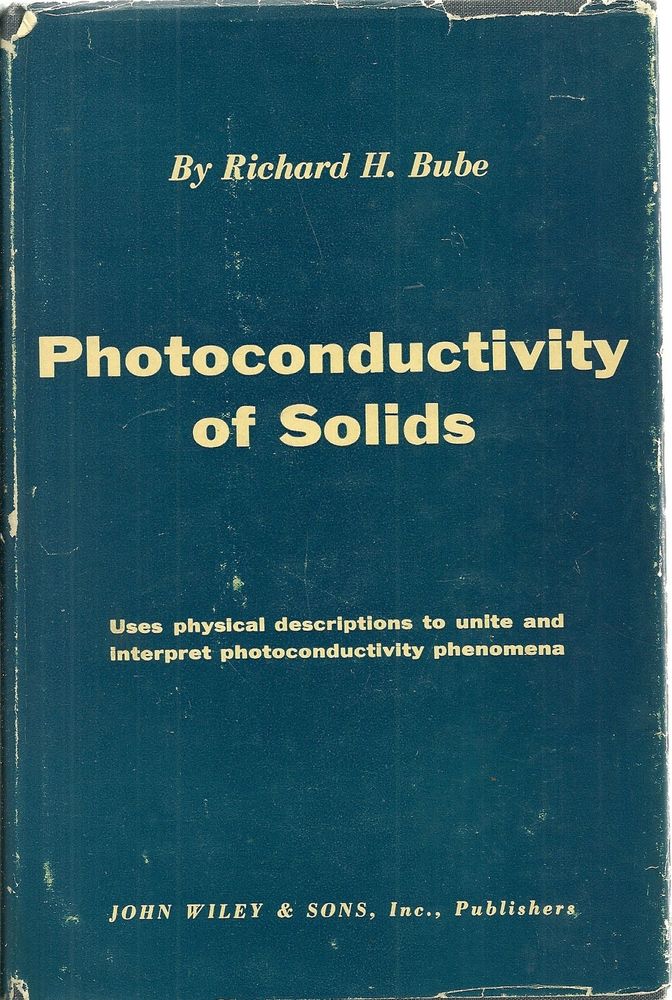
Photoconductivity of Solids

Book
Bube, R.H. (1960) Photoconductivity of Solids. New York, John Wiley & Sons, 461 pp.
Record No. 3238  |  Sinkankas/Born No.: NIS/NIB  |  RWHL
View Individual Record ↗
Richard H. Bube’s Photoconductivity of Solids is a comprehensive treatment of the physical principles, experimental investigations, preparation methods, and practical applications of photoconducting materials. Written for graduate students and researchers in solid-state physics, chemistry, and related fields, the book examines the increase in electrical conductivity that occurs when solids absorb electromagnetic radiation, including infrared, visible, ultraviolet, X-rays, and gamma rays. Beginning with Willoughby Smith’s discovery of the photoconductivity of selenium in 1873, Bube traces the historical development of the subject and the growing understanding of electronic processes in semiconductors and insulators. The theoretical discussion introduces crystal structures, chemical bonding, electronic energy bands, forbidden energy gaps, charge-carrier mobility, and the influence of impurities and structural imperfections on electronic behavior. Particular emphasis is placed on the generation of electrons and holes by optical excitation, their transport through crystals, and the processes by which they become trapped or recombine. The author distinguishes intrinsic photoconductivity, arising from excitation across a material’s fundamental energy gap, from impurity or imperfection photoconductivity, in which localized electronic states associated with foreign atoms, vacancies, and other defects determine the absorption and electrical response. The treatment includes detailed consideration of carrier lifetimes, trapping centers, recombination kinetics, photoconductive gain, spectral sensitivity, electrode effects, and the influence of temperature, applied voltage, and illumination intensity. Separate chapters examine the preparation of photoconducting materials, including powders, sintered and evaporated films, chemically deposited layers, and single crystals grown by vapor-phase, melt, solution, and zone-melting techniques. These methods are discussed in relation to chemical purity, crystal perfection, impurity incorporation, and the reproducibility of electrical and optical properties. Particular attention is given to materials such as selenium, diamond, zinc sulfide, cadmium sulfide, cadmium selenide, lead sulfide, lead selenide, germanium, silicon, and the alkali halides. The discussion of crystal imperfections is especially relevant to the study of color centers, including F centers formed by electrons trapped at anion vacancies, whose characteristic optical absorption can be accompanied by photoconductivity. The relationship between absorption, luminescence, and photoconductivity is examined throughout, providing a physical framework for understanding how defects and impurities modify the optical and electronic properties of crystalline solids. Later chapters address energy-band transitions, excitons, charge-carrier scattering, trapping phenomena, recombination mechanisms, and theoretical models of photoconductivity. Related phenomena, including photovoltaic, photomagnetoelectric, surface photoelectric, photodielectric, and bombardment-induced effects, are also considered. An appendix surveys practical applications of photoconductors in radiation detectors, infrared sensing, television camera tubes, electrophotography, and other electronic devices. Extensive references, mathematical treatments, experimental data, tables, and diagrams support the discussion. Although primarily concerned with solid-state physics rather than gemology, the book provides important background for understanding electronic defects, color centers, optical absorption, and luminescence in minerals and gemstones, particularly where these phenomena arise from impurities and structural imperfections in crystals.

Highlights at the Gem Trade Lab in Los Angeles: Star sapphire with double asterism
Journal Article
Benson, L.B. (1960) Highlights at the Gem Trade Lab in Los Angeles: Star sapphire with double asterism. Gems & Gemology, Vol. 10, No. 1, Spring, p. 5.
Record No. 457  |  ISBN/ISSN: 0016626X  |  Sinkankas/Born No.: NIS/NIB  |  RWHL
View Individual Record ↗

Idar-Oberstein today

Journal Article
Wells, C.L. (1959) Idar-Oberstein today. Gems & Gemology, Vol. 9, No. 9, Spring, pp. 259–263.
Record No. 29959  |  Sinkankas/Born No.: NIS/NIB  |  Language: in English  |  RWHL
View Individual Record ↗
A firsthand account of Idar-Oberstein’s gemstone industry following its postwar recovery. Visits to Professor Schlossmacher’s gemological institute, the Gebrüder Leyser cutting establishment, and the Heinz brothers’ historic water-powered workshop document laboratory equipment, specialized cutting operations, and traditional agate-working methods. Photographs illustrate sawing, grinding, and polishing. The article also describes the town’s extensive network of cutters, dealers, and jewelry manufacturers, its international rough supplies, and difficulties recruiting skilled workers and attracting younger people to the craft.

Highlights at the Gem Trade Lab in New York: [Sapphires: unusual spectra, yellow-sapphire fading, 12-rayed blue star]
Sapphires: unusual spectra, yellow-sapphire fading, 12-rayed blue star
Journal Article
Crowningshield, G.R. (1959) Highlights at the Gem Trade Lab in New York: [Sapphires: unusual spectra, yellow-sapphire fading, 12-rayed blue star]. Gems & Gemology, Vol. 9, No. 10, Summer, p. 294.
Record No. 7446  |  ISBN/ISSN: 0016626X  |  Sinkankas/Born No.: NIS/NIB  |  RWHL
View Individual Record ↗

Leucite: A gem of volcanic origin

Journal Article
Gübelin, E.J. (1959) Leucite: A gem of volcanic origin. Gems & Gemology, Vol. 9, No. 11, Fall, pp. 333–335, 350.
Record No. 2058  |  ISBN/ISSN: 0016626X  |  Sinkankas/Born No.: NIS/NIB  |  RWHL
View Individual Record ↗

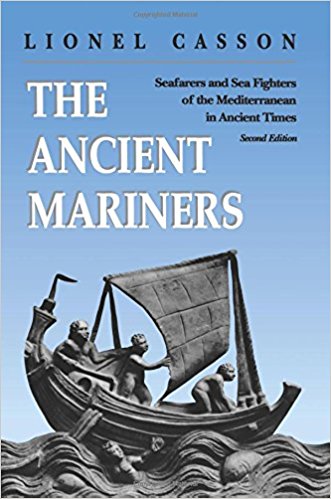
The Ancient Mariners

Book
Casson, L. (1959) The Ancient Mariners. London, Victor Gollancz Ltd., 286 pp.
Record No. 43  |  Sinkankas/Born No.: NIS/NIB  |  RWHL
View Individual Record ↗
Written by the renowned authority on ancient ships and seafaring Lionel Casson, The Ancient Mariners has long served the needs of all who are interested in the sea, from the casual reader to the professional historian. This completely revised edition takes into account the fresh information that has appeared since the book was first published in 1959, especially that from archaeology's newest branch, marine archaeology. Casson does what no other author has done: he has put in a single volume the story of all that the ancients accomplished on the sea from the earliest times to the end of the Roman Empire. He explains how they perfected trading vessels from mere rowboats into huge freighters that could carry over a thousand tons, how they transformed warships from simple oared transports into complex rowing machines holding hundreds of marines and even heavy artillery, and how their maritime commerce progressed from short cautious voyages to a network that reached from Spain to India.

The Powder Method in X-ray Crystallography
Book
Azaroff, L.V. and Bueger, M.J. (1958) The Powder Method in X-ray Crystallography. New York, MacGraw-Hill, 342 pp.
Record No. 26929  |  Sinkankas/Born No.: NIS/NIB  |  RWHL
View Individual Record ↗
Instruction in the various laboratory methods for investigating crystals has long been part of the mineralogy and geology curriculum at the Massachusetts Institute of Technology, encompassing both optical and x-ray techniques. While suitable texts exist for optical methods, there has been no adequate textbook on the x-ray powder method. To support lectures and prepare students for laboratory work, the authors initially wrote a set of notes on the theory and practice of this method, which eventually evolved into this book. The expanded format allowed for more detailed discussion and the inclusion of advanced material beyond what could be covered in a short course. The powder method is inherently simple yet widely valuable across science and industry, often used by individuals with no formal training in crystallography. This book is written with such users in mind, maintaining a fundamental approach while assuming only limited prior knowledge. It omits detailed coverage of general crystallography, x-ray generation, and equipment beyond powder cameras, as these are addressed in other sources. Detection methods using photographic film are emphasized, given their simplicity and permanence, despite the growing use of ionization-type detectors. The principles outlined apply regardless of detection technique, but film is expected to remain relevant in routine applications for the foreseeable future.

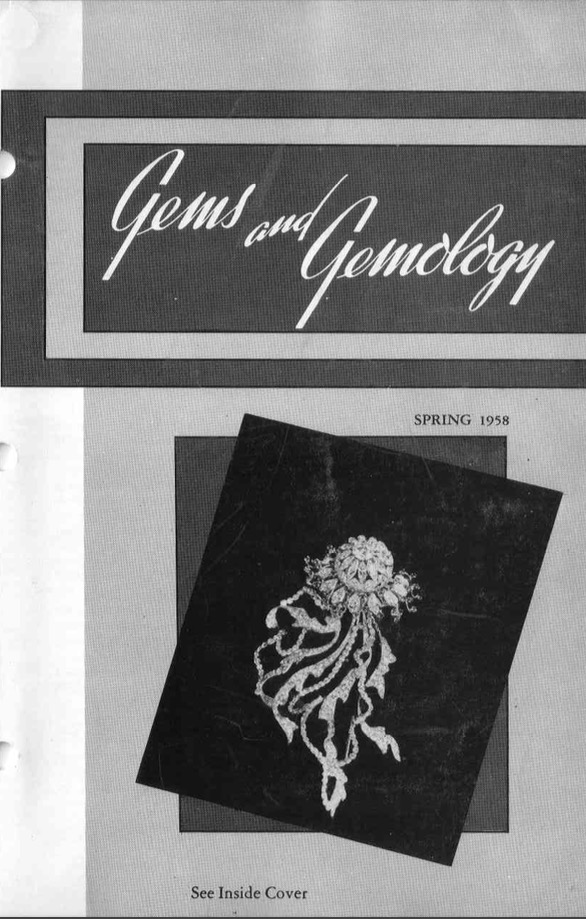
Ascertaining the nature and extent of damage or inherent flaws in gemstones
Journal Article
Crowningshield, G.R. (1958) Ascertaining the nature and extent of damage or inherent flaws in gemstones. Gems & Gemology, Vol. 9, No. 5, Spring, pp. 131–133, 159.
Record No. 26766  |  Sinkankas/Born No.: NIS/NIB  |  RWHL
View Individual Record ↗
The Gem Trade Laboratories of the Gemological Institute of America are frequently called on to render opinions regarding the nature of cracks and flaws in many varieties of stones. Most often, the question is whether a crack is inherent, partly inherent and extended, or due to damage that occurred after the stone was polished. It is my purpose here to set forth the methods used by the staff of the Laboratories in arriving at an opinion based on careful microscopic observations. It is common knowledge that insurance companies do not require very much information about jewelry before issuing policies and collecting premiums. Most jewelers have experienced cases where this practice has been troublesome, if not embarrassing. Few jewelers make a detailed diagram of inherent flaws in stones they sell or appraise, other than perhaps in diamonds, since insurance companies do not demand it. Therefore, stones with inherent fractures are frequently insured that may later be mistaken for damage, causing an unnecessary and time-consuming settlement. Let us reconstruct a hypothetical case in which an insured customer first believes he has damaged a stone. One day the insured trips and falls and believes that he has struck his star sapphire on the concrete floor. His first thought, after seeing that no bones are broken, is to inspect his star sapphire. For the first time the stone is examined carefully, perhaps with strong transmitted light. Sure enough, there is a crack! The insurance company and an adjuster are notified, and he sees the crack. The jeweler is notified. He inspects the stone with his loupe and admits that he sees a crack too. All too often the insurance company pays off, but not before considerable time and effort have been expended.

Ratna Pariksha | Being Treatises on Gems from Smrtisaarooddhaara & by Iswaradiiksita
Book
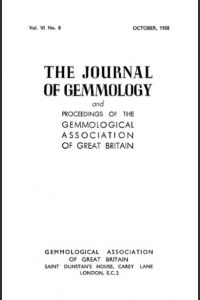
Smrtisaarooddhaara and Iswaradiksita (1958) Ratna Pariksha | Being Treatises on Gems from Smrtisaarooddhaara & by Iswaradiiksita. Srirangam, Sri Vani Vilas Press, 62 pp.
Record No. 16848  |  Sinkankas/Born No.: NIS/NIB  |  Language: in Sanskrit/Tamil  |  RWHL
View Individual Record ↗
This small volume brings together two Sanskrit treatises on the traditional Indian examination of gemstones, one extracted from the Smṛtisāroddhāra and the other attributed to Īśvaradīkṣita, with the Sanskrit text in Devanagari accompanied by a Tamil translation by K. S. Subramanya Sastri. The works belong to the Indian ratna-parīkṣā tradition, in which precious stones are classified and assessed according to their appearance, physical characteristics, desirable qualities, defects, provenance, and suitability for use. Attention is given to the recognition and valuation of gems and to traditional ideas concerning the beneficial or harmful effects associated with stones of particular qualities. The volume is valuable for preserving relatively short Sanskrit sources on practical gem knowledge and for illustrating the close relationship in traditional Indian gemology between observation and commercial evaluation on the one hand and religious, astrological, and cultural concepts on the other. The two texts were originally issued in 1958 in the journal of the Tanjore Maharaja Serfoji’s Sarasvati Mahal Library.

Emeralds from Sandawana

Journal Article
Gübelin, E.J. (1958) Emeralds from Sandawana. Journal of Gemmology, Vol. 6, No. 8, October, pp. 340–354.
Record No. 2055  |  ISBN/ISSN: 221252  |  Sinkankas/Born No.: 2566  |  RWHL
View Individual Record ↗
E.J. Gübelin characterizes emeralds from the recently discovered Sandawana deposits in Southern Rhodesia [Zimbabwe], combining an account of their discovery and geological setting with chemical, optical, and microscopic examination intended to establish distinguishing features of origin. Prospectors Laurence Gontat and Cornelius Oosthuizen found the first emeralds in October 1956, followed seven months later by a richer occurrence. The deposits lie on the southern side of the Mweza Range, where pegmatite dykes intersect tremolite schists within a complex assemblage of ancient metamorphic and intrusive rocks. Gübelin interprets emerald formation as a product of contact metamorphism bringing beryllium-bearing granitic material into interaction with chromium-bearing rocks derived from ultrabasic intrusions. Study of ninety-two cut stones reveals a vivid emerald-green colour with a yellow glint, retained even in very small gems. Fracturing and small crystal size limit most available cut stones to less than a quarter carat. Chemical and spectrographic analyses indicate appreciable magnesium and sodium, together with chromium, iron, and lithium, although the small amount of material available restricts analytical accuracy. Detailed physical measurements on ten selected stones establish comparatively high refractive indices, with representative values near 1.593 and 1.586 and birefringence of approximately 0.007. Specific gravity is likewise relatively high, averaging about 2.756. The emeralds show yellow-green and bluish-green dichroism, a weak red response through the Chelsea filter, and the usual chromium-related absorption features. They are inert under both long- and short-wave ultraviolet illumination but display pale-red fluorescence in a crossed-filter fluoroscope; ultraviolet transmission ends sharply near 320 nm. Gübelin emphasizes that overlap in physical constants among emerald sources makes these measurements insufficient for reliable provenance determination by themselves. Internal characteristics provide stronger evidence, particularly short tremolite pins and exceptionally fine, sometimes curved fibres occurring singly or in bundles. Their morphology and distribution are compared with amphibole inclusions in Habachtal emeralds. Additional features include partly resorbed garnets with brownish halos, limonite-filled cracks, rare hematite, feldspar and magnetite inclusions, dustlike patches, and distinctive systems of fine fissures parallel to the basal plane. Lace-like residual liquid films observed in one stone are recorded without being treated as an established locality characteristic. Photomicrographs and comparative tables support the conclusion that Sandawana emeralds combine attractive colour with a recognizable suite of internal features useful in distinguishing them from other contemporary sources.

Notes on the new emeralds from Sandawana
Journal Article
Gübelin, E.J. (1958) Notes on the new emeralds from Sandawana. Gems & Gemology, Vol. 9, No. 7, Fall, pp. 195–203.
Record No. 2054  |  ISBN/ISSN: 0016626X  |  Sinkankas/Born No.: NIS/NIB  |  RWHL
View Individual Record ↗
Gübelin examines emeralds from the newly discovered Sandawana deposits in the Belingwe area of present-day Zimbabwe, combining an account of their discovery and geological setting with measurements and microscopic observations intended to establish distinguishing characteristics. Laurence Contat and Cornelius Oosthuizen encountered emerald while prospecting for pegmatite minerals, with an initial discovery in October 1955 followed by a significant deposit found in May 1957. The emeralds occur in association with tremolite schists and pegmatite dikes in the Mweza Range, a setting compared with that of emeralds from Austria’s Habachtal. Geological knowledge remained preliminary, and the workings were still limited, although emerald-bearing material derived from erosion was also recognized. An initial lot of ninety-two emeralds was submitted for investigation. The faceted specimens described are small, weighing 0.15–0.38 carat, but display vivid, comparatively uniform green color with a warm yellow component that remains strong even at these sizes. A reported chemical analysis includes chromium, iron, magnesium, sodium, and lithium in addition to the principal constituents of beryl. Measured optical properties are relatively high for emerald, with representative refractive indices of approximately 1.593 and 1.586 and birefringence near 0.007. Specific gravity ranges from 2.744 to 2.768. Most specimens show the familiar emerald absorption spectrum, a weak red appearance through the Chelsea filter, and distinct bluish-green and yellowish-green dichroic colors. They are inert under the long-wave and short-wave ultraviolet radiation used in the study, with ultraviolet transmission ending near 320 nm. Because these properties overlap those of emeralds from other deposits, Gübelin places particular emphasis on inclusions. The most characteristic assemblage consists of fine tremolite needles approaching actinolite in composition, occurring as short scattered rods and long, slender, sometimes curved fibers. Tiny disk-like fissures along some needles create the appearance of flakes pierced by rods. Compared with Habachtal material, Sandawana emeralds contain finer needles, less densely grouped, with short rods accompanying the longer fibers. Other observed inclusions include brown garnet, limonite coatings and fracture fillings, and rare altered plagioclase, magnetite, and hematite. Dust-like green or brown patches, described as splashes, may form halos around resorbed garnets; an illustration identifies such formations as comprising extremely minute liquid droplets. Additional fissures form interrupted lines and bands parallel to the basal plane, differing in appearance from the more extensive layers of disk-like fissures described in Russian emeralds. Gübelin concludes that the combination of physical properties, tremolite morphology, internal irregularities, and vivid color provides a practical basis for recognizing Sandawana emeralds, while emphasizing the importance of direct observational experience.

The God of Adam’s Peak

Book
Paranavitana, S. (1958) The God of Adam’s Peak. Ascona, Switzerland, Artibus Asiae, 78 pp.
Record No. 1391  |  Sinkankas/Born No.: NIS/NIB  |  RWHL
View Individual Record ↗
S. Paranavitana’s The God of Adam’s Peak is a scholarly investigation into the origins, identity and religious significance of Saman (Sumana), the guardian deity of Adam’s Peak (Sri Pada) in Ceylon (Sri Lanka). Drawing upon Sinhalese and Pali chronicles, Sanskrit literature, inscriptions, archaeological discoveries and religious iconography, Paranavitana advances the thesis that Saman is an indigenous continuation of the ancient Indo-Aryan god Yama, traditionally associated with death, justice, righteousness and the southern quarter. The study begins with the religious and historical importance of Adam’s Peak, whose summit bears a footprint revered by Buddhists as that of the Buddha, by Muslims as that of Adam and by Hindus as that of Śiva. The mountain also stands near the celebrated gem-producing districts of Ratnapura, contributing to Ceylon’s ancient reputation as Ratnadvīpa, the Island of Gems. Paranavitana examines early references to the mountain in the Mahāvaṃsa, the Maṇimēkalai, the writings of Chinese pilgrims, Arabic travel accounts and Sanskrit poetry, particularly passages describing Mount Rohana as a source of precious stones and the surrounding ocean as a source of pearls. These literary references associate the mountain with remarkable mineral wealth, including rubies, sapphires and other gems, while reflecting the importance of Ceylon in ancient Indian Ocean commerce. The central argument rests partly upon a comparison between the Sinhalese Jātaka and its Pali original, in which the name Sumana appears in a passage corresponding to Yama. Paranavitana develops this identification through linguistic analysis, comparisons of divine attributes and examination of religious traditions connecting Saman with prosperity, compassion, wisdom and the protection of Buddhist sanctuaries. Particular attention is devoted to the iconography of Saman and Yama, including representations from Dambulla, Polonnaruva, Anuradhapura and other archaeological sites. The author compares sculptures, bronze figurines and paintings showing the deities in varying colours, with crowns, ornaments, bows, arrows and the rod or sceptre associated with Yama as Dandadhara, the bearer of the staff of justice. Further chapters investigate Samiddhi Sumana, Mahākāla and other divine manifestations, together with associated figures such as the Aśvins, the goddess Yami and the sage Agastya. Paranavitana also examines the possibility that the ancient Sinhalese king Vaṭṭagāmaṇī Abhaya deliberately identified himself with Yama, interpreting royal titles and inscriptions within the broader tradition of divine kingship. The concluding discussion proposes that worship of Yama was introduced to Ceylon by early Indo-Aryan settlers and subsequently incorporated into Buddhism, with the deity’s punitive characteristics gradually subordinated to his role as a benevolent protector. The work is illustrated with photographs and reproductions of religious images, sculptures and archaeological objects. Although several identifications remain interpretative rather than conclusively demonstrated, the monograph offers a detailed examination of religious continuity and transformation in Sri Lanka. Its particular relevance to gemological history lies in its documentation of early literary traditions associating Adam’s Peak and Mount Rohana with the island’s precious stones, pearls and longstanding reputation as a source of exceptional mineral wealth.

Notes on asterism in corundum, rose quartz and almandine garnet and chatoyancy in beryl
Journal Article
Eppler, W.F. (1958) Notes on asterism in corundum, rose quartz and almandine garnet and chatoyancy in beryl. Journal of Gemmology, Vol. 6, No. 5, January, pp. 195–212.
Record No. 715  |  ISBN/ISSN: 221252  |  Sinkankas/Born No.: NIS/NIB  |  RWHL
View Individual Record ↗
W.F. Eppler examines the inclusions responsible for asterism in spinel and chatoyancy in chrysoberyl, quartz, tourmaline, zircon, and scapolite, emphasizing the need to distinguish solid crystals from apparently similar hollow channels and to assess whether inclusions were trapped during growth or formed subsequently by exsolution. In natural spinel, oriented rutile needles following octahedral edges provide one explanation for asterism, but other fibrous inclusions remain unidentified. Sphene crystals in Ceylon spinel illustrate the distinction between relatively large primary crystals enclosed during host growth and minute needles attributed to exsolution. Partial dissolution and the arrangement of larger crystals on former growth planes support their primary origin, whereas their sparse distribution prevents them from producing a star. Burmese spinels contain additional unidentified dark crystals and minute brownish particles tentatively interpreted as rutile; patterned concentrations around larger inclusions suggest localized strain may influence exsolution. Experiments with synthetic spinel show that heat-induced separation of excess alumina can generate oriented plates and weak asterism, but the resulting effects lack commercial value. Elongated gas inclusions can also produce a four-rayed star in suitably oriented cabochons. Examination of a sharply chatoyant chrysoberyl reveals short, birefringent needles with a refractive index higher than the host, contradicting an explanation based exclusively on hollow channels for that specimen. Their identity and origin remain uncertain, although exsolution is suggested. Similarly, inclusions in a rose-coloured tourmaline that resemble channels in reflected light prove in transmitted light to be brown, birefringent crystal fibres with a higher refractive index than tourmaline. Eppler interprets these as primary inclusions formed alongside the host. Quartz cat’s-eye and tiger’s-eye are discussed in terms of aligned amphibole-asbestos fibres, while an earlier observation of zircon chatoyancy is attributed to unidentified minute crystals parallel to its principal axis. Madagascar scapolite displays a combination of hollow and liquid-filled channels, crystalline needles, and oriented blades, all potentially contributing to its cat’s-eye effect. The blades are interpreted as products of exsolution within the marialite–meionite series. Photomicrographs demonstrate that similar optical phenomena can arise from inclusions differing in composition, physical state, morphology, and developmental history, making detailed optical examination essential to explaining individual specimens.

Color changes in irradiated gemstones
Journal Article
Burbage, E. and Jones, T.G. (1957) Color changes in irradiated gemstones. Journal of Gemmology, Vol. 6, No. 2; April, pp. 74–77.
Record No. 4727  |  ISBN/ISSN: 221252  |  Sinkankas/Born No.: NIS/NIB  |  RWHL
View Individual Record ↗
E. Burbage and T.G. Jones present preliminary observations of colour and optical changes produced by neutron irradiation in a range of natural and synthetic gemstones. Pairs of specimens were assembled for comparative study, with one member irradiated for three or six days and the other retained untreated. The resulting collection was exhibited at Harwell and subsequently at Haslemere’s Educational Museum. Synthetic corundum showed particularly conspicuous and variable responses. A colourless boule became brown, developed strong dichroism, and displayed enhanced fluorescence under crossed filters, which the authors tentatively associate with trace chromium impurities. Synthetic ruby darkened and became more strongly dichroic while showing reduced fluorescence; pink synthetic sapphire turned brown and likewise fluoresced less strongly. Two blue synthetic sapphires exposed for six days responded differently: one became dark brown with little appreciable dichroism, whereas the other became greenish blue with pronounced directional colour differences. An alexandrite-type synthetic corundum became garnet red and lost its change of colour between different illuminants. Natural corundum changed less markedly, with no appreciable alteration in the ruby examined and only slight darkening in sapphire. Synthetic spinels showed either substantial fading towards pale grayish brown or a shift towards a steely blue. Among quartz varieties, cairngorm darkened slightly, while amethyst and rose quartz showed stronger darkening. Pink topaz returned to a sherry-brown appearance resembling its colour before heating, and pale-yellow topaz became darker and greener with increased dichroism. Blue and golden zircons underwent especially dramatic changes after only three days, becoming deep reddish brown and nearly opaque, although examination at their edges confirmed that they remained anisotropic. Garnets were comparatively little affected: rhodolite appeared unchanged, almandine deepened slightly, and demantoid shifted towards a peridot-like green. Additional changes included greener brown tourmaline, sherry-brown kunzite, brownish-green peridot, deeper golden beryl, and brown orthoclase. Colourless periclase developed a blue resembling chalcedony, judged the most attractive result. The observations demonstrate that irradiation can alter dichroism and fluorescence as well as visible colour, with markedly different responses even among nominally similar materials. The authors frame the work as an interim report rather than a comprehensive survey of gemstone irradiation.

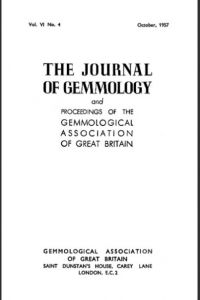
Use of the terms greenstone, nephrite, bowenite, and jade
Journal Article
Reed, J.J. (1957) Use of the terms greenstone, nephrite, bowenite, and jade. The Journal of the Polynesian Society, Vol. 66, No. 2, pp. 204–205.
Record No. 3525  |  ISBN/ISSN: 324000  |  Sinkankas/Born No.: NIS/NIB  |  RWHL
View Individual Record ↗
J.J. Reed clarifies the mineralogical distinctions underlying the terms greenstone, nephrite, bowenite, and jade, responding to uncertainty in their application to Māori artefacts. He explains that the materials commonly grouped together as Māori greenstone include two compositionally distinct substances. Nephrite consists essentially of amphibole belonging to the tremolite–actinolite series, whereas bowenite consists essentially of serpentine. Jadeite, a sodium aluminium pyroxene, is mineralogically distinct from both. These differences make the customary group terms unsuitable as substitutes for precise material identification. In strict gemmological usage, jade encompasses nephrite and jadeite alone; bowenite therefore falls outside its definition. Greenstone, as applied to Māori objects, covers both nephrite and bowenite, so the two collective terms overlap without being synonymous. Reed notes that pounamu and tangiwai are generally considered the Māori names for nephrite and bowenite, respectively, while leaving the interpretation and acceptance of broader ethnological terminology to ethnologists. He recognizes a practical need for a collective expression covering jadelike artefacts regardless of their mineralogical composition. Although a broader definition of jade might have served this purpose, its established restriction to nephrite and jadeite makes descriptions that include bowenite under “Māori jade” misleading. “Māori greenstone” offers a suitable alternative if greenstone is accepted in the inclusive sense proposed. Examples from European archaeological writing demonstrate that greenstone has also been used outside New Zealand for jadeite and other materials, supporting its potential as a general descriptive category rather than a designation confined to particular minerals. Reed suggests that the term would presumably have encompassed jadeite in New Zealand had that mineral occurred there and been used by Māori. His recommendation combines broad classification with explicit identification: scientific descriptions should employ nephrite, jadeite, or bowenite whenever the material is known, while an inclusive archaeological designation can retain the specific identification in parentheses, as in “greenstone (nephrite).” The note thus proposes a terminological framework that accommodates established ethnological usage while preserving the mineralogical distinctions necessary for accurate descriptions and comparisons of artefacts.

Application of phase contrast microscopy in gemmology
Journal Article
Gübelin, E.J. (1957) Application of phase contrast microscopy in gemmology. Journal of Gemmology, Vol. 6, No. 4, October, pp. 151–165.
Record No. 2051  |  ISBN/ISSN: 221252  |  Sinkankas/Born No.: NIS/NIB  |  RWHL
View Individual Record ↗
Gübelin introduces phase contrast microscopy as a means of improving the visibility of inclusions and structural irregularities within gemstones, explaining its optical principles and the modifications required for gemmological use. The method increases brightness differences between transparent features and their surroundings, allowing details that are indistinct under conventional illumination to become more readily observable. He first considers the limitations of bright-field and dark-field examination. Closing the condenser diaphragm can increase contrast in bright-field illumination, but reduces resolving power, darkens the image, and introduces diffraction effects that may complicate interpretation. Dark-field illumination makes inclusions conspicuous against a dark background, yet may emphasize their boundaries while obscuring subtler internal details. To explain the alternative offered by phase contrast, Gübelin outlines Abbe’s account of microscopic image formation through diffraction and interference, stressing that magnification alone cannot reveal progressively finer structures. He distinguishes amplitude objects, whose visibility depends principally on differences in light absorption, from phase objects, whose transparent structures chiefly alter the phase of transmitted light. Although most actual specimens combine both effects, this distinction explains why transparent inclusions can remain difficult to see even when they differ optically from the surrounding gemstone. Following Zernike’s principle, a phase plate positioned in the objective’s back focal plane shifts the direct light relative to the diffracted light by approximately one-quarter wavelength. Their subsequent interference converts otherwise imperceptible phase differences into visible intensity differences, producing stronger contrast. Gübelin then addresses the practical difficulty of applying conventional phase contrast equipment to gemstones: objectives designed for high magnification and thin preparations cannot readily examine inclusions situated deep within a substantial stone. He describes equipment developed by Zeiss-Winkel, with the assistance of H. Piller, to meet this requirement. Its components include an adjustable collecting lens, three special achromatic objectives incorporating annular phase plates and providing long working distances, and alternative condensers fitted with appropriate phase annuli. The objectives also permit bright-field and dark-field observation, facilitating direct comparison of the same feature under different illumination conditions. In the supplied opening portion of the article, the emphasis is therefore on the physical basis and instrumental adaptation of the technique, presenting phase contrast as a complementary tool for detailed examination and research into gemstone interiors.

The phase-contrast method

Journal Article
Gübelin, E.J. (1957) The phase-contrast method. Gems & Gemology, Vol. 9, No. 3, Fall, pp. 67–79.
Record No. 2050  |  ISBN/ISSN: 0016626X  |  Sinkankas/Born No.: NIS/NIB  |  RWHL
View Individual Record ↗
Gübelin explains the principles of phase-contrast microscopy and describes equipment adapted to examining inclusions and subtle internal structures in gemstones. Developed from F. Zernike’s work, the method converts differences in the phase of transmitted light, arising from variations in thickness or refractive index, into visible differences in brightness. It thereby reveals transparent features that produce insufficient contrast under ordinary bright-field illumination. Closing the condenser aperture or defocusing can improve conventional contrast but reduces resolving power, while dark-field illumination chiefly emphasizes sharp boundaries and may inadequately display gradual transitions or details within inclusions. Phase contrast employs an annular illuminating diaphragm and a corresponding phase plate in the objective to modify the relationship between direct and diffracted light. Positive phase contrast renders optically denser features darker than their surroundings, whereas negative phase contrast reverses this relationship. Conventional equipment initially presented difficulties because its high-power objectives had insufficient working distance and depth of focus for inclusions situated within relatively thick gemstones. With assistance from H. Piller of Zeiss-Winkel, Gübelin obtained a specially designed arrangement incorporating suitable illumination components, annular diaphragms, and objectives of lower magnification with longer working distances. An auxiliary microscope permits alignment of the illuminating ring and the objective’s phase ring. The arrangement allows convenient changes between phase contrast and conventional illumination, facilitating comparison and interpretation of the same features. Its principal value lies in increasing the visibility of inclusions and compositional irregularities, rather than providing quantitative refractive-index measurements. Comparative examples include muscovite flakes in yellow beryl from Madagascar, structures in a Colombian emerald attributed to incomplete calcite exsolution, alteration to pinite in Sri Lankan iolite, and partly healed fissures in sapphire, fluorite, and beryl. Phase contrast makes the boundaries and internal details of muscovite conspicuous despite its small refractive-index difference from beryl. It also distinguishes residual liquid-filled portions of healed fractures from the surrounding healed material and can reveal gas bubbles within those residual cavities. Structural irregularities and zoning may become visible as contrasting light and dark areas where exsolution, precipitation, alteration, or healing has produced slight local differences in refractive index. Gübelin emphasizes that the method is most useful when optical differences are small and the relevant structures sufficiently thin. It offers little advantage for many ordinary inclusions whose refractive indices differ greatly from those of their hosts, and it does not reveal strain or deformation caused by stress. The article presents phase contrast as a valuable addition to gemological microscopy for investigating internal heterogeneity and interpreting processes recorded within gemstones.

Gem mining in Burma

Journal Article
Ehrmann, M.L. (1957) Gem mining in Burma. Gems & Gemology, Vol. 9, No. 1, Spring, pp. 3–30.
Record No. 694  |  ISBN/ISSN: 0016626X  |  Sinkankas/Born No.: 1870  |  RWHL
View Individual Record ↗
Sinkankas: Both articles based on author’s many gem-buying trips and with photos taken by himself; describes geography, transport, the people, mining of gemstones, geology of deposits, mineralogy, history, recovery of jade and amber, mines, and gem trading. Obit. American Mineralogist, 59, 1974, p. 1870. Mining. [414].

Building a Gemological Library

Gemological books range from general identification manuals and textbooks to specialized works on individual gems, mineralogy, jewelry, treatments, synthesis, history and gem-producing regions.

For a curated selection of particularly useful books, read The Gemologist's Core Library — Classic Books on Gemology, Jewelry and Mineralogy.

About Four Treasures

Four Treasures is Lotus Gemology's freely accessible gemological reference database. Use the full database to search by author, title or keyword and explore literature on gemology, mineralogy, jewelry and related fields. Where available, hyperlinks on titles may lead directly to the full publication.

Search the Complete Four Treasures Database