
Four Treasures Reference Database
Record No. 3238
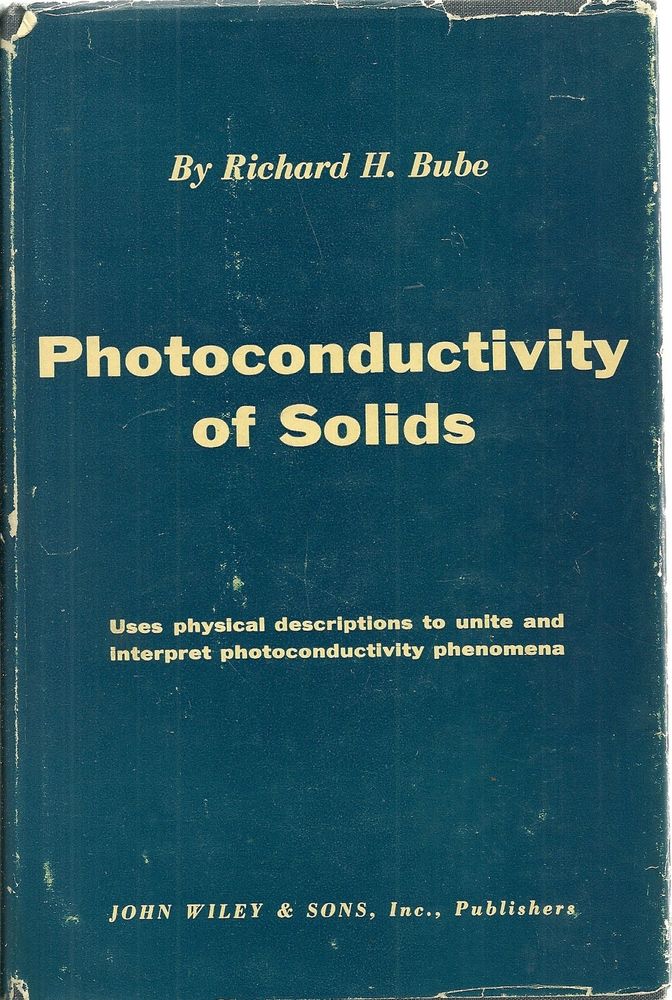
Photoconductivity of Solids
Book
Bube, R.H. (1960) Photoconductivity of Solids. New York, John Wiley & Sons, 461 pp.
Sinkankas/Born No.: NIS/NIB | RWHL
corundum, color.4, gems
Richard H. Bube’s Photoconductivity of Solids is a comprehensive treatment of the physical principles, experimental investigations, preparation methods, and practical applications of photoconducting materials. Written for graduate students and researchers in solid-state physics, chemistry, and related fields, the book examines the increase in electrical conductivity that occurs when solids absorb electromagnetic radiation, including infrared, visible, ultraviolet, X-rays, and gamma rays. Beginning with Willoughby Smith’s discovery of the photoconductivity of selenium in 1873, Bube traces the historical development of the subject and the growing understanding of electronic processes in semiconductors and insulators. The theoretical discussion introduces crystal structures, chemical bonding, electronic energy bands, forbidden energy gaps, charge-carrier mobility, and the influence of impurities and structural imperfections on electronic behavior. Particular emphasis is placed on the generation of electrons and holes by optical excitation, their transport through crystals, and the processes by which they become trapped or recombine. The author distinguishes intrinsic photoconductivity, arising from excitation across a material’s fundamental energy gap, from impurity or imperfection photoconductivity, in which localized electronic states associated with foreign atoms, vacancies, and other defects determine the absorption and electrical response. The treatment includes detailed consideration of carrier lifetimes, trapping centers, recombination kinetics, photoconductive gain, spectral sensitivity, electrode effects, and the influence of temperature, applied voltage, and illumination intensity. Separate chapters examine the preparation of photoconducting materials, including powders, sintered and evaporated films, chemically deposited layers, and single crystals grown by vapor-phase, melt, solution, and zone-melting techniques. These methods are discussed in relation to chemical purity, crystal perfection, impurity incorporation, and the reproducibility of electrical and optical properties. Particular attention is given to materials such as selenium, diamond, zinc sulfide, cadmium sulfide, cadmium selenide, lead sulfide, lead selenide, germanium, silicon, and the alkali halides. The discussion of crystal imperfections is especially relevant to the study of color centers, including F centers formed by electrons trapped at anion vacancies, whose characteristic optical absorption can be accompanied by photoconductivity. The relationship between absorption, luminescence, and photoconductivity is examined throughout, providing a physical framework for understanding how defects and impurities modify the optical and electronic properties of crystalline solids. Later chapters address energy-band transitions, excitons, charge-carrier scattering, trapping phenomena, recombination mechanisms, and theoretical models of photoconductivity. Related phenomena, including photovoltaic, photomagnetoelectric, surface photoelectric, photodielectric, and bombardment-induced effects, are also considered. An appendix surveys practical applications of photoconductors in radiation detectors, infrared sensing, television camera tubes, electrophotography, and other electronic devices. Extensive references, mathematical treatments, experimental data, tables, and diagrams support the discussion. Although primarily concerned with solid-state physics rather than gemology, the book provides important background for understanding electronic defects, color centers, optical absorption, and luminescence in minerals and gemstones, particularly where these phenomena arise from impurities and structural imperfections in crystals.