
Four Treasures Reference Database
Record No. 1391
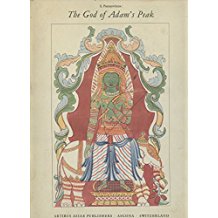
The God of Adam’s Peak
Book
Paranavitana, S. (1958) The God of Adam’s Peak. Ascona, Switzerland, Artibus Asiae, 78 pp.
Sinkankas/Born No.: NIS/NIB | RWHL
corundum, Sri Lanka.12, gems
S. Paranavitana’s The God of Adam’s Peak is a scholarly investigation into the origins, identity and religious significance of Saman (Sumana), the guardian deity of Adam’s Peak (Sri Pada) in Ceylon (Sri Lanka). Drawing upon Sinhalese and Pali chronicles, Sanskrit literature, inscriptions, archaeological discoveries and religious iconography, Paranavitana advances the thesis that Saman is an indigenous continuation of the ancient Indo-Aryan god Yama, traditionally associated with death, justice, righteousness and the southern quarter. The study begins with the religious and historical importance of Adam’s Peak, whose summit bears a footprint revered by Buddhists as that of the Buddha, by Muslims as that of Adam and by Hindus as that of Śiva. The mountain also stands near the celebrated gem-producing districts of Ratnapura, contributing to Ceylon’s ancient reputation as Ratnadvīpa, the Island of Gems. Paranavitana examines early references to the mountain in the Mahāvaṃsa, the Maṇimēkalai, the writings of Chinese pilgrims, Arabic travel accounts and Sanskrit poetry, particularly passages describing Mount Rohana as a source of precious stones and the surrounding ocean as a source of pearls. These literary references associate the mountain with remarkable mineral wealth, including rubies, sapphires and other gems, while reflecting the importance of Ceylon in ancient Indian Ocean commerce. The central argument rests partly upon a comparison between the Sinhalese Jātaka and its Pali original, in which the name Sumana appears in a passage corresponding to Yama. Paranavitana develops this identification through linguistic analysis, comparisons of divine attributes and examination of religious traditions connecting Saman with prosperity, compassion, wisdom and the protection of Buddhist sanctuaries. Particular attention is devoted to the iconography of Saman and Yama, including representations from Dambulla, Polonnaruva, Anuradhapura and other archaeological sites. The author compares sculptures, bronze figurines and paintings showing the deities in varying colours, with crowns, ornaments, bows, arrows and the rod or sceptre associated with Yama as Dandadhara, the bearer of the staff of justice. Further chapters investigate Samiddhi Sumana, Mahākāla and other divine manifestations, together with associated figures such as the Aśvins, the goddess Yami and the sage Agastya. Paranavitana also examines the possibility that the ancient Sinhalese king Vaṭṭagāmaṇī Abhaya deliberately identified himself with Yama, interpreting royal titles and inscriptions within the broader tradition of divine kingship. The concluding discussion proposes that worship of Yama was introduced to Ceylon by early Indo-Aryan settlers and subsequently incorporated into Buddhism, with the deity’s punitive characteristics gradually subordinated to his role as a benevolent protector. The work is illustrated with photographs and reproductions of religious images, sculptures and archaeological objects. Although several identifications remain interpretative rather than conclusively demonstrated, the monograph offers a detailed examination of religious continuity and transformation in Sri Lanka. Its particular relevance to gemological history lies in its documentation of early literary traditions associating Adam’s Peak and Mount Rohana with the island’s precious stones, pearls and longstanding reputation as a source of exceptional mineral wealth.