
Four Treasures Reference Database
Record No. 7664
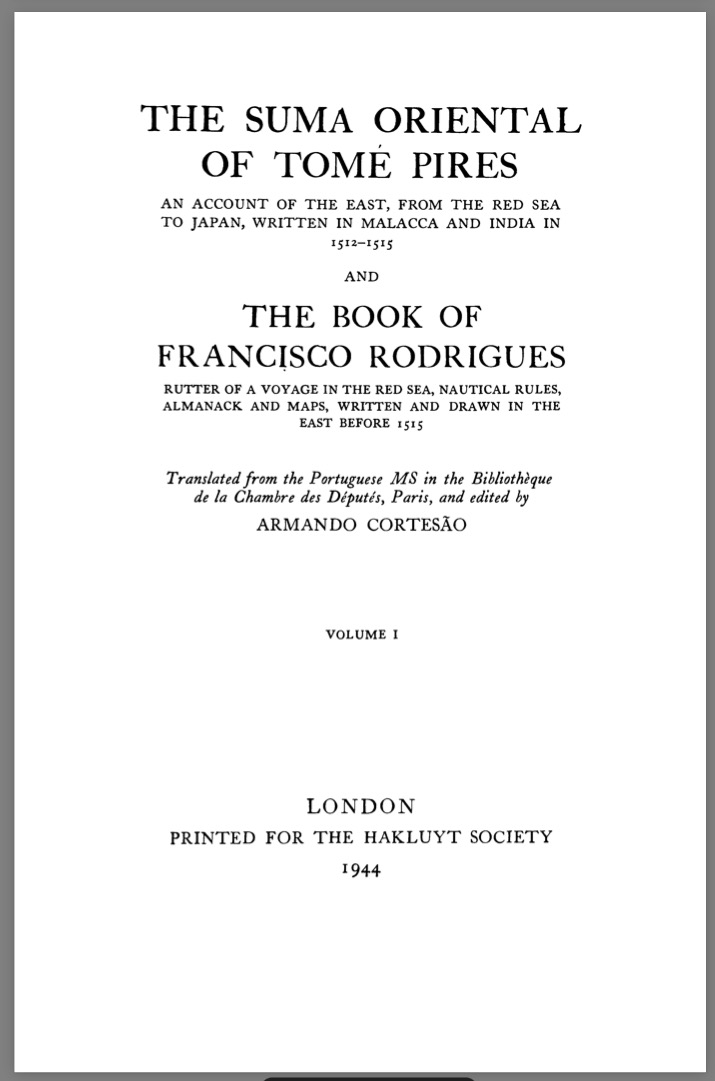
The Suma Oriental of Tomé Pires and the Book of Francisco Rodrigues
Book
Pires, T. and Rodrigues, F. (1944) The Suma Oriental of Tomé Pires and the Book of Francisco Rodrigues. London, Hakluyt Society, 2 Vols., Vol. 1, Series 2
Sinkankas/Born No.: NIS/NIB | RWHL
corundum, history.1, Sri Lanka.12, Burma.12, Thailand.12, gems
A major scholarly edition and English translation of two important early sixteenth-century Portuguese accounts of maritime Asia, edited and annotated by Armando Cortesão. Tomé Pires’s Suma Oriental, composed principally between 1512 and 1515, provides one of the earliest comprehensive European descriptions of the geography, peoples, political organization, commerce, and trading networks of Asia, extending from the Red Sea and Persian Gulf through India, Ceylon, Burma, Siam, Malacca, Sumatra, Java, and the Spice Islands to China and Japan. Written shortly after the Portuguese conquest of Malacca in 1511, the work draws upon Pires’s firsthand observations and information obtained from Asian merchants, navigators, and officials. Particularly valuable are its detailed descriptions of commercial ports, maritime routes, merchandise, currencies, customs duties, and the complex relationships among Arab, Persian, Indian, Malay, and Chinese trading communities. Of special gemological interest are references to the trade in diamonds, rubies, sapphires, pearls, and other precious stones, including the importance of Ceylon, Burma, and Indian commercial centers in supplying gems to regional and international markets. Pires describes the commercial importance of precious stones alongside spices, textiles, metals, porcelain, aromatics, and other luxury commodities, providing evidence for the extensive exchange networks that connected South and Southeast Asia with China and the Middle East before European maritime dominance. The accompanying Book of Francisco Rodrigues reproduces and translates the writings, sailing directions, and cartographic materials of a Portuguese pilot active in Southeast Asia during the same period. Rodrigues’s navigational observations and maps document coastlines, islands, harbors, and sea routes, particularly around the Malay Peninsula, Sumatra, Java, and the eastern Indonesian archipelago. Cortesão’s extensive introduction, commentary, geographical identifications, and historical notes place both works within the context of Portuguese exploration and the expansion of European knowledge of Asia. Together, these documents constitute fundamental primary sources for the history of Indian Ocean commerce, early European encounters with Asian societies, and the movement of gemstones and other valuable commodities through the maritime trading networks of the early sixteenth century.