
Four Treasures Reference Database
Record No. 4679
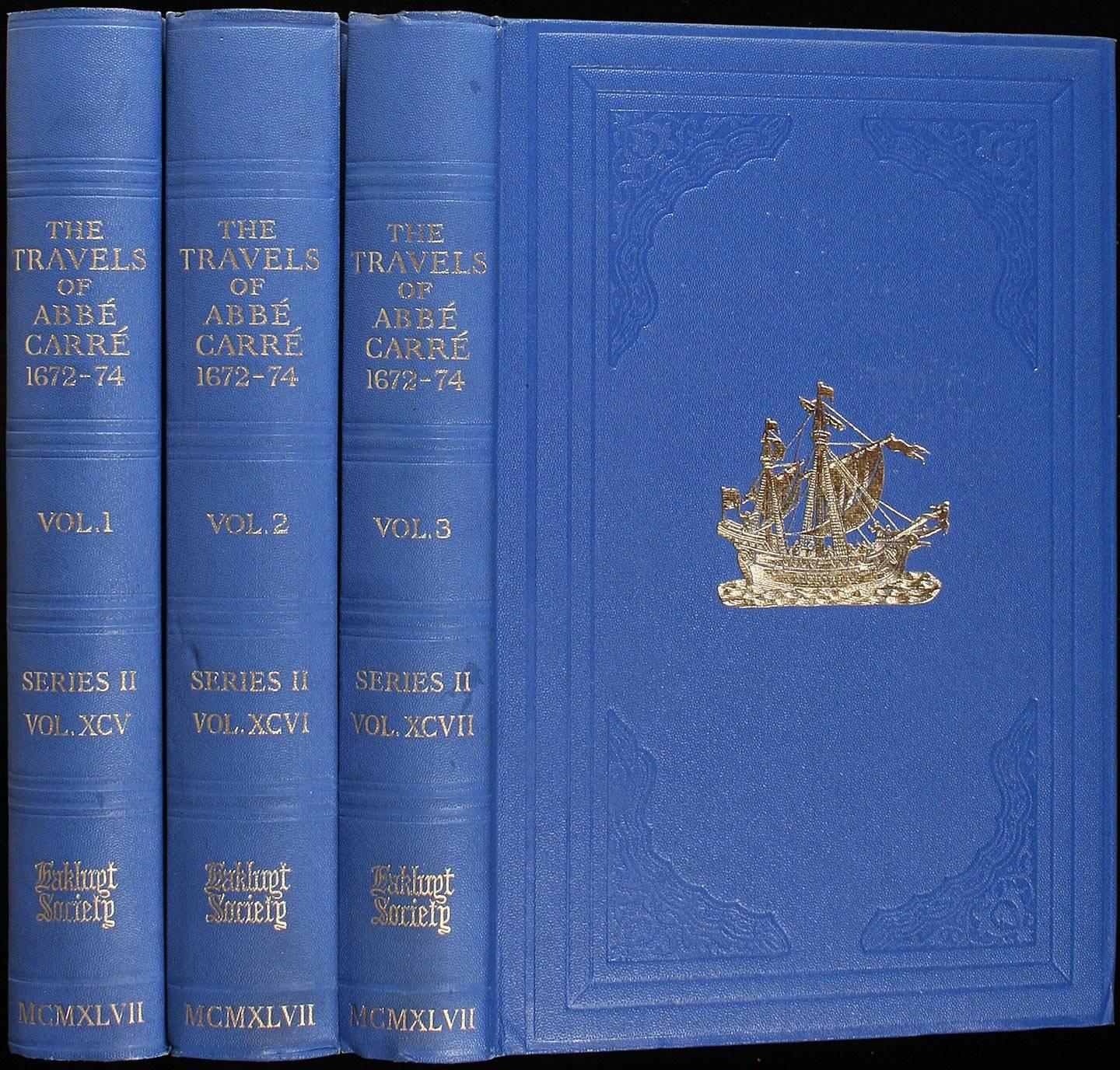
The Travels of the Abbé Carre in India and the Near East
Book
Fawcett, C. and Burn, R. (1947) The Travels of the Abbé Carre in India and the Near East. London, Hakluyt Society, 3 Vols., Second Series, No. 95–97 , 984 pp.
Sinkankas/Born No.: NIS/NIB | RWHL
travel and exploration, India, diamonds, Golconda, gems
The Travels of the Abbé Carré in India and the Near East, 1672 to 1674 is an English translation of the manuscript journal of Barthélemy Carré, a French Catholic priest and traveler whose journeys provide a detailed account of political conditions, commerce, religion, and European colonial rivalry in seventeenth-century India and the Near East. Translated by Lady Fawcett and edited by Sir Charles Fawcett with the assistance of Sir Richard Burn, the work was published by the Hakluyt Society in three volumes between 1947 and 1948. Carré traveled extensively through the territories of the Mughal Empire, the Deccan sultanates, and European trading settlements, recording his experiences and observations of local rulers, merchants, religious communities, transportation, and commercial practices. His narrative is particularly valuable for its contemporary descriptions of the French East India Company’s early attempts to establish itself in India and the fierce competition among French, Dutch, English, and Portuguese interests. The second volume concentrates on Carré’s journey from Bijapur through Golconda and Bhagnagar (Hyderabad) to the Coromandel coast in 1673, followed by his account of French military operations at St. Thomé, near Madras (Chennai), and the conflict involving the kingdom of Golconda and the Dutch. Of particular gemological interest is Carré’s description of the opulent court of Golconda, whose princes and nobles displayed their wealth through jewels and precious stones adorning their persons, elephants, horse harnesses, weapons, and palanquins. He describes the fortified royal city of Golconda and neighboring Bhagnagar as centers of extraordinary wealth and commerce, attracting merchants from many countries. Although Golconda was internationally renowned for its diamond trade and the celebrated diamond-producing districts associated with its kingdom, Carré’s account in this volume emphasizes the visible wealth of the court and the commercial importance of the region rather than providing detailed descriptions of diamond mining or cutting. In discussing the ambitions of the French East India Company, he specifically identifies pearls and diamonds among the valuable commodities that European merchants sought to obtain, alongside spices, textiles, and other luxury merchandise. His descriptions of the Dutch trading establishment at Bhagnagar, its warehouses, commercial privileges, customs arrangements, and extensive trading networks offer valuable evidence of the organization of European commerce in this important Indian market. The narrative also records the movement of merchants and merchandise between Golconda, Surat, Masulipatam, Madras, Ceylon (Sri Lanka), and Southeast Asia, illustrating the commercial connections through which precious stones and other luxury goods could circulate. Carré’s strong French patriotism, religious prejudices, and occasional exaggerations require critical interpretation, a problem addressed in the editors’ extensive historical annotations. The work is an important primary source for the economic and political history of seventeenth-century India, particularly the commercial environment surrounding Golconda during the period of its greatest international reputation as a center of the diamond trade.