
Four Treasures Reference Database
Record No. 10
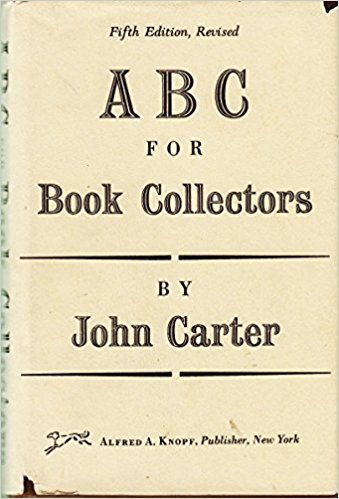
ABC for Book Collectors
Book
Carter, J. (1952) ABC for Book Collectors. New Castle, Delaware, Oak Knoll Press, 224 pp.
ISBN/ISSN: 1884718051 | Sinkankas/Born No.: NIS/NIB | RWHL
bibliography, book collecting, books on books, gems
John Carter’s ABC for Book Collectors, first published in 1952, is an authoritative and often witty dictionary of the specialized terminology employed by antiquarian booksellers, bibliographers, auctioneers, and collectors of rare books. Drawing upon Carter’s extensive experience in the antiquarian book trade, the work was designed to explain the technical language and conventions encountered in booksellers’ catalogues and auction descriptions, particularly those that might confuse newcomers to book collecting. Rather than offering a general history of printing or an encyclopedia of bibliography, Carter concentrates on the vocabulary necessary to understand, identify, describe, evaluate, and purchase collectible books. Arranged alphabetically, the entries explain terms relating to editions, impressions, issues, states, bindings, paper, typography, illustration, provenance, condition, rarity, and bibliographical description. Particular attention is devoted to the frequently misunderstood distinctions between first editions, first impressions, and subsequent issues or states, together with the evidence necessary to establish their chronological priority. Carter also examines the identification of incomplete, altered, restored, or otherwise imperfect copies, explaining such terms as cancels, collation, conjugate leaves, inserted advertisements, facsimiles, and made-up copies. The extensive treatment of bookbinding encompasses historical materials and techniques, including calf, morocco, vellum, buckram, publisher’s cloth, decorative tooling, and the various forms of contemporary and later bindings. Equally useful are the discussions of condition and the subjective language employed by booksellers, from descriptions such as “fine” and “very good” to euphemisms that may conceal serious defects. Carter warns collectors against exaggerated claims of rarity, unsupported assertions of priority, misleading bibliographical descriptions, and the temptation to equate high prices with importance. His observations on auction practices, provenance, association copies, presentation copies, dust jackets, and the preservation of original bindings demonstrate a practical understanding of the factors influencing the desirability and commercial value of books. Throughout the work, technical definitions are accompanied by historical examples, occasional anecdotes, and pointed comments on the habits and pretensions of collectors and dealers. The book’s distinctive combination of scholarship, practical advice, and dry humor distinguishes it from more conventional bibliographical dictionaries. Following Carter’s death in 1975, Nicolas Barker revised and expanded the work, incorporating developments in bibliography, the antiquarian trade, and collecting practices while preserving much of the original author’s distinctive style. Although the book contains no substantive gemological information, it is particularly valuable to collectors of historical gemological literature, providing the terminology and bibliographical principles needed to distinguish original editions from later printings, recognize significant variants, evaluate the completeness and condition of rare volumes, and interpret antiquarian booksellers’ descriptions. It remains an important reference for anyone assembling, cataloguing, or studying a specialized library of rare and historical books.