Gemstone Inclusions Bibliography

Gemstone Inclusions Bibliography

Explore books, articles and historical sources on inclusions in gemstones in Four Treasures, the Lotus Gemology reference database. This bibliography brings together matching records from the collection, with publication details, abstracts and cover images where available.

Gemstone Inclusion References

The list below matches the terms inclusion or inclusions in the database's searchable fields. Some references discuss inclusions as part of a broader subject.
1,181–1,200 of 1,344 matching references

Gemstone inclusions

Journal Article
Gübelin, E.J. (1944–46) Gemstone inclusions. Gems & Gemology, Vol. 4–5, Vol. 4, No. 10, Summer, pp. 142–149 (sapphire); No. 11, Fall, pp. 158–163 (ruby); No. 12, Winter, pp. 174–179 (emerald); Vol. 5, No. 1, Spring, pp. 205–210 (diamond); No. 5, Spring, p. 294–300; No. 6, Summer, pp. 318–323 (various gems).
Record No. 2027  |  ISBN/ISSN: 0016626X  |  Sinkankas/Born No.: NIS/NIB  |  RWHL
This illustrated series presents gemstone inclusions as practical evidence for identification, distinguishing natural from synthetic stones, and interpreting the conditions under which gems formed. Drawn from Gübelin’s photomicrographic studies and a collection of Kodachrome transparencies supplied to the Gemological Institute of America, the installments combine explanatory text with photographs and descriptive captions. Microscopic examination, particularly with dark-field illumination, reveals structures that may be overlooked or misinterpreted with a loupe. The sapphire section illustrates oriented needles and silk, angular growth zoning, mineral crystals, fluid cavities, and featherlike networks. Examples include hematite plates, enclosed corundum crystals, and cavities containing liquid and gas. These features are compared with curved growth striae and gas bubbles in synthetic sapphire. Gübelin cautions that appearances can be deceptive: natural cavities may resemble bubbles, while the curvature of synthetic growth lines may be difficult to recognize within a small field of view. The ruby installment similarly contrasts natural rutile arrangements, straight structural features, mineral inclusions, and fluid-related formations with curved striae and concentrations of gas bubbles in synthetic material. Zircon inclusions surrounded by halos and intersecting rutile needles illustrate characteristic internal features of individual specimens from Sri Lanka and Myanmar. The emerald section describes enclosed crystals, irregular cavities, and inclusions containing liquid, gas, and a solid phase, while comparing these with wispy formations and other internal features observed in synthetic emeralds. The diamond installment demonstrates the importance of illumination when interpreting dark inclusions: objects commonly regarded as black or carbonaceous may prove to be transparent crystals when examined appropriately. Photographs show enclosed crystals, including diamond, together with cleavage features and fractures associated with inclusions or extending inward from the surface. Subsequent installments broaden the survey to additional sapphires and other gem materials. Illustrated examples include fine networks of channels, negative crystals, mineral plates, zircon-associated halos, liquid inclusions with mobile bubbles, and cavities containing separate liquids. Topaz and tourmaline provide further examples of fluid-bearing inclusions, while the concluding selection extends the illustrated material to emerald, peridot, quartz, garnet, and moldavite. Biotite flakes in peridot and fibrous actinolite in quartz demonstrate the variety of solid inclusions; a fluid-bearing negative crystal in citrine reproduces the host’s prismatic form. Throughout the series, the diagnostic value lies in the combined character, arrangement, and appearance of internal features rather than in an isolated resemblance. Gübelin advocates making inclusion study an early part of gem examination, potentially preceding routine measurements of physical and optical properties. The series also emphasizes the scientific and aesthetic interest of microscopic structures, presenting gemstone interiors as records of mineral growth and subsequent events as well as aids to identification.

American-made synthetic crystals

Journal Article
Seemann, A.K. (1944) American-made synthetic crystals. Gems & Gemology, Vol. 4, No. 9, Spring, pp. 129–133.
Record No. 1572  |  ISBN/ISSN: 0016626X  |  Sinkankas/Born No.: NIS/NIB  |  RWHL
Gübelin investigates microscopic criteria for distinguishing emeralds from Colombia and Russia’s Ural Mountains, arguing that color alone provides an unreliable indication of origin. Although Colombian emeralds are associated with a velvety green and Russian stones with more yellowish hues, examples from either source may resemble those from the other, particularly in small sizes. A comparative table records their appearances through several colored filters, but the author emphasizes that interpreting these subtle differences requires considerable experience, a sensitive eye, and suitable comparison material. Seeking more objective evidence, he examined numerous emeralds of known provenance, including specimens supplied by the Colombian Consulate in Paris. He identifies minute fluid inclusions, rather than conspicuous fractures or cloudy areas, as the most useful distinguishing features. Colombian emeralds are described as containing scattered, irregular groups of delicate, frequently tail-like cavities. Their boundaries are faint, suggesting that the enclosed liquid has a refractive index relatively close to that of the host. The liquid’s composition was not established, although behavior during heating and considerations of formation led the author to suggest water. The cavities show no consistent crystallographic orientation and remain separate even when grouped. Almost every cavity is reported to contain a tiny cubic crystal, commonly adjoining a rounded gas bubble with a dark outline, so that solid, liquid, and gaseous phases coexist within one inclusion. Carbon dioxide is proposed as the gas, while the solid’s chemical identity remains unresolved. Gübelin regards the cubic form of this solid inclusion as the principal diagnostic feature of Colombian material. Russian emeralds likewise contain multiphase inclusions, but their distribution, cavity shapes, and enclosed crystals differ. Their cavities are more closely associated with fractures and moss-like internal features, lack the characteristic Colombian tails, and contain solid crystals displaying lozenge-shaped or rhombic outlines rather than clearly rectangular cubic forms. The author presents this contrast as a dependable means of separating the two sources and supplies a mnemonic linking Colombian origin with cubic crystals and Russian origin with rhombic crystals. He recommends photomicrography to document the observations and notes that the features can also be examined with a diamondscope. The concluding discussion separates geographical interest from intrinsic quality: identifying a fine emerald as Russian need not diminish its value, while knowledge of provenance may increase an owner’s appreciation of either a Colombian stone or an unusually fine-colored Ural specimen.

Survey of the genesis of gem stones

Journal Article
Gübelin, E.J. (1943) Survey of the genesis of gem stones. Gems & Gemology, Vol. 4, No. 8, Winter, pp. 110–113.
Record No. 2022  |  ISBN/ISSN: 0016626X  |  Sinkankas/Born No.: NIS/NIB  |  RWHL
Gübelin presents a schematic introduction to gemstone formation and deposits, using a circular diagram and an element-based table to make geological relationships more accessible to students of gemology. He emphasizes that such summaries necessarily simplify a complex subject but can clarify the individuality of gemstones, guide the practical study of deposits, and provide a foundation for further investigation. The classification distinguishes primary mineral formation from ascending solutions, termed magmatic in a broad sense, from secondary growth and concentration associated with decomposition, sedimentation, and metamorphism. Primary processes are subdivided into liquid-magmatic, pegmatitic and pneumatolytic, and hydrothermal and volcanic-exhalative categories. Secondary categories comprise chemical sediments derived from the atmosphere or hydrosphere, residual deposits produced through decomposition and metamorphism, and mechanically concentrated sediments, particularly alluvial deposits. The circular diagram places deposit types outside the circumference and representative gem materials within the corresponding sectors. Minerals occurring in more than one geological setting cross sector boundaries; corundum, spinel, and garnet are specifically identified as examples with multiple modes of occurrence. Related minerals are grouped according to chemical composition or paragenesis, while the more important gem materials receive typographical emphasis. Gübelin explains that the diagram favors practical usefulness over strict genetic classification. Thus, amber and jet are placed among metamorphic formations, while pearls and corals appear among chemical sediments, although he explicitly recognizes their organic origin. The accompanying table develops the survey through chemical elements, linking important minerals with magmatic, sedimentary, residual, and metamorphic settings. It includes familiar gems such as spodumene, tourmaline, beryl, chrysoberyl, corundum, diamond, quartz, opal, zircon, turquoise, and garnet, together with less common ornamental minerals and several metallic minerals. Separate columns indicate the different processes through which these materials may form or become concentrated. Notes draw attention to the production of aluminum-rich residues by weathering and their subsequent metamorphic transformation, the role of atmospheric carbon in carbonates and organic materials, and the redistribution of certain minerals into alluvial deposits. The inclusion of rare elements requires reference to some uncommon gem materials, but the author stresses that neither the mineral list nor the deposit classification is exhaustive. Together, the diagram and table offer a condensed teaching aid connecting gemstone chemistry, mineral associations, formation processes, and economically relevant occurrences, intended as a starting point for more detailed geological study.

The chemical compounds of some liquid inclusions
Journal Article
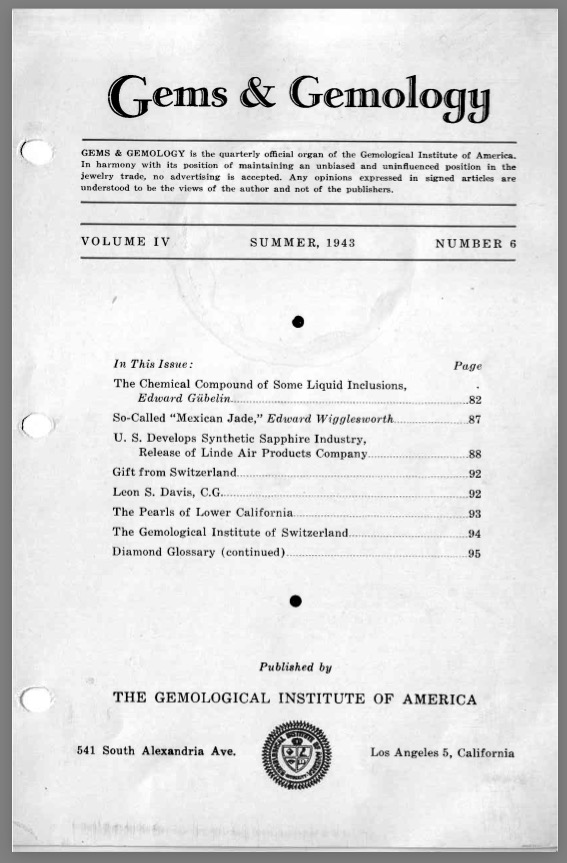
Gübelin, E.J. (1943) The chemical compounds of some liquid inclusions. Gems & Gemology, Vol. 4, No. 6, Summer, pp. 82–86; No. 7, Fall, pp. 98–100.
Record No. 2021  |  ISBN/ISSN: 0016626X  |  Sinkankas/Born No.: NIS/NIB  |  RWHL
Gübelin investigates the composition of fluid inclusions in gemstones through microscopic observation during heating and cooling, relating their phase behavior to the conditions of gem formation. He reviews earlier work by David Brewster, R.Th. Simmler, H. Vogelsang, H. Geissler, H.C. Sorby, and P.J. Butler, emphasizing evidence for water and carbon dioxide in cavities within quartz, corundum, beryl, topaz, and other minerals. The experimental method uses heat from a diamondscope’s illuminator, regulated through its transformer, together with temperature measurements; further investigations employ a special electric heating furnace attached to a microscope. Inclusions containing a mobile gas bubble are particularly suitable because changes in the liquid–gas boundary can be followed directly. A large negative-crystal inclusion in smoky quartz provides the principal example. As the stone warms, the curved meniscus progressively flattens, the liquid expands, and the bubble diminishes. At a reported temperature of 29.9 ± 0.1 °C, the boundary disappears abruptly; cooling restores the two-phase appearance, sometimes after a transient mist develops within the cavity. Gübelin interprets this behavior as evidence of nearly pure carbon dioxide with minor impurities, comparing the observed transition with the approximately 31 °C critical temperature of pure carbon dioxide. He reports comparable behavior in selected inclusions in Colombian emerald, Ceylon ruby, sapphire, and alexandrite, other beryls, topaz, phenakite, and several quartz varieties. The same response was absent from the tourmaline and chrysoberyl specimens examined, certain topaz inclusions, and some solid-bearing three-phase inclusions in Colombian and Ural emeralds. The continuation discusses cavities containing two distinguishable liquids and a gas bubble. Heating experiments lead the author to identify the liquids as water and liquid carbon dioxide, with water wetting the cavity walls and occupying marginal extensions, while carbon dioxide occupies the central region and contains the gas bubble. From these observations, he proposes a model in which crystals initially grow from aqueous solutions saturated with carbon dioxide under pressure. A sudden pressure release, possibly caused by tectonic movement, induces boiling and the separation of bubbles containing water vapor and carbon dioxide. Rapid subsequent crystal growth traps these bubbles against crystal surfaces. Larger cavities may reproduce an earlier crystal outline, whereas smaller inclusions preserve rounded or elongated bubble shapes. Gübelin also proposes pressure and temperature limits for formation from the phase relationships, presenting these as deductions from his interpretation. He considers the occurrence of carbon dioxide particularly consistent with gems associated with limestone and dolomite. The study presents thermal microscopy as a practical means of investigating inclusion chemistry and developing hypotheses about gemstone genesis.

Chinese Snuff-Bottles in Parti-Coloured Hardstones
Journal Article
Hildburgh, W.L. (1942) Chinese Snuff-Bottles in Parti-Coloured Hardstones. The Burlington Magazine for Connoisseurs, Vol. 81, No. 475, pp. 247–251.
Record No. 3406  |  ISBN/ISSN: 9510788  |  Sinkankas/Born No.: NIS/NIB  |  RWHL
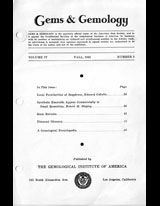
W.L. Hildburgh examines Chinese snuff-bottles carved from parti-coloured hardstones, emphasizing the lapidary’s ability to transform natural layers, stains, inclusions, and irregularities into coherent decorative designs. Extending an earlier discussion of Chinese hardstone carving, he argues that these small utilitarian objects often display exceptional artistic invention alongside technical mastery. He explains that the exterior is completed before hollowing begins, allowing the craftsman to investigate colour distribution, exploit useful features, and remove defects before undertaking the lengthy excavation of the interior. Reports from carvers using treadle-driven tools suggest that shaping and ornamenting a fine bottle could require ten to fifteen days, with another ten to thirty days devoted to hollowing and internal polishing. Thin walls enhance translucency, reduce weight, and demonstrate skill, while the precision achieved inside opaque or awkwardly shaped vessels reflects sophisticated control of tools and material. Hildburgh distinguishes several approaches to coloured decoration. Contrasting layers may be carved in rounded cameo relief against a relatively uniform body, as in agate bottles bearing horses, birds, bamboo, or a cricket among vegetables. Rock crystal with adhering white quartz matrix provides another combination, with the matrix shaped into trees, animals, and figures; one smoky-quartz example retains the crystal’s natural hexagonal form beneath carved decoration on all six faces. More complex stones permit the coordination of several coloured strata, variations in translucency, and differentiated polish within a single composition. Hildburgh also notes that separately carved reliefs may be cemented over flaws so skilfully that the repair is difficult to detect. Where colour occurs only in a thin surface concentration, the carver must preserve its irregular level and avoid rounding edges that would expose the underlying body colour. The article’s most sustained analysis concerns agates containing dispersed dark markings. Here the craftsman selectively lowers and shapes the surface to reveal coloured areas at different depths, adjusting their contours and opacity to create silhouettes, figures, foliage, birds, and landscape effects. Some natural formations remain untouched, while others are integrated with carefully worked details. Hildburgh contrasts this responsive manipulation with European uses of patterned stones, crediting Chinese carvers with an unusually sensitive appreciation of each specimen’s individual possibilities. Throughout, he stresses that photographs inadequately convey many effects dependent on subtle colour, translucency, depth, or decoration extending around the vessel. The study presents successful snuff-bottle carving as an accommodation between the demands of handling, the geological character of the stone, and the craftsman’s imaginative interpretation.

Local peculiarities of sapphires

Journal Article
Gübelin, E.J. (1942–43) Local peculiarities of sapphires. Gems & Gemology, Vol. 4, No. 3, Fall, pp. 34–39; No. 4, Winter, pp. 50–54; No. 5, Spring, pp. 66–69.
Record No. 877  |  ISBN/ISSN: 0016626X  |  Sinkankas/Born No.: NIS/NIB  |  RWHL
Gübelin’s three-part study investigates the geographical identification of sapphires from Kashmir, Burma, Siam, and Ceylon, emphasizing microscopic inclusions as records of differing geological conditions. Reference specimens were obtained from selected dealers trading directly with the producing regions, while Ceylon’s fancy-colored sapphires supplied additional comparative material. The introductory discussion reviews characteristic colors, chemical differences, luminescence, refractive indices, and density, but cautions that these properties generally provide indications rather than certain determinations of origin. Comparative emission spectra of Burmese and Ceylon sapphires are interpreted in relation to their iron and titanium contents. Luminescence under cathode rays and ultraviolet radiation varies among the four sources, although exceptions and inconsistent responses limit its diagnostic value. Small differences in refractive index and specific gravity are likewise considered insufficient for confident identification alone. Microscopic examination forms the principal basis of the regional comparisons. Kashmir sapphires exhibit a characteristic haze that resolves under magnification into delicate veils of wavy, intersecting filaments arranged in hexagonal patterns. Gübelin distinguishes these from rutile needles, describing them instead as minute fissures or hollow tubes. Other Kashmir inclusions comprise thin films bordered by irregular networks of liquid-filled channels extending into individual droplets; their appearance changes as the stone is tilted. Burmese sapphires are characterized chiefly by short rutile needles densely distributed or grouped into patches, clouds, and zones. These follow the host’s crystallographic directions and intersect at 60° and 120° when viewed along the optic axis. Larger, well-formed rutile crystals and occasional curved liquid-filled cavities containing mobile gas bubbles are also described. Siamese sapphires are reported to lack rutile and instead contain broad, flat, loop-like fluid inclusions associated with opaque, approximately hexagonal features interpreted as resorbed crystals or negative crystals. Additional characteristics include brown material attributed to iron compounds, recrystallized inclusions in hexagonal arrangements, checkered twinning lamellae, and rows of script-like or arabesque fluid inclusions. Ceylon sapphires display a greater variety and generally less orderly distribution of inclusions. Their rutile needles are notably longer, sparser, and more widely spaced than those in Burmese material. Characteristic fluid feathers and flags comprise numerous tubular or wormlike cavities extending into isolated droplets, often with mobile gas bubbles; Gübelin identifies their liquid as carbon dioxide on the basis of his own investigations. He also describes scattered minute mineral inclusions, broad irregular fluid-filled tubes, and brown zircon crystals surrounded by pleochroic radiation halos. These zircons are regarded as particularly useful indicators of Ceylon origin, whereas accessory minerals occurring across several sources provide less decisive evidence. The study concludes that reliable interpretation requires extensive experience with numerous specimens and that photomicrographs offer a useful means of documenting the observed characteristics.

Genuine type inclusions in new European synthetics
Journal Article
Gübelin, E.J. (1942) Genuine type inclusions in new European synthetics. Gems & Gemology, Vol. 4, No. 2, Summer, pp. 18–21.
Record No. 876  |  ISBN/ISSN: 0016626X  |  Sinkankas/Born No.: NIS/NIB  |  RWHL
Gübelin describes unusual gas inclusions in synthetic corundum and spinel that closely resemble fluid inclusions in natural gems, emphasizing the need to examine their contents and optical behavior rather than identify origin from shape alone. Natural and synthetic corundum have closely similar chemical and physical properties, while differences in refractive index and luminescence may be too small or overlapping to provide decisive evidence. Microscopic characteristics therefore assume particular importance. The author reviews natural corundum’s oriented rutile needles, other mineral inclusions, fluid cavities, and growth structures, contrasting these with the curved striae and rounded gas bubbles commonly associated with synthetic material. He cautions that twinning occasionally occurs in synthetics and that internal cracks near facet junctions can result from strain in either natural or synthetic stones. Recent examinations revealed rare, irregular gas cavities, particularly in blue synthetic sapphires, with elongated, tubular, wormlike, dendritic, and mesh-like forms. Some resemble coarse liquid feathers in natural corundum so closely that they could lead to misidentification. Small accompanying spherical bubbles and, in one illustrated specimen, curved striae exposed by closing the microscope’s iris diaphragm provide additional evidence of synthetic origin. Dark, hazy areas in another sapphire are attributed to localized concentrations of coloring material. Gübelin distinguishes the illustrated gas-filled cavities from natural liquid inclusions by rotating the stone in an immersion cell: the gas inclusions remain black, whereas liquid-filled cavities appear transparent when viewed through their flat sides and may contain a separate gas bubble. He notes that such deceptive forms were uncommon at the time but might become more frequent as manufacturing improved. The discussion then turns to synthetic spinel, whose variable excess of aluminum oxide affects refractive index and specific gravity, limiting reliance on these properties alone. Although curved striae are absent, occasional gas inclusions may likewise be elongated, wormlike, sharply outlined, or apparently oriented. Anomalous double refraction caused by internal strain offers a further means of recognition. Under polarized examination, synthetic spinel displays incomplete extinction and irregular bright and dark patterns, including cloudy, fibrous, feathery, and crosshatched appearances. The author contrasts these with the weaker, indistinct, blotchy anomalous double refraction sometimes observed in natural spinel, commonly associated with solid or fluid inclusions. He also distinguishes the latter from the more checkered patterns seen in garnet. The article concludes that characteristic strain patterns, considered together with inclusion morphology, cavity contents, and other microscopic evidence, permit recognition of synthetic material despite its potentially deceptive resemblance to natural gems.

The synthetic emerald

Journal Article
Gübelin, E.J. (1941) The synthetic emerald. Gems & Gemology, Vol. 3, No. 10, Summer, pp. 146–150.
Record No. 2020  |  ISBN/ISSN: 0016626X  |  Sinkankas/Born No.: NIS/NIB  |  RWHL
Gübelin and Robert M. Shipley, Jr., examine the identification of synthetic emerald following its introduction into the American jewelry trade, including reports of synthetic stones mixed with natural emeralds. Their account draws on five specimens studied by Gübelin and ten examined at the Gemological Institute of America’s Los Angeles laboratory. It discusses the German product marketed by I.G. Farbenindustrie as “Igmerald,” while an editorial note states that the American laboratory’s specimens came from an agent claiming independent manufacture in the United States. Synthetic emerald resembles natural material in color, luster, chemical composition, and crystal form. Unlike the pear-shaped boules associated with synthetic corundum and spinel, it develops as groups of well-formed hexagonal crystals, sometimes large enough to yield fashioned stones exceeding one carat. Straight growth bands parallel to the basal plane may occur, but external appearance and crystal habit provide little assistance in identification. The authors instead advocate combining optical measurements with microscopic examination. Their synthetic specimens show lower refractive indices and birefringence than the natural emeralds tabulated for comparison; representative synthetic values are 1.562–1.564 for the ordinary ray and 1.559–1.561 for the extraordinary ray, giving birefringence of approximately 0.003. Recent synthetic material displays relatively weak dichroism, contrasting with earlier reports of strong dichroism and indicating changes accompanying manufacturing progress. Pronounced anomalous double refraction produces birefringent patches and interference colors, attributed to internal strain probably associated with rapid growth. Previously published Laue photographs are cited as additional evidence of strain. Igmerald also exhibits absorption bands at 594 and 606 nm beyond the chromium-related features discussed for emerald; the authors propose these as diagnostic of that product and tentatively associate them with increased chromium content. Specific gravity is generally lower in synthetic material, but overlapping values limit its usefulness alone. Microscopic inclusions receive particular emphasis as a practical means of distinction. The examined synthetics lack the solid crystalline particles within fluid cavities that the authors associate with natural emerald’s three-phase inclusions. Separate minute solid particles may nevertheless occur in swarms. The most characteristic internal features are delicate featherlike, wispy, or veil-shaped formations resembling cracked lacquer or cloisonné. At approximately 250× magnification, these resolve into numerous small liquid inclusions containing rounded gas bubbles, arranged in broad, slightly curved groups. Nearly parallel rodlike features, interpreted as probable gas-filled cavities, are especially conspicuous in older synthetic material. The authors conclude that the combined evidence of refractive properties, strain patterns, absorption features, and characteristic inclusions permits reliable separation of the synthetic emeralds examined from natural stones, despite their close visual resemblance.

Differentiation between Russian and Colombian emerald
Journal Article
Gübelin, E.J. (1940) Differentiation between Russian and Colombian emerald. Gems & Gemology, Vol. 3, No. 6, Summer, pp. 89–92.
Record No. 2018  |  ISBN/ISSN: 0016626X  |  Sinkankas/Born No.: NIS/NIB  |  RWHL
Gübelin investigates microscopic criteria for distinguishing emeralds from Colombia and Russia’s Ural Mountains, arguing that color alone provides an unreliable indication of origin. Although Colombian emeralds are associated with a velvety green and Russian stones with more yellowish hues, examples from either source may resemble those from the other, particularly in small sizes. A comparative table records their appearances through several colored filters, but the author emphasizes that interpreting these subtle differences requires considerable experience, a sensitive eye, and suitable comparison material. Seeking more objective evidence, he examined numerous emeralds of known provenance, including specimens supplied by the Colombian Consulate in Paris. He identifies minute fluid inclusions, rather than conspicuous fractures or cloudy areas, as the most useful distinguishing features. Colombian emeralds are described as containing scattered, irregular groups of delicate, frequently tail-like cavities. Their boundaries are faint, suggesting that the enclosed liquid has a refractive index relatively close to that of the host. The liquid’s composition was not established, although behavior during heating and considerations of formation led the author to suggest water. The cavities show no consistent crystallographic orientation and remain separate even when grouped. Almost every cavity is reported to contain a tiny cubic crystal, commonly adjoining a rounded gas bubble with a dark outline, so that solid, liquid, and gaseous phases coexist within one inclusion. Carbon dioxide is proposed as the gas, while the solid’s chemical identity remains unresolved. Gübelin regards the cubic form of this solid inclusion as the principal diagnostic feature of Colombian material. Russian emeralds likewise contain multiphase inclusions, but their distribution, cavity shapes, and enclosed crystals differ. Their cavities are more closely associated with fractures and moss-like internal features, lack the characteristic Colombian tails, and contain solid crystals displaying lozenge-shaped or rhombic outlines rather than clearly rectangular cubic forms. The author presents this contrast as a dependable means of separating the two sources and supplies a mnemonic linking Colombian origin with cubic crystals and Russian origin with rhombic crystals. He recommends photomicrography to document the observations and notes that the features can also be examined with a diamondscope. The concluding discussion separates geographical interest from intrinsic quality: identifying a fine emerald as Russian need not diminish its value, while knowledge of provenance may increase an owner’s appreciation of either a Colombian stone or an unusually fine-colored Ural specimen.

Characteristics of Ceylon rubies

Journal Article
Gübelin, E.J. (1940) Characteristics of Ceylon rubies. Gems & Gemology, Vol. 3, No. 8, Winter, pp. 121–124.
Record No. 2017  |  ISBN/ISSN: 0016626X  |  Sinkankas/Born No.: NIS/NIB  |  RWHL
Gübelin examines the characteristics of rubies from Ceylon, now Sri Lanka, emphasizing microscopic inclusions as evidence for distinguishing them from rubies of other origins. The study follows his examination of Ceylon rubies passing through his laboratory after an earlier article in which he had been unable to describe their diagnostic inclusions. He notes that these stones are generally paler than rubies from other localities and approach the color commonly termed pink sapphire, although he regards them as pale rubies colored by chromium. Comparative spectrograms of Burmese and Ceylon rubies are interpreted as supporting a lower chromium content in the latter, whose absorption lines are fainter and fewer. Differences in ultraviolet fluorescence may also assist an experienced observer, but Gübelin considers microscopic examination more accurate and informative. Fine rutile needles are common and follow crystallographic directions, intersecting at 60° when viewed along the optic axis. Compared with Burmese rubies, the needles in Ceylon material are described as scarcer and more widely spaced. Photographic comparisons demonstrate that darkfield illumination reveals these delicate inclusions much more effectively than direct transmitted light, which can obscure their appearance. Rutile frequently occurs together with liquid inclusions forming large flags, feathers, irregular tubes, wormlike cavities, and droplike features arranged in approximately parallel dotted lines. Some thin, elongated channels combine into vane-like formations. Many cavities contain mobile gas bubbles, confirming the presence of liquid. Carbon dioxide is mentioned as a proposed identity for the enclosed liquid, but the author explicitly states that this has not been proved. Liquid inclusions also occur in rubies from Siam, now Thailand, although their contrasting forms are considered useful in determining origin. Gübelin identifies zircon crystals surrounded by halos as the most characteristic inclusions in Ceylon rubies. These crystals display strong relief because of their high refractive index, while their external forms are seldom clearly defined. The surrounding halos are usually brown and may appear as concentric zones fading outward, groups of radial rays, or incomplete arrangements of irregular rays. The author attributes the halos to structural alteration of the host caused by radiation from constituents within the zircon. Examination in plane-polarized light reveals direction-dependent absorption, with the stronger absorption apparently corresponding to that of the host mineral. Comparable halos are noted around zircon inclusions in Ceylon sapphires, cordierite, and dark brown biotite. Additional solid inclusions reported in the rubies comprise more or less well-formed muscovite and corundum crystals, together with occasional very thin calcite blades.

Asterism in garnet, spinel, quartz, and sapphire
Journal Article
Walcott, A.J. (1937) Asterism in garnet, spinel, quartz, and sapphire. Geological Series of the Field Museum of Natural History, Vol. 7, No. 3, December, pp. 39–57.
Record No. 1803  |  Sinkankas/Born No.: NIS/NIB  |  RWHL
Walcott investigates asterism in garnet, spinel, quartz and sapphire through microscopic observations, measurements of angular relationships, and geometrical reconstructions of luminous bands on spheres and crystal models. His principal aim is to relate star patterns to crystallographic symmetry and to identify the internal structures responsible for their formation. Two almandine garnet spheres in the Field Museum display four great-circle chatoyant bands intersecting to produce twelve four-rayed stars, each with alternating angles of 70°32′ and 109°28′. These bands are associated with fine elongated inclusions oriented parallel to the crystal’s threefold symmetry axes. A garnet cabochon possesses an additional inclusion system parallel to the fourfold axes, producing a combination of four- and six-rayed stars. A dark-red spinel cabochon contains inclusions aligned with the twofold symmetry axes; projected onto a complete sphere, its six bands would generate eight six-rayed stars with 60° angles and six four-rayed stars with 90° angles. These observations directly challenge the assumption that cubic minerals can exhibit only four-rayed stars with right angles. Walcott develops a classification of possible inclusion arrangements parallel to the three classes of symmetry axes in the hexoctahedral crystal class, considering both complete and incomplete sets and their combinations. He calculates a minimum of 179 possible arrangements, while distinguishing the few represented by available specimens from hypothetical configurations. The most elaborate configuration considered would produce thirteen great-circle bands and combinations of six- and eight-rayed stars. Turning to colourless quartz, rose quartz and sapphire, he describes three intersecting bands forming six-rayed stars at the poles of the crystallographic c-axis. Restricted illumination reveals fine internal striae that he interprets as surface growth striations incorporated into the crystal during oscillatory development of different crystal forms. In sapphire, he further suggests that some striae lengthened through minute cracks associated with metamorphism. He attributes the greater abundance of star sapphires than star rubies to differences in prevailing crystal habits and their propensity to develop striations. Variations in the fineness, continuity and arrangement of these structures are used to explain sharply defined, broad or feathery star bands, while zoning, twinning and other inclusions may diminish their brightness. A predominantly single directional system can produce a sapphire cat’s-eye when appropriately cut. Throughout the study, Walcott interprets asterism chiefly as a diffraction phenomenon, supported by transmitted-light stars in quartz and spectral colours observed in sapphire bands. The paper combines documented observations with geometrical predictions and proposed explanations for the origin of the structures producing the optical effects.

Unusual inclusions in synthetic ruby

Journal Article
Anonymous (1937) Unusual inclusions in synthetic ruby. Gems & Gemology, Vol. 2, No. 5, Spring, pp. 91–92.
Record No. 277  |  ISBN/ISSN: 0016626X  |  Sinkankas/Born No.: NIS/NIB  |  RWHL
This brief laboratory report describes unusual inclusions in synthetic rubies submitted to the Gemological Institute of America during the opening months of 1937 and warns that their appearance can lead to mistaken identification as natural stones. Several specimens contained highly irregular inclusions resembling crystalline features ordinarily associated with natural gems. The article presents ten photomicrographs documenting different features within a single synthetic ruby, thereby showing how apparently natural inclusions can coexist with evidence of synthetic origin in the same specimen. The first two views emphasize the crystallized appearance of the inclusions, without showing any of the bubbles typically associated with synthetic material. In the next five views, the features described as crystalloids occur together with bubbles; the seventh illustration particularly emphasizes prominent bubbles. The final three photographs were obtained with the stone immersed in methylene iodide, which made its curved striae readily visible. Without immersion in a highly refractive liquid, these striae were insufficiently conspicuous to reveal the stone’s synthetic identity. The principal diagnostic difficulty is therefore that a hurried examination may disclose only the inclusions resembling those of a natural ruby, while overlooking the bubbles and curved striae needed to establish synthetic origin. The report notes that, in every specimen of this type examined by the institute up to that time, the bubbles were very large and prominent once located. Their presence nevertheless required deliberate examination rather than reliance on the first features observed. The sequence of illustrations supports the author’s warning that inclusions with an apparently crystalline form should not, by themselves, be accepted as proof that a ruby is natural. Greater care is urged before issuing such an identification, particularly where the initial microscopic impression appears convincing but other internal characteristics remain unexamined. The report confines its observations to synthetic rubies received for testing and does not establish that comparable inclusions occur in synthetic stones of other colors. It nevertheless raises that possibility as a reason for broader vigilance. Its central contribution is to document the deceptive coexistence of natural-looking inclusions, bubbles, and inconspicuous curved striae, and to demonstrate the importance of immersion when ordinary examination fails to reveal diagnostic internal structure.

Bergkristall, Glas und Glasflüsse nach dem Steinbuch von el-Bērūnī
Rock crystal, glass, and glass fluxes according to Al-Biruni's Book of Stones
Journal Article
Kahle-Bonn, P. (1936) Bergkristall, Glas und Glasflüsse nach dem Steinbuch von el-Bērūnī. [Rock crystal, glass, and glass fluxes according to Al-Biruni's Book of Stones] Zeitschrift der Deutschen Morgenländischen Gesellschaft, Vol. 90, pp. 322–356.
Record No. 8124  |  Sinkankas/Born No.: NIS/NIB  |  Language: in German  |  RWHL
Kahle presents and translates sections of al-Bīrūnī’s eleventh-century Kitāb al-jamāhir fī maʿrifat al-jawāhir dealing with rock crystal, glass, enamel/glass fluxes (mīnā), and ruby glass (adrak), using two manuscripts and emphasizing the value of al-Bīrūnī’s account for understanding the materials and techniques represented among the Fatimid treasures. Rock crystal is described as a transparent, colorless stone prized for vessels, hardness, clarity, and resemblance to water and air; al-Bīrūnī discusses its sources, working, value, inclusions, and supposed formation, including contemporary observations and historical anecdotes concerning valuable crystal vessels. Glass is described as produced by melting quartz or sand with alkali, prolonged firing increasing its clarity and hardness; properly made colorless glass could approach rock crystal in transparency, though its greater abundance and softness reduced its value. Particularly important is al-Bīrūnī’s treatment of mīnā, explicitly described as a type of glass, softer and heavier according to its lead content. He records recipes employing finely powdered quartz or rock crystal with red lead or tin oxide, together with natron or borax-type fluxes, and gives coloring materials: lead compounds for yellow, copper compounds for green, burned brass for red, iron residues for black, manganese for wine-purple, lead white for white, burned gold for ruby color, and lapis lazuli and carnelian for violet. Kahle notes that these descriptions strongly support the interpretation of mīnā in Fatimid inventories primarily as enamel or vitreous flux. The final section discusses adrak, an ancient Alexandrian red or garnet-colored glass reportedly comparable in appearance and value to ruby and whose manufacture was said already to have been lost by the ninth century; al-Bīrūnī preserves several recipes or traditions for attempting its production, along with observations on other artificial colored materials, mosaics, and objects recovered from ancient Egyptian and Yemeni burials.

Jade

Journal Article
Anonymous (1934) Jade. Gems & Gemology, Vol. 1, No. 3, May–June, pp. 80–82.
Record No. 3636  |  ISBN/ISSN: 0016626X  |  Sinkankas/Born No.: NIS/NIB  |  RWHL
This article surveys jade’s physical characteristics, sources, cultural associations, manufacture, valuation, and ornamental uses, while promoting it as a suitable Mother’s Day gift. It distinguishes nephrite from fei cui, describing nephrite as a compact aggregate of minute fibrous amphibole crystals whose exceptional toughness exceeds that of the more granular fei cui. Fei cui is presented as harder, heavier, and more refractive than nephrite, while dark green to black material termed chloromelanite is associated with increased iron content. The principal source of fei cui is identified as the Mogaung district of Upper Burma, whereas nephrite is reported from the Karakash Valley in Turkestan, China, Siberia, New Zealand, and other localities. Guangzhou and Beijing are described as important trading and carving centers, although the author cautions that the finest pieces seldom appear openly in tourist shops and that inexperienced visitors may pay excessive prices. Historical discussion connects the names jade and nephrite with beliefs concerning their ability to remedy kidney or loin disorders, and recounts the esteem accorded jade by the Aztecs, Māori, and other peoples who fashioned it into tools and weapons. Particular attention is given to Chinese traditions, including jade’s association with charity, modesty, courage, justice, wisdom, constancy, happiness, and longevity. The article also describes its use in musical instruments and burial customs, together with collectors’ appreciation of rust-colored archaeological pieces, whose appearance was sometimes imitated artificially. Traditional manufacture involves sawing with wire and an abrasive, usually powdered corundum, followed by hand carving and polishing. Carved motifs are assigned symbolic meanings, including the bat for happiness and the butterfly for immortality. The color discussion encompasses numerous greens, white, yellow, brown, lavender, and bluish lavender. The author contrasts Chinese appreciation of “mutton-fat” white material with American preference for emerald-green fei cui, and questions reports of genuinely blood-red jade. Dark inclusions and uneven coloration are said to diminish value, although skilled carvers incorporate contrasting areas into their designs. Fine, flawless, uniformly colored material fashioned as a simple cabochon is considered more valuable than pierced carving. Uses include earrings, brooches, rings, snuff bottles, vases, bowls, belt buckles, and dress clasps. The concluding passages encourage collecting and repeated gifts of jade, emphasizing its durability, varied appearance, cultural significance, and availability across a broad range of prices.

New facts about Siam rubies

Journal Article
Halford-Watkins, J.F. (1934) New facts about Siam rubies. The Gemmologist, Vol. 4, No. 41, December, pp. 147–149.
Record No. 915  |  Sinkankas/Born No.: NIS/NIB  |  RWHL

Lapis-lazuli et rubis balais des cipolins afghans
Lapis lazuli and balas rubies from Afghan marbles
Journal Article
Barthoux, J. (1933) Lapis-lazuli et rubis balais des cipolins afghans. [Lapis lazuli and balas rubies from Afghan marbles] Comptes Rendus de l’Académie des Sciences de France, Vol. 196, 10-Apr, pp. 1131–1134.
Record No. 436  |  Sinkankas/Born No.: NIS/NIB  |  Language: in French  |  RWHL
Describes lapis lazuli, spinel, and ruby occurrences in the crystalline limestones and marbles associated with Afghanistan’s extensive metamorphic formations. The Badakhshan lapis lazuli deposit lies in the upper Kokcha valley, about ten kilometres downstream from Robat, where mineralization locally replaces the enclosing marble. Barthoux records three commercial colour varieties and describes extraction by heating selected portions of the rock with fires, followed by ventilation and removal of the loosened blocks. Lazurite crystals reaching 15 mm occur in the surrounding white marble, accompanied by phlogopite, humite, forsterite, and pyrite; crystallographic details are provided for several minerals. Historical balas rubies from Gharan, near Siz on the right bank of the Oxus, are described as large, slightly cloudy, violet-pink spinel octahedra, distinguished from almandine obtained across the river. At Jagdalak, between Kabul and Jalalabad, steeply inclined marbles contain abundant spinels of various colours together with pink corundum. The paper describes the crystal forms of the corundum and associated minerals, including humite, chondrodite, phlogopite, fuchsite, rutile, titanite, hematite, pyrite, and diopside. Emerald-green pargasite occurs as isolated crystals or aggregates with phlogopite, and a chemical analysis is reported for comparison with edenite.

Some Notes on the Ruby

Journal Article
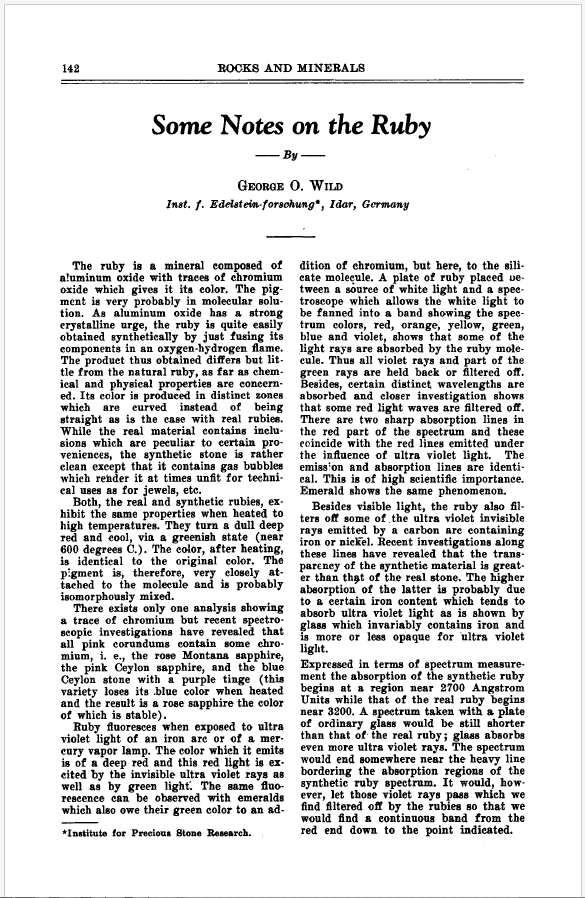
Wild, G.O. (1930) Some Notes on the Ruby. Rocks & Minerals, Vol. 5, No. 4, p. 142.
Record No. 30000  |  ISBN/ISSN: 0035-7529  |  Sinkankas/Born No.: NIS/NIB  |  RWHL
The ruby is a mineral composed of aluminum oxide with traces of chromium oxide which gives it its color. The pigment is very probably in molecular solution. As aluminum oxide has a strong crystalline urge, the ruby is quite easily obtained synthetically by just fusing its components in an oxygen-hydrogen flame. The product thus obtained differs but little from the natural ruby, as far as chemical and physical properties are concerned. Its color is produced in distinct zones which are curved instead of being straight as is the case with real rubies. While the real material contains inclusions which are peculiar to certain proveniences, the synthetic stone is rather clean except that it contains gas bubbles which render it at times unfit for technical uses as for jewels, etc. Both, the real and synthetic rubies, exhibit the same properties when heated to high temperatures. They turn a dull deep red and cool, via a greenish state (near 600 degrees C.). The color, after heating, is identical to the original color. The pigment is, therefore, very closely attached to the molecule and is probably isomorphously mixed. There exists only one analysis showing a trace of chromium but recent spectroscopic investigations have revealed that all pink corundums contain some chromium, i. e., the rose Montana sapphire, the pink Ceylon sapphire, and the blue Ceylon stone with a purple tinge (this variety loses its blue color when heated and the result is a rose sapphire the color of which is stable). Ruby fluoresces when exposed to ultra violet light of an iron arc or of a mercury vapor lamp. The color which it emits is of a deep red and this red light is excited by the invisible ultra violet rays as well as by green light. The same fluorescence can be observed with emeralds which also owe their green color to an addition of chromium, but here, to the silicate molecule. A plate of ruby placed between a source of white light and a spectroscope which allows the white light to be fanned into a band showing the spectrum colors, red, orange, yellow, green, blue and violet, shows that some of the light rays are absorbed by the ruby molecule. Thus all violet rays and part of the green rays are held back or filtered off. Besides, certain distinct wavelengths are absorbed and closer investigation shows that some red light waves are filtered off. There are two sharp absorption lines in the red part of the spectrum and these coincide with the red lines emitted under the influence of ultra violet light. The emission and absorption lines are identical. This is of high scientific importance. Emerald shows the same phenomenon. Besides visible light, the ruby also filters off some of the ultra violet invisible rays emitted by a carbon arc containing iron or nickel. Recent investigations along these lines have revealed that the transparency of the synthetic material is greater than that of the real stone. The higher absorption of the latter is probably due to a certain iron content which tends to absorb ultra violet light as is shown by glass which invariably contains iron and is more or less opaque for ultra violet light. Expressed in terms of spectrum measurement the absorption of the synthetic ruby begins at a region near 2700 Angstrom Units while that of the real ruby begins near 3200. A spectrum taken with a plate of ordinary glass would be still shorter than that of the real ruby; glass absorbs even more ultra violet rays. The spectrum would end somewhere near the heavy line bordering the absorption regions of the synthetic ruby spectrum. It would, however, let those violet rays pass which we find filtered off by the rubies so that we would find a continuous band from the red end down to the point indicated.

The composition of the earth’s crust

Journal Article
Clarke, F.W. and Washington, H.S. (1924) The composition of the earth’s crust. USGS Professional Paper, No. 127, 117 pp..
Record No. 4736  |  Sinkankas/Born No.: NIS/NIB  |  RWHL
Clarke and Washington estimate the chemical composition of the earth’s accessible outer crust through a compilation of 5,159 selected analyses of igneous rocks, supplemented by data on sedimentary rocks, ocean water, and the atmosphere. Regional and continental averages are compared, with explicit consideration of uneven geographical coverage, analytical quality, minor constituents, and alternative weighting methods. Calculations adopt an assumed crustal thickness of ten miles and distinguish the composition of solid rocks from that of the combined lithosphere, hydrosphere, and atmosphere. Oxygen and silicon dominate the resulting estimates, while a small group of common elements accounts for nearly all crustal material. The average igneous composition is interpreted as broadly granodioritic, although provisional inclusion of ocean-floor areas produces a more mafic estimate. Further sections examine analytical methods, meteorite composition, elemental abundance, mineral associations, and relationships to the periodic classification. The authors distinguish predominantly rock-forming, or petrogenic, elements from ore-forming, or metallogenic, elements, relating their occurrence to characteristic mineral groups and natural processes of concentration. The study provides a quantitative framework for geochemical comparison while acknowledging substantial uncertainties arising from incomplete sampling and assumptions about the crust’s structure and extent.

Le rubis

The ruby
Journal Article
Escard, J.-G. (1913) Le rubis. [The ruby] Cosmos, Vol. 62, No. 1481,, 12 Juin pp. 655–660.
Record No. 2547  |  Sinkankas/Born No.: NIS/NIB  |  Language: in French  |  RWHL
Escard provides a concise survey of the ruby, describing its varieties, physical properties, geographical sources, mining, cutting, valuation, and methods of distinguishing natural stones from imitations and artificial products. [655] He identifies ruby as red corundum and discusses differences in color among rubies from Burma, Siam, and Ceylon, noting that terminology such as “Oriental ruby” and “Siam ruby” was often applied inconsistently in commerce. [656] Particular attention is given to microscopic examination: natural rubies may contain crystalline inclusions and other internal features, while differences in color and dichroism can help separate stones from different sources; illustrations show characteristic inclusions and a Ceylonese lapidary at work. [657] Escard discusses the distinctive internal structure of Burmese and Siamese rubies, differences observed with the dichroscope, and variations in specific gravity, accompanied by photomicrographs and a map of the ruby-bearing district of Burma. [658] Fluorescence and phosphorescence are described as useful diagnostic properties, Burmese rubies showing particularly strong fluorescence; the principal ruby deposits are said to occur in Burma and Ceylon, where ruby-bearing gravels are washed and sorted, with an account of mining and recovery methods in the Mogok district and illustrations of the Burmese mines. [659] The article gives production and value figures for Burmese ruby mining, mentions occurrences in Ceylon, Siam, Afghanistan, and elsewhere, discusses the considerable variation in value according to color, quality, and size, and briefly describes cutting practices, including the preference for the oval form. [660] Escard concludes with remarks on celebrated rubies, including stones associated with European collections, and emphasizes the commercial importance of distinguishing natural rubies from artificial stones, illustrating a certificate of authenticity for a natural Burmese ruby.

The Morgan Collection of precious stones

Journal Article
Kunz, G.F. (1913) The Morgan Collection of precious stones. American Museum Journal, Vol. 13, No. 4, April, pp. 159–168.
Record No. 1150  |  Sinkankas/Born No.: NIS/NIB  |  RWHL
Traces the formation of J. Pierpont Morgan’s gem collection at the American Museum of Natural History, beginning with material assembled by Kunz through Tiffany & Co. for the Paris Exposition of 1889 and expanded through a second collection exhibited in 1900. Describes outstanding rough crystals, cut gemstones, pearls and carved objects, recording their localities, weights, colors and historical associations. Highlights include large sapphires and aquamarines, Madagascar morganite, California tourmalines and kunzite, American freshwater pearls, jade vessels, Babylonian cylinder seals and Persian engraved gems. Explains that the collection was intended to illustrate both gemstone diversity and the history of lapidary craftsmanship across cultures. Notes mineral inclusions, phantom growth structures and exceptionally thin polished jade sections, alongside Morgan’s subsequent acquisition of the Bement mineral and meteorite collections. Photographs illustrate selected specimens and objects.

Exploring the Literature of Gemstone Inclusions

The literature of gemstone inclusions covers identification, origin determination, treatments, synthesis, mineral inclusions, fluid inclusions and other internal features of natural and synthetic gems.

For a curated selection of important sources, read Inclusions in Gemstones — Hyperion Literature Sources.

About Four Treasures

Four Treasures is Lotus Gemology's freely accessible gemological reference database. Use the full database to search by author, title or keyword and explore literature on gemology, mineralogy, jewelry and related fields. Where available, hyperlinks on titles may lead directly to the full publication.

Search the Complete Four Treasures Database