Gemology Books Bibliography

Gemology Books Bibliography

Explore books on gems, gemology, jewelry and mineralogy in Four Treasures, the Lotus Gemology reference database. This bibliography brings together matching book records from the collection, with publication details, abstracts and cover images where available.

Gemology Book References

The list below matches books concerning gemology and related subjects in the database's searchable fields. Some works cover several branches of gems, jewelry or mineralogy.
3,101–3,120 of 3,598 matching references

Memoir of Giuseppe d’Amato

Journal Article
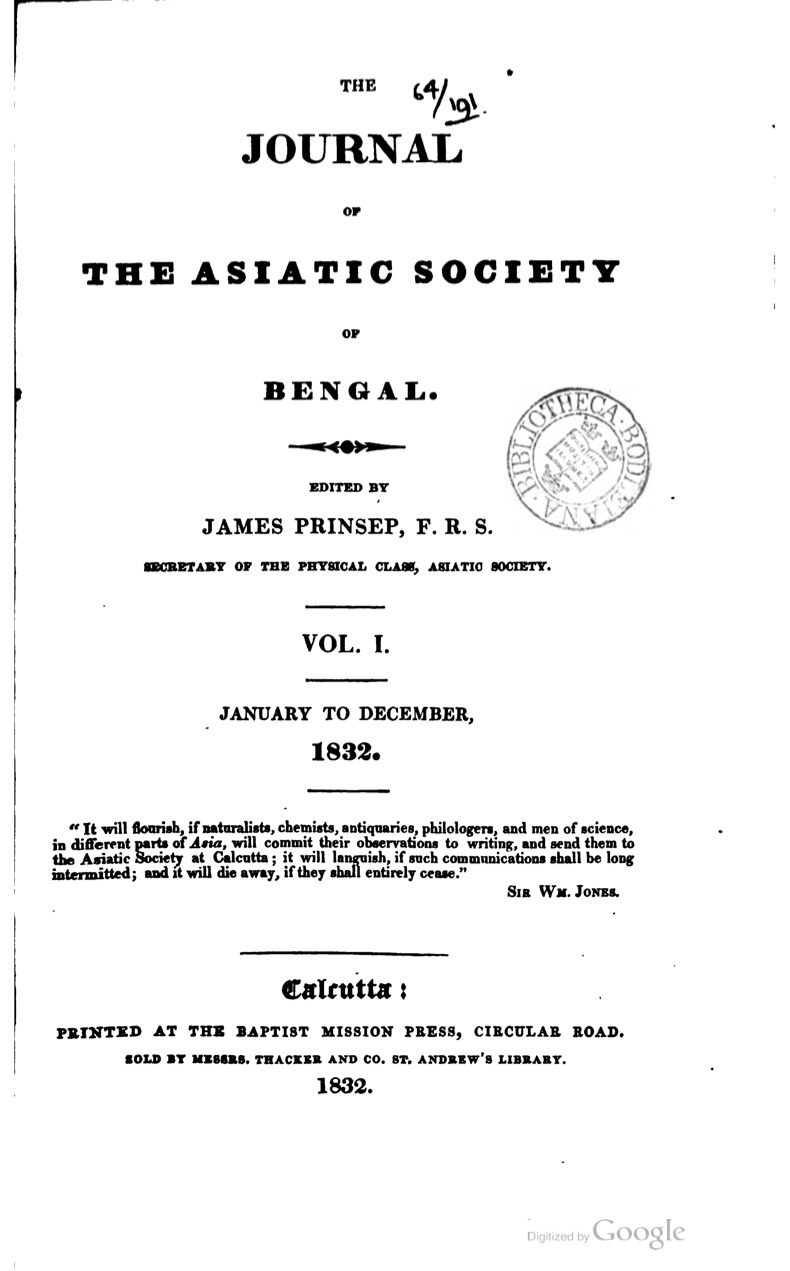
Burney, H. (1832) Memoir of Giuseppe d’Amato. Journal of the Asiatic Society of Bengal, Vol. 1, No. 8, Aug., pp. 349–353.
Record No. 544  |  Sinkankas/Born No.: NIS/NIB  |  RWHL
A biographical memoir by Henry Burney of the Italian Catholic missionary Giuseppe d’Amato, who spent nearly five decades in Burma and died at Moun-lha in 1832. Burney describes d’Amato’s long residence in the country, his missionary work, knowledge of Burmese language and society, and the respect he had acquired among the local population. Of particular gemological importance, d’Amato had personally visited the precious-stone mines of Kyat-pyen (Kyatpyin) in the Mogok district and left a description of their workings. That account, published separately in the Journal of the Asiatic Society of Bengal in 1833, is among the earliest firsthand European descriptions of the Burmese ruby mines. Burney’s memoir is therefore an important source for establishing d’Amato’s identity, background and connection with the early documentation of Mogok.

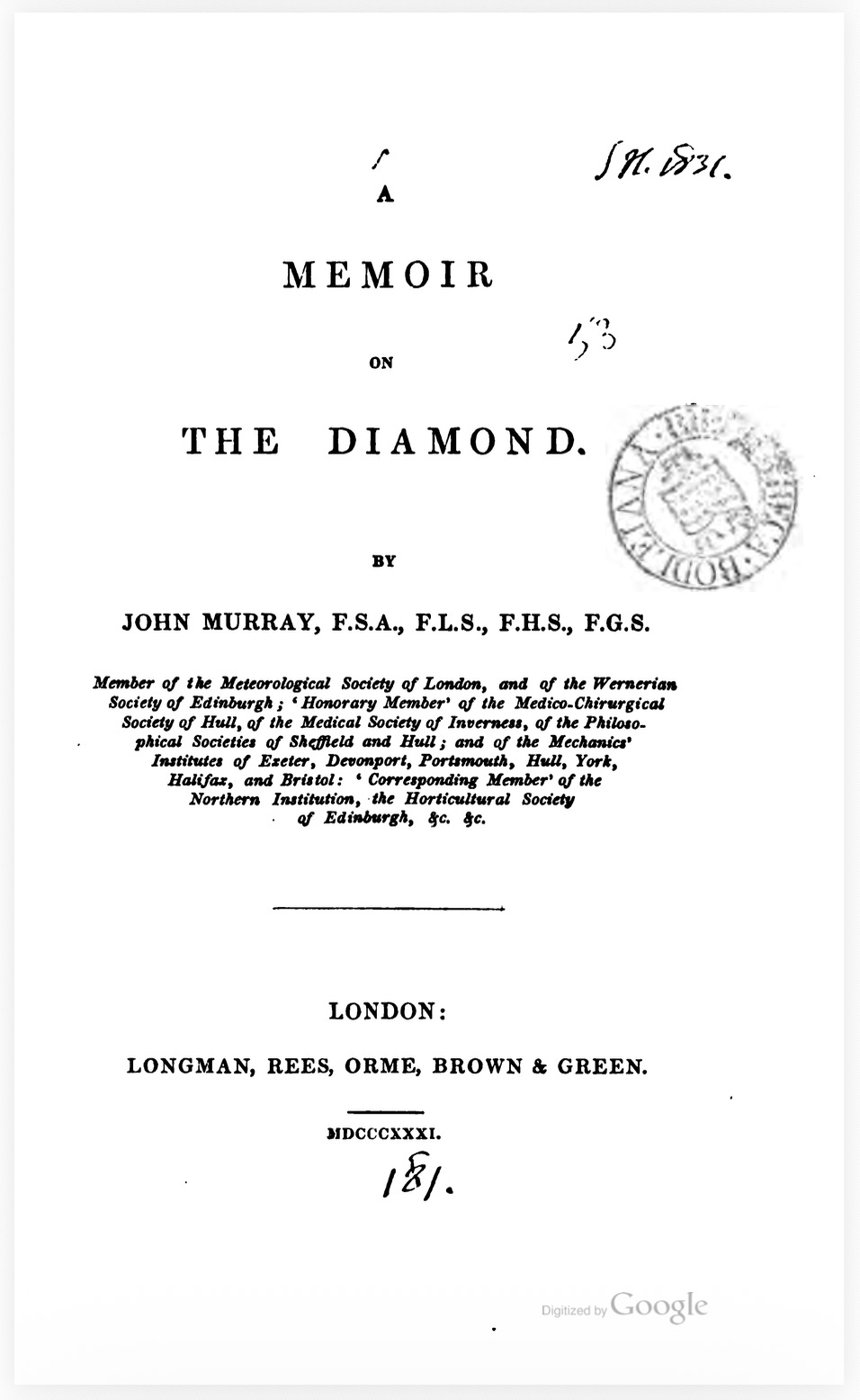
A Memoir on the Diamond

Book
Murray, J. (1831) A Memoir on the Diamond. London, 67 pp.
Record No. 29478  |  Sinkankas/Born No.: NIS/NIB  |  RWHL
A short treatise devoted to the diamond, summarizing contemporary knowledge of its physical and chemical properties, geological occurrence, geographical sources, and distinctive characteristics. Murray discusses the exceptional hardness and combustibility of diamond, together with experiments concerning its composition and behavior, and considers the principal diamond-producing regions known at the time. The work is of gemological interest as an early nineteenth-century synthesis of scientific knowledge of diamond, reflecting the transition from traditional descriptions of precious stones to their investigation through chemistry, mineralogy, and experimental science.

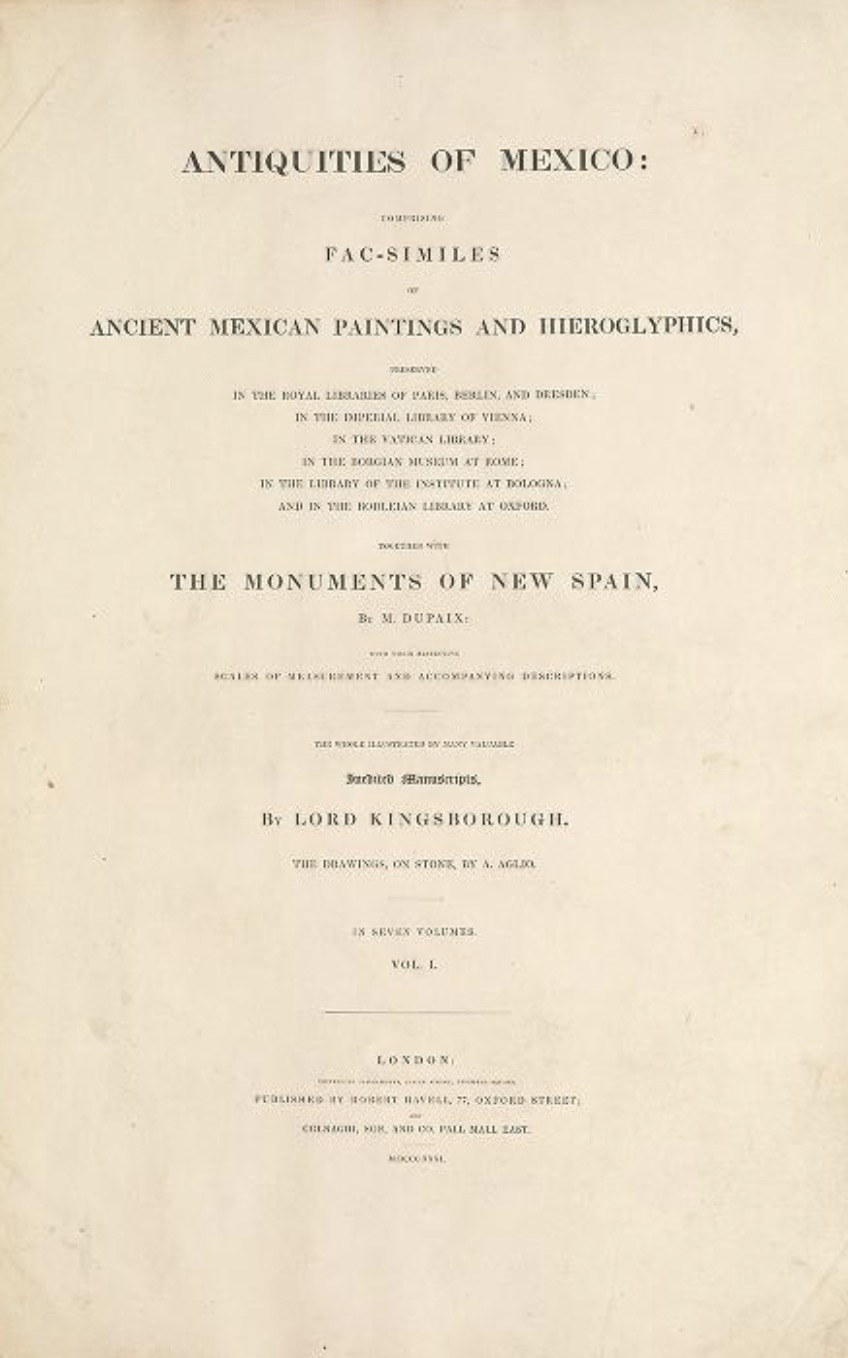
Antiquities of Mexico | Comprising Fac-similes of Ancient Mexican Paintings and Hieroglyphics, Preserved in the Royal Libraries of Paris, Berlin, and Dresden; in the Imperial Library of Vienna
Book
Kingsborough, E.K. (1831–1848) Antiquities of Mexico | Comprising Fac-similes of Ancient Mexican Paintings and Hieroglyphics, Preserved in the Royal Libraries of Paris, Berlin, and Dresden; in the Imperial Library of Vienna. London, Robert Havell, 9 Vols. (see p. 204).
Record No. 7972  |  Sinkankas/Born No.: NIS/NIB  |  RWHL
A monumental nine-volume publication devoted to the antiquities and pictorial manuscripts of pre-Columbian Mexico, assembled by Edward King, Viscount Kingsborough. The work reproduces in elaborate facsimile a number of major Mexican codices and other Indigenous manuscripts preserved in European collections, accompanied by historical, linguistic and antiquarian commentary drawn from colonial sources. Its contents document religion, calendrical systems, tribute, costume, warfare, ritual and material culture. Of particular relevance to gemological research are depictions and references to valued materials such as greenstone/jade, turquoise, gold and other ornaments used in elite and ceremonial contexts. Despite Kingsborough’s highly speculative interpretations, the volumes remain an important early source for the publication and study of Mesoamerican manuscripts and material culture.

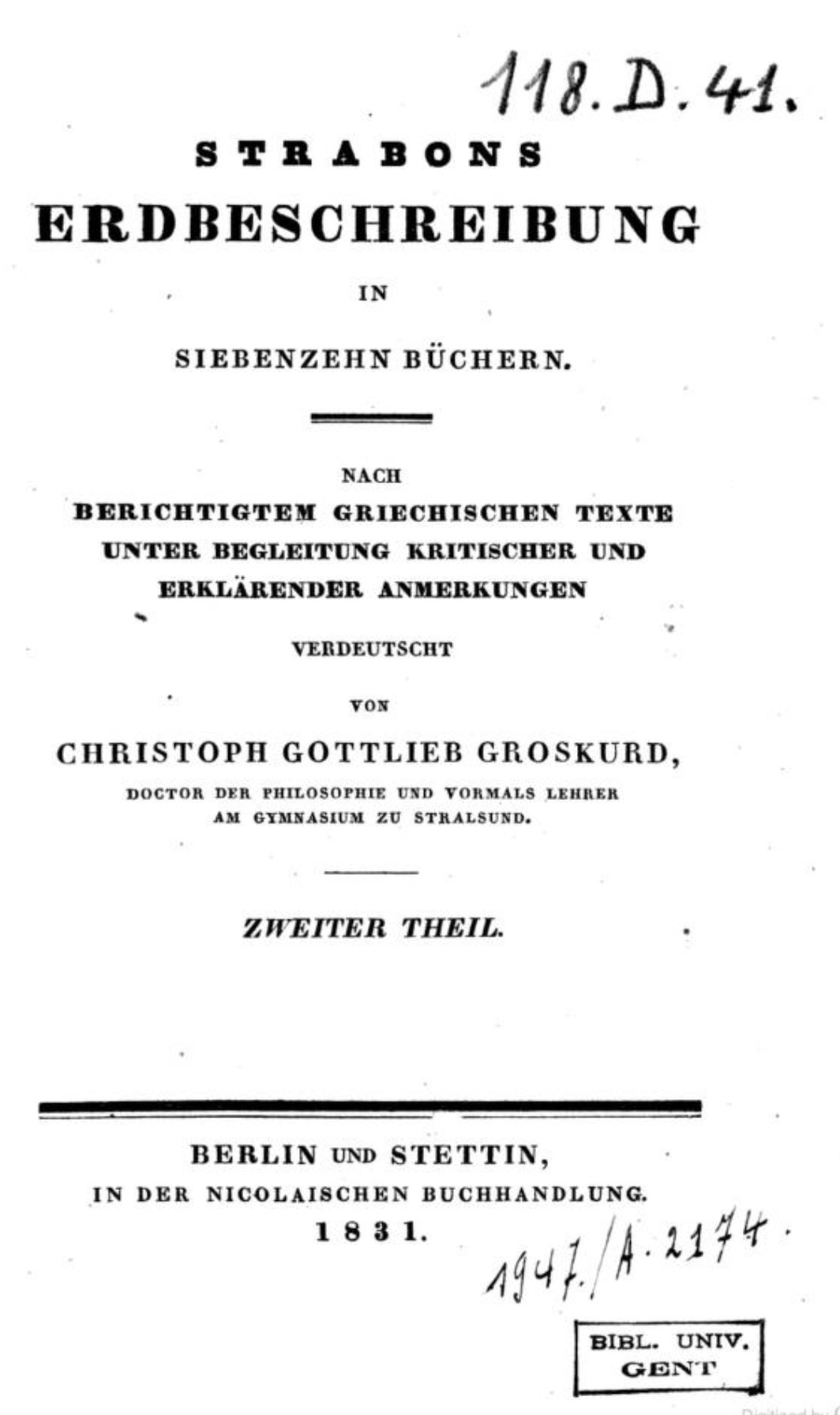
Strabons Erdbeschreibung in Siebenzhen Büchern
Strabo's Geography in Seventeen Books
Edited Book
Groskurd, C.G., editor (1831–1834) Strabons Erdbeschreibung in Siebenzhen Büchern. [Strabo's Geography in Seventeen Books]. Berlin, Nicolai, 4 Vols., 590, 634, 464, 456 pp..
Record No. 7492  |  Sinkankas/Born No.: NIS/NIB  |  Language: in German  |  RWHL
A four-volume German translation of Strabo’s Geographica, edited and translated by Christian Gottlieb Groskurd. The work presents Strabo’s seventeen books of geography, covering the known world of the Greco-Roman period and combining geographical description with history, ethnography, natural resources and accounts of trade. Of particular relevance to gemological research are Strabo’s references to precious stones, pearls, mineral resources and mining districts in regions including India, Arabia, Egypt and the Near East. This nineteenth-century edition is useful both as an accessible German rendering of the ancient text and as a source for studying classical knowledge of gemstones and mineral wealth.

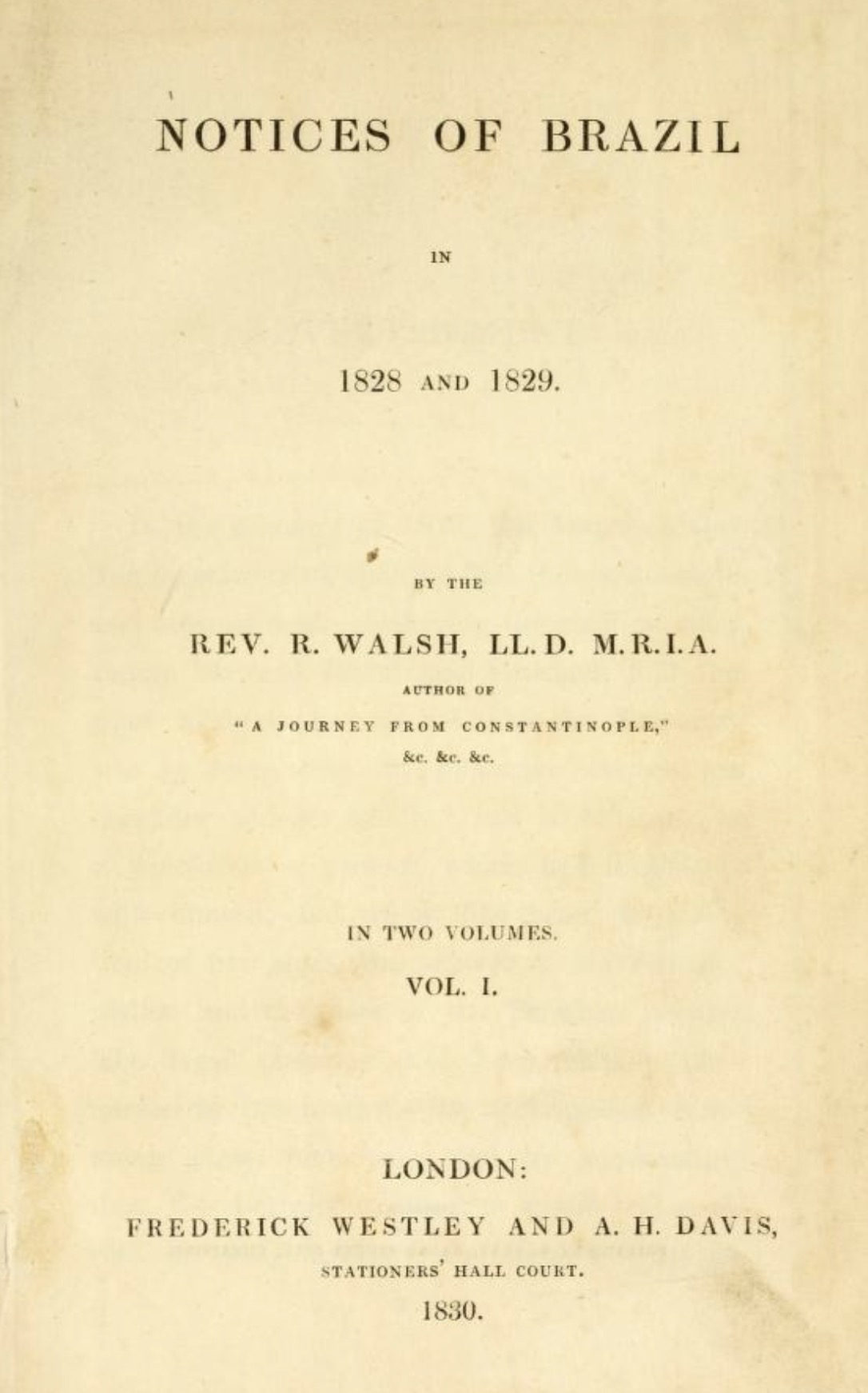
Notices of Brazil in 1828 and 1829

Book
Walsh, R. (1830) Notices of Brazil in 1828 and 1829. London, F. Westley and A.H. Davis, 2 Vols., 528, 542 pp.
Record No. 29370  |  Sinkankas/Born No.: NIS/NIB  |  RWHL
A two-volume account by the Irish clergyman and traveler Robert Walsh describing Brazil during his residence and travels there in 1828–1829. The work covers Rio de Janeiro and journeys into the interior, with observations on politics, society, slavery, religion, natural history, agriculture and commerce. Of particular gemological interest is Walsh’s visit to Minas Gerais, where he describes mining districts, gold workings and the Capão topaz mine near Ouro Preto (Vol. 2, pp. 104–108), including the occurrence and extraction of Brazilian topaz. The work is a valuable firsthand source for the mineral wealth and mining practices of Brazil in the early nineteenth century.

The Modern Traveller: Burmah, Siam, Etc.
Book
Conder, J. (1830) The Modern Traveller: Burmah, Siam, Etc. London, James Duncan, 30 Vols.
Record No. 2739  |  Sinkankas/Born No.: NIS/NIB  |  RWHL
A volume in Josiah Conder’s Modern Traveller series devoted to Burma, Siam and neighboring regions, compiled from contemporary travel narratives, diplomatic accounts and geographical sources rather than from Conder’s own travels. The work summarizes the geography, government, peoples, customs, commerce and natural productions of mainland Southeast Asia. Of particular gemological interest are its notices of the ruby and sapphire resources of Burma and the gem-producing districts of Siam, reflecting European knowledge of these sources in the early nineteenth century. The volume is useful as a synthesis of contemporary reports on the mineral wealth and trade of the region.

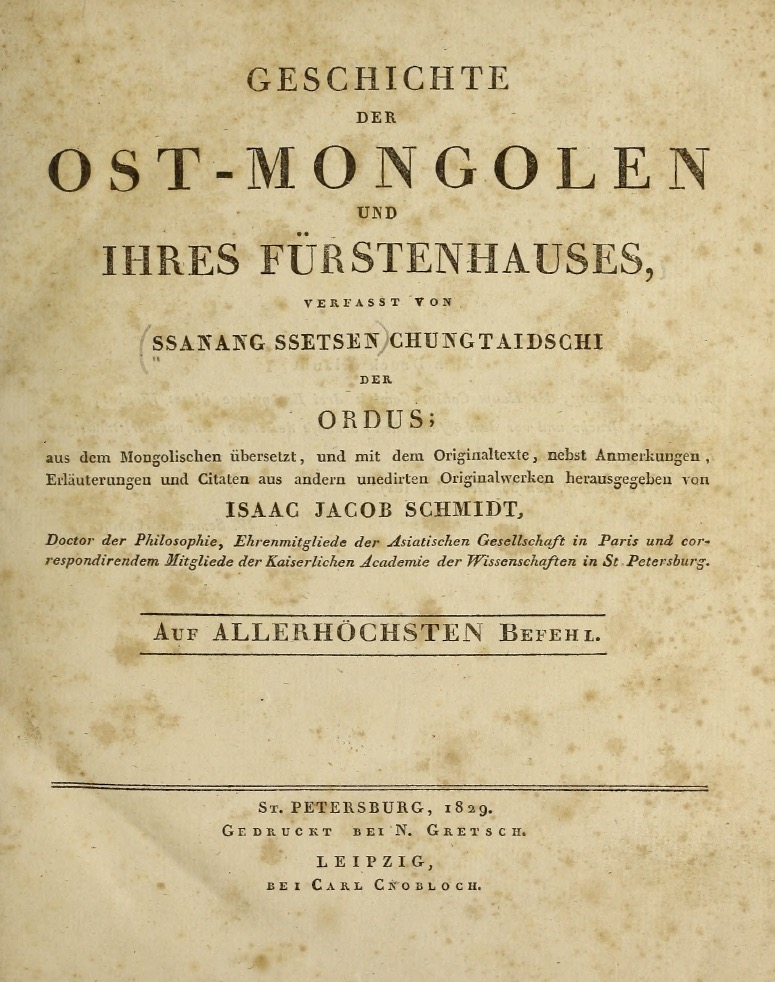
Geschichte der Ost-Mongolen und ihres Fürstenhauses
History of the Eastern Mongols and Their Princely House
Book
Ssanang Ssetsen, C. (1829) Geschichte der Ost-Mongolen und ihres Fürstenhauses. [History of the Eastern Mongols and Their Princely House] St. Petersburg, N. Gretsch, 511 pp.
Record No. 6900  |  Sinkankas/Born No.: NIS/NIB  |  Language: in German  |  RWHL
A German translation of the seventeenth-century Mongolian chronicle commonly known as the Erdeni-yin Tobči(“Precious Summary”), composed by Ssanang Ssetsen Chungtaidschi of the Ordos Mongols. The work traces the history of the Mongols and their ruling houses from legendary origins through the era of Chinggis Khan and his successors to the seventeenth century, combining dynastic history, genealogy, Buddhist tradition and accounts of relations with Tibet and China. It is an important source for Mongolian historiography and for the political and religious history of Inner Asia. Its relevance to gemological research is secondary, chiefly through references to precious objects, royal gifts and material culture rather than any systematic discussion of gemstones.

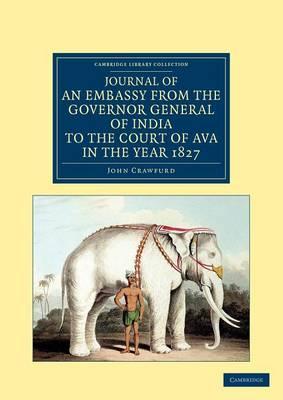
Journal of an Embassy From the Governor-General of India to the Court of Ava, in the Year 1827
Book
Crawfurd, J. (1829) Journal of an Embassy From the Governor-General of India to the Court of Ava, in the Year 1827. London, Henry Colburn, 2 Vols., 605 pp.
Record No. 3124  |  Sinkankas/Born No.: NIS/NIB  |  RWHL
A detailed account by John Crawfurd of his diplomatic mission from British India to the Burmese court at Ava in 1827. The work describes the journey, the court and government of Burma, its peoples, customs, commerce, geography and natural resources. Of particular gemological interest are Crawfurd’s remarks on rubies and other precious stones of Burma, including their occurrence, trade and association with the royal economy. The book is an important early nineteenth-century source for European knowledge of Burma and for the history of its gemstone resources before the later colonial-era investigations of the Mogok ruby mines.

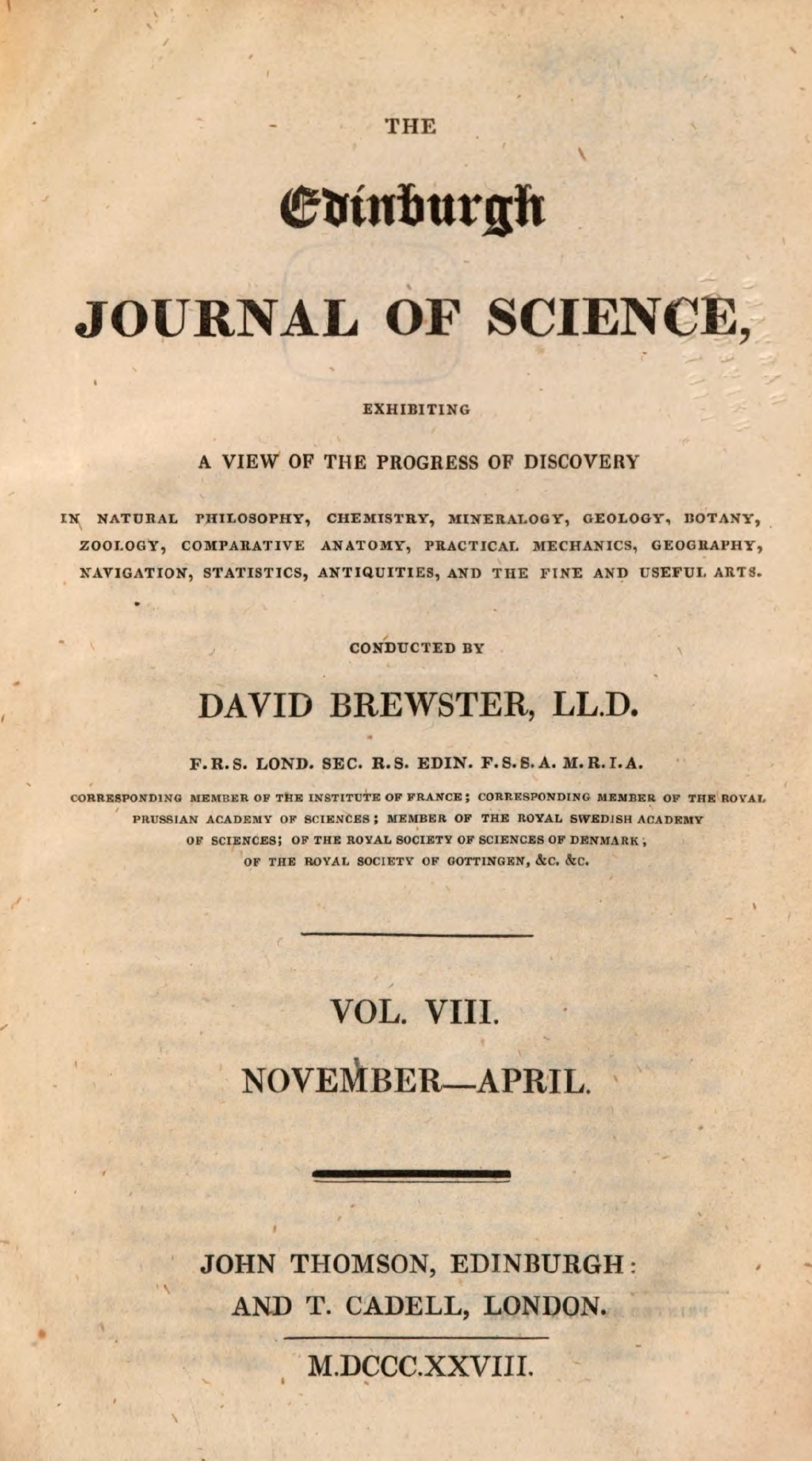
Narrative of the proceedings and scientific observations of the late mission to Ava
Journal Article
Anonymous (1828) Narrative of the proceedings and scientific observations of the late mission to Ava. Edinburgh Journal of Science, Vol. 8, No. 15, pp. 10–25.
Record No. 29570  |  Sinkankas/Born No.: NIS / NIB  |  RWHL
Account of a British mission to Ava following the First Anglo-Burmese War, combining a narrative of its journey from Rangoon to the Burmese capital and return with observations on the country’s geography, geology, mineral resources, botany, zoology, and economy. The mission travelled up the Irrawaddy, visiting Prome, the petroleum wells at Renangyoung, Pagan, and Ava, where it attended the Burmese court and concluded a short commercial treaty. Of particular gemological importance is its description of the celebrated ruby and sapphire mines at “Mo-gaot” and “Kyat-pyan,” said to lie about five days’ journey ESE of Ava. Members of the mission examined sapphires in both crystallized and rough states and the gem-bearing gravel, and collected specimens. The stones reported include ruby (“red sapphire”), blue sapphire, spinel ruby, white, yellow, green, opalescent, amethyst and girasol sapphires, together with common corundum. Fine ruby was described as scarce and expensive even at Ava, while blue sapphire was more common and cheaper; one imperfect sapphire examined reportedly weighed 951 carats. The account also records the Burmese king’s claim to rubies and sapphires exceeding 100 ticals in value, the alleged practice of miners breaking valuable stones to evade this claim, and the export of rubies and sapphires by Chinese merchants. Precious serpentine is likewise noted as an important Burmese product exported by the Chinese. The wider scientific survey describes fossiliferous deposits near the petroleum wells, marble around Ava, metallic ores and mining in the Shan regions, the petroleum industry, and extensive botanical collections made during the mission.

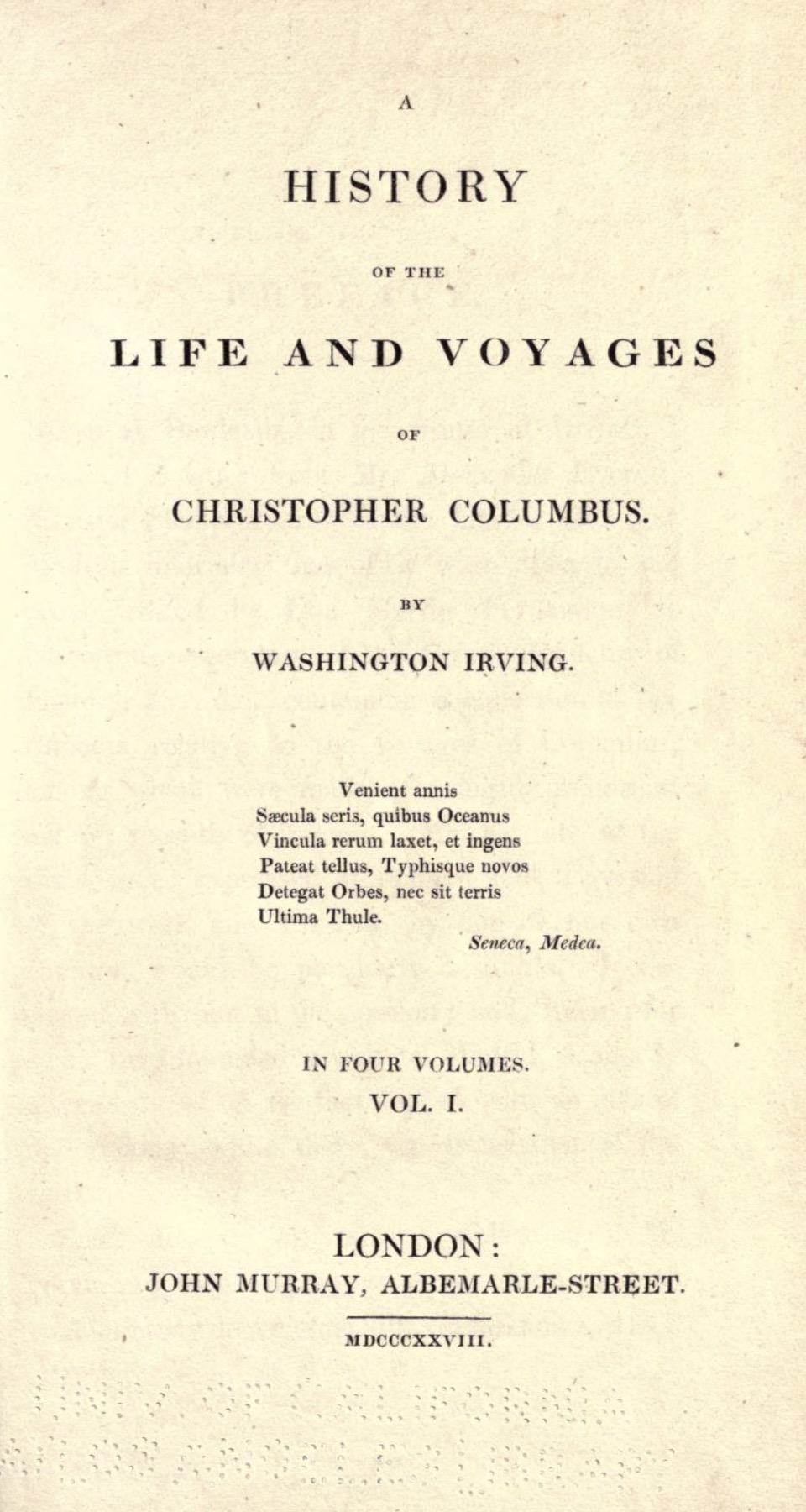
A History of the Life and Voyages of Christopher Columbus
Book
Irving, W. (1828) A History of the Life and Voyages of Christopher Columbus. New York, G. & C. Carvill, 3 Vols., 389 pp. (jade see Vol. 1, p. 379).
Record No. 8006  |  Sinkankas/Born No.: NIS/NIB  |  RWHL
A three-volume biography and narrative history of Christopher Columbus by Washington Irving, based on published accounts and archival materials consulted during Irving’s residence in Spain. The work recounts Columbus’s life, his four voyages across the Atlantic, encounters with Indigenous peoples, and the Spanish exploration and colonization of the Caribbean and adjacent regions. Of interest to gemological and economic history are repeated references to the search for gold, pearls and other valuable natural products, which figured prominently in European expectations of the newly encountered lands. Although written in a literary style and not regarded today as a fully reliable modern historical study, the work was highly influential in shaping nineteenth-century perceptions of Columbus and the early Spanish voyages.

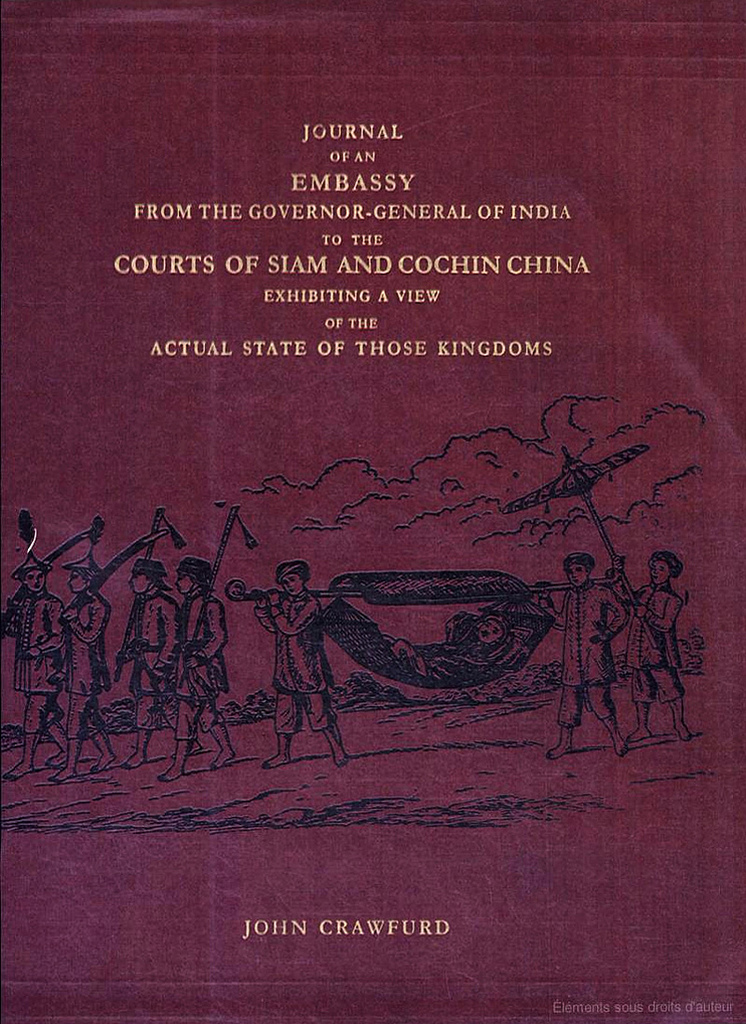
Journal of an Embassy to the Courts of Siam and Cochin China
Book
Crawfurd, J. (1828, 1830) Journal of an Embassy to the Courts of Siam and Cochin China. London, Henry Colburn, 2 Vols., see pp. 419–420
Record No. 2744  |  Sinkankas/Born No.: NIS/NIB  |  RWHL
A detailed account of John Crawfurd’s British diplomatic mission to Siam and Cochin China in 1821–1822, combining travel narrative with observations on government, commerce, society, geography and natural resources. Of particular gemological importance are his remarks on the gem deposits of Chanthaburi, where he records sapphire, ruby and “Oriental topaz” (yellow sapphire) occurring in alluvial ground at the foot of the hills. He describes the washing of the gem-bearing soil, notes that the recovered gravel was sent to Bangkok for examination, and states that the Chanthaburi gem workings were a royal monopoly. Crawfurd also compares Siamese ruby and sapphire unfavorably with stones from Ava. The work is an important early nineteenth-century source for the history of the Chanthaburi gem fields and the Siamese gem trade.

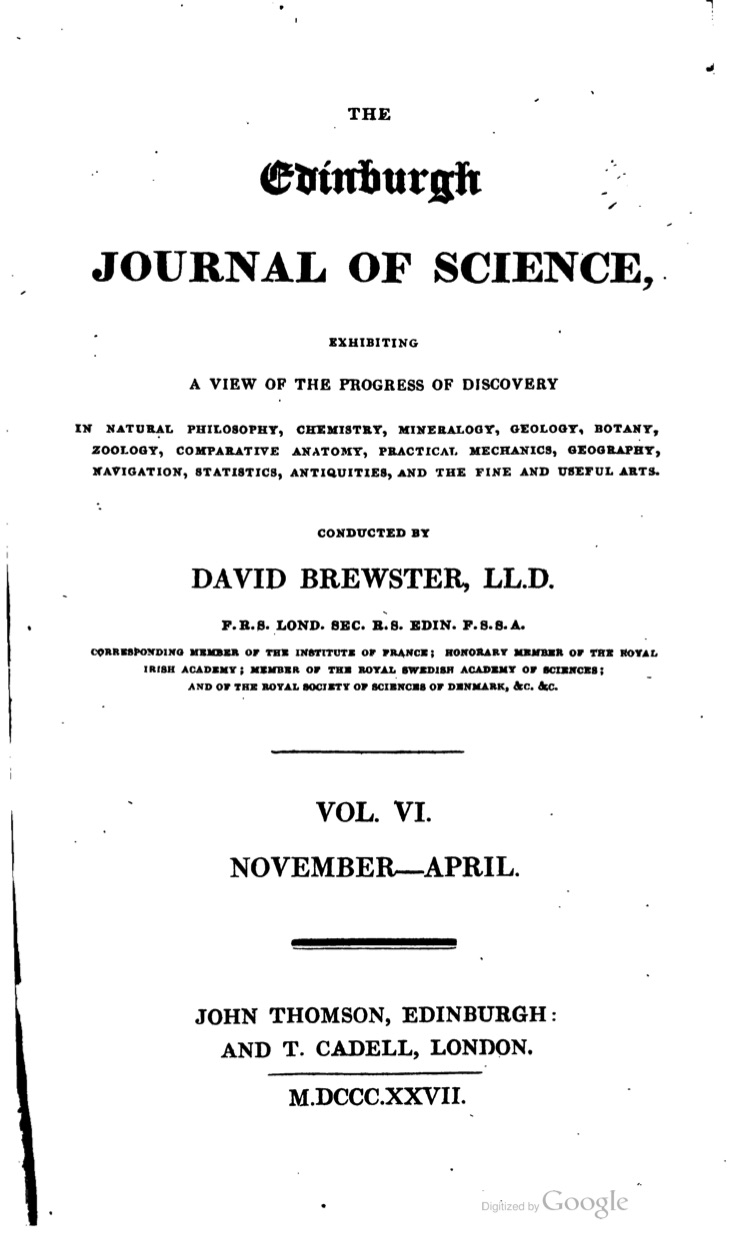
Notice respecting the existence of the new fluid in a large cavity in a specimen of sapphire
Journal Article
Brewster, D. (1827) Notice respecting the existence of the new fluid in a large cavity in a specimen of sapphire. Edinburgh Journal of Science, Vol. 6, pp. 155–156.
Record No. 491  |  Sinkankas/Born No.: 919; NIB  |  RWHL
A brief note by David Brewster reporting a large fluid-filled cavity observed in a specimen of sapphire. The paper extends his earlier investigations of fluids enclosed within minerals and records the presence and behavior of the trapped liquid in corundum. Of particular gemological importance, it is an early specific description of a fluid inclusion in sapphire, demonstrating that such inclusions occur in precious stones as well as in other minerals. The notice forms part of Brewster’s pioneering work on mineral inclusions and the physical conditions under which crystals form.

Travels and Adventures in the Persian Provinces on the Southern Banks of the Caspian Sea
Book
Fraser, J.B. (1826) Travels and Adventures in the Persian Provinces on the Southern Banks of the Caspian Sea. London, Longman, Rees, Orme, Brown and Green, 384 pp. (see pp. 343–347).
Record No. 29482  |  Sinkankas/Born No.: NIS/NIB  |  RWHL
An account of James Baillie Fraser’s travels through the Persian provinces bordering the southern Caspian Sea, describing the geography, peoples, settlements, political conditions, commerce, and natural resources encountered along his route. The cited pages (pp. 343–347) are of particular gemological interest for Fraser’s discussion of turquoise and its trade, including observations on the stones, their sources, qualities, valuation, and commercial importance. The work provides useful firsthand evidence for the early nineteenth-century Persian gemstone trade and complements Fraser’s more detailed account of the celebrated turquoise mines of Khorasan.

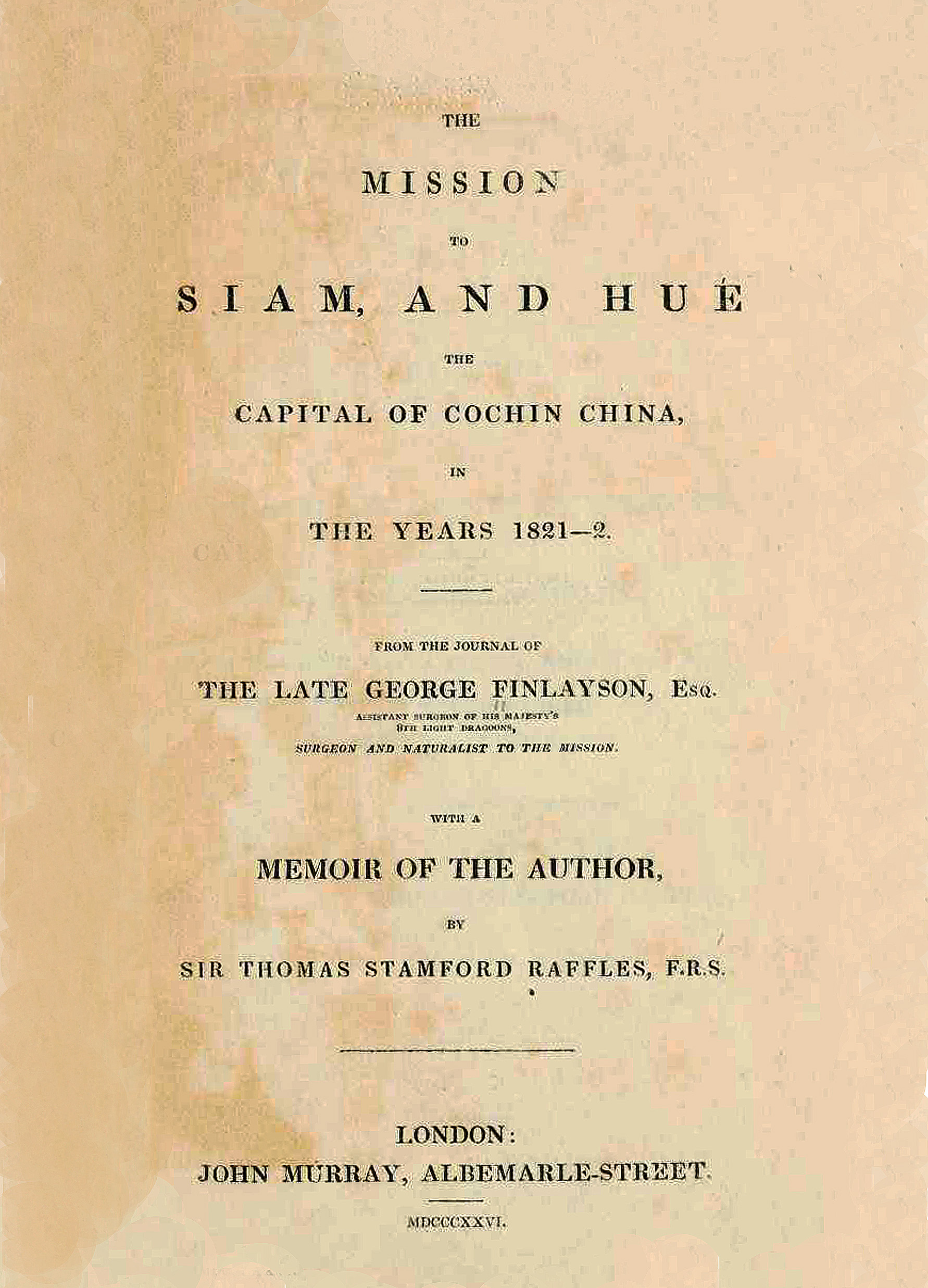
The Mission to Siam and Hue, the Capital of Cochin China, in the years 1821–2
Book
Finlayson, G. (1826) The Mission to Siam and Hue, the Capital of Cochin China, in the years 1821–2. London, Murray, xxxi + 427 pp.
Record No. 2759  |  Sinkankas/Born No.: NIS/NIB  |  RWHL
A firsthand narrative of a British diplomatic mission to Siam and Cochin China in 1821–1822, written from the journal of George Finlayson, who served as surgeon and naturalist to the mission, and published after his death with a memoir by Sir Stamford Raffles. The work combines travel narrative with observations on geography, natural history, commerce, customs and political conditions. Of particular gemological interest is Finlayson’s description of the province of Chantibond (Chanthaburi), which he calls one of the richest parts of Siam and notes as producing precious stones, including deposits on nearby islands, although he considered the stones generally of inferior quality. He also records jewelry set with diamonds, sapphires and other precious stones observed in Siam. The book is therefore an important early nineteenth-century source for the gem resources and material culture of southeastern Siam.

On the existence of two new fluids in the cavities of minerals, which are immiscible, and possess remarkable physical properties
Journal Article
Brewster, D. (1826) On the existence of two new fluids in the cavities of minerals, which are immiscible, and possess remarkable physical properties. Transactions of the Royal Society of Edinburgh, Vol. 10, Part 1, pp. 1–41, 2 plates.
Record No. 490  |  Sinkankas/Born No.: NIS/NIB  |  RWHL
An important early study by David Brewster of liquid inclusions enclosed within minerals. Brewster describes cavities containing two immiscible fluids with markedly different physical properties and examines their behavior under changes of temperature and pressure. Using microscopic observation and optical methods, he investigated the relative volumes, expansion and contraction of the enclosed fluids and the formation and movement of bubbles within the cavities. The paper is a major early contribution to the study of fluid inclusions and is especially important to gemology and mineralogy because such inclusions later became valuable evidence for mineral growth conditions, geological environment and, in some cases, geographic origin.

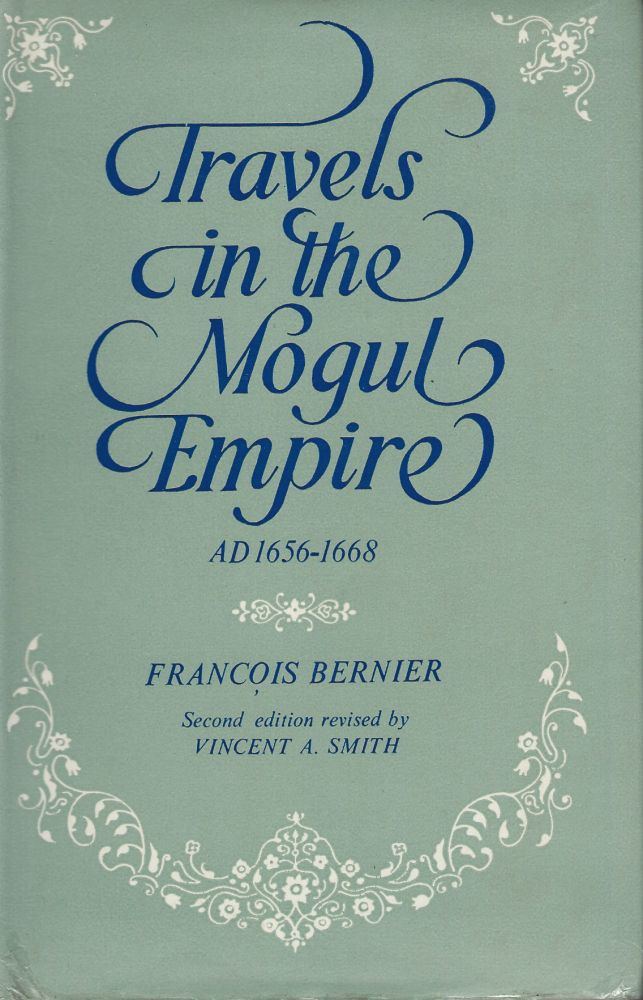
Travels in the Mogul Empire: AD 1656–1668
Book
Bernier, F. (1826) Travels in the Mogul Empire: AD 1656–1668. London, William Pickering, 2 Vols., 280, 280 pp.
Record No. 460  |  Sinkankas/Born No.: NIS/NIB  |  RWHL
Bernier recounts his travels and experiences in the Mughal Empire between 1656 and 1668, during which he served for several years as a physician at the imperial court and observed at close hand the reigns of Shah Jahan and Aurangzeb. He gives a detailed eyewitness account of the struggle for succession among Shah Jahan’s sons, the defeat of Dara Shikoh, and Aurangzeb’s accession, together with descriptions of the imperial court, army, administration, taxation, landholding, cities, commerce, crafts, and social and religious customs. His journeys include extensive observations on Delhi, Agra, Bengal, and Kashmir, whose landscape and products he describes at length. Of particular gemological interest are Bernier’s observations on the enormous wealth of the Mughal court, including diamonds, pearls, rubies, emeralds, and other precious stones displayed in imperial regalia and the celebrated Peacock Throne, as well as his discussion of the diamond mines and trade of Golconda. The work provides an important seventeenth-century European eyewitness account of the production, commerce, valuation, and conspicuous consumption of gems within the Mughal Empire.

The Modern Traveller: Brazil and Buenos Ayres
Book
Conder, J. (1825) The Modern Traveller: Brazil and Buenos Ayres. London, James Duncan, 2 Vols., Vol. 2 , 340 pp.
Record No. 29369  |  Sinkankas/Born No.: NIS/NIB  |  RWHL
A two-volume geographical, historical and topographical account of Brazil and Buenos Aires compiled by Josiah Conder as part of his extensive Modern Traveller series. Drawing on the published narratives of earlier travelers and explorers rather than on Conder’s own travels, the work describes the geography, cities, inhabitants, government, commerce and natural productions of Brazil and the Río de la Plata region. Of particular interest to mineralogical and gemological research are its notices of the mining districts and mineral wealth of Brazil, reflecting contemporary European knowledge of the country’s gold, diamonds and other valuable natural resources. The work provides a useful synthesis of early nineteenth-century travel literature on South America.

Ueber das Entstehen der grammatischen Formen und ihren Einfluss auf die Ideenentwicklung
On the Emergence of Grammatical Forms and their Influence on the Development of Ideas
Journal Article
Humboldt, W., von (1825) Ueber das Entstehen der grammatischen Formen und ihren Einfluss auf die Ideenentwicklung. [On the Emergence of Grammatical Forms and their Influence on the Development of Ideas] Abhandlungen der Königlichen Akademie der Wissenschaften zu Berlin, Vol. 3, Years 1822–1823, Gelesen in der Akademie der Wissenschaften am 17. Januar 1822, pp. 401–430.
Record No. 16565  |  Sinkankas/Born No.: NIS/NIB  |  Language: in German  |  RWHL
A linguistic essay by Wilhelm von Humboldt examining the origin and development of grammatical forms and their relationship to human thought. Humboldt argues that language is not merely a passive means of expressing ideas but actively shapes the way speakers organize and develop them. The paper discusses how grammatical structures arise, how languages differ in the ways they encode relationships and concepts, and how these structures influence intellectual development. It is an important early statement of Humboldt’s philosophy of language and comparative linguistics. The work has no direct gemological or mineralogical content; its relevance would be linguistic or historical rather than scientific.

Notice des monumens exposés dans le cabinet des médailles, antiques et pierres gravées de la bibliothèque du roi
Catalogue of the Monuments Exhibited in the Cabinet of Medals, Antiquities, and Engraved Gems of the King’s Library
Book
Dumersan, J.M. (1824) Notice des monumens exposés dans le cabinet des médailles, antiques et pierres gravées de la bibliothèque du roi. [Catalogue of the Monuments Exhibited in the Cabinet of Medals, Antiquities, and Engraved Gems of the King’s Library] Paris, M. Journé, 88 pp., 42 plates
Record No. 28946  |  Sinkankas/Born No.: NIS/NIB  |  Language: in French  |  RWHL
A catalogue by Jean-Marie Dumersan of the antiquities, medals and engraved gems exhibited in the Cabinet des Médailles of the Bibliothèque du Roi in Paris. The work describes objects from the royal collection, including ancient coins, sculptures, antiquities, cameos and intaglios, and is illustrated with 42 plates. Of particular gemological and art-historical interest are the engraved stones, which are discussed as works of glyptic art and as evidence for classical iconography and antiquity. The volume is an important early nineteenth-century guide to one of Europe’s major collections of ancient engraved gems and documents the state of the French royal collection before its later reorganization as part of the Bibliothèque nationale.

Description of certain gangues of spinelle brought from the Island of Ceylon by M. Leschenault de Latour

Journal Article
Bournon, J.-L., de (1824) Description of certain gangues of spinelle brought from the Island of Ceylon by M. Leschenault de Latour. Philosophical Magazine, Vol. 63, No. 309, pp. 30–36.
Record No. 8082  |  Sinkankas/Born No.: NIS/NIB  |  RWHL
A short mineralogical study by Jacques-Louis, Comte de Bournon, of spinel-bearing gangue material collected in Ceylon (Sri Lanka) by Jean-Baptiste Leschenault de la Tour. Bournon describes the mineral assemblages associated with the spinel and their physical and crystallographic characters, using the specimens to clarify the geological occurrence of Ceylon spinel. The paper is of particular gemological importance as an early study not merely of isolated gemstones but of the matrix and associated minerals in which spinel occurs, providing evidence concerning the natural setting of Sri Lankan gem deposits. It complements Bournon’s broader work on minerals collected by Leschenault in Ceylon and southern India.

Building a Gemological Library

Gemological books range from general identification manuals and textbooks to specialized works on individual gems, mineralogy, jewelry, treatments, synthesis, history and gem-producing regions.

For a curated selection of particularly useful books, read The Gemologist's Core Library — Classic Books on Gemology, Jewelry and Mineralogy.

About Four Treasures

Four Treasures is Lotus Gemology's freely accessible gemological reference database. Use the full database to search by author, title or keyword and explore literature on gemology, mineralogy, jewelry and related fields. Where available, hyperlinks on titles may lead directly to the full publication.

Search the Complete Four Treasures Database